
Consideration of the situation in the Central African Republic
Date | 8 April 2026
Tomorrow (9 April), the African Union (AU) Peace and Security Council (PSC) will convene to receive a briefing on the situation in the Central African Republic (CAR).
The session will start with the opening remarks of Hirut Zemene, Permanent Representative of the Federal Democratic Republic of Ethiopia to the AU and Chair of the PSC for April 2026. It will be followed by a statement from Bankole Adeoye, Commissioner for Political Affairs, Peace and Security (PAPS). It is also anticipated that the Special Representative of the AU Commission Chairperson will brief the PSC. The representatives of the CAR, as the country concerned, the Economic Community of Central African States (ECCAS), as the concerned Regional Economic Community/Regional Mechanism, and the UN are also expected to deliver statements.
This session is convened for the first time since the country held presidential, parliamentary and local elections in December 2025. The last time the AU PSC met to discuss the situation in the CAR was on 19 September, in which it took note of the preparations for the harmonised elections and requested the chairperson of the Commission to mobilise the necessary resources to facilitate the completion of the electoral processes.
The December 2025 elections marked a major milestone in the quest for institutional and political consolidation in the CAR. The elections brought together four elections, including the presidential. parliamentary and regional elections in a single electoral process, unprecedented in the recent history of the country. It also included the municipal elections, a key component of the 2019 Political Agreement for Peace and Reconciliation-Central African Republic (APPR-RCA), that took place in the country for the first time since 1988. While reflective of progress registered in the CAR, the organisation and conduct of the elections also benefited from support by MINUSCA. The support involved the transportation of electoral materials to various parts of the country through flights and road convoys, the training of election agents, supervisors and polling station staff and security assistance through strengthened patrols by MINUSCA personnel and provision of vehicles and motorcycles to CAR forces and security personnel.
On 5 January, the National Elections Authority (ANE) announced the results of the presidential election, with incumbent President Faustin-Archange Touadéra winning approximately 76 per cent of the vote. He was widely expected to secure a third term following the controversial 2023 constitutional referendum that removed presidential term limits. The results were subsequently certified by the Constitutional Court on 19 January. The Chairperson of the AU Commission, Mahmoud Ali Youssouf, congratulated Touadéra on his re-election. Touadéra was sworn in for his third term at an inauguration ceremony held in Bangui on 30 March, in the presence of regional leaders, with the AU Commission Chairperson represented by the Chief of Staff of the Commission Souef Mohamed El-Amine. Under the country’s new constitution, the presidential term lasts seven years.
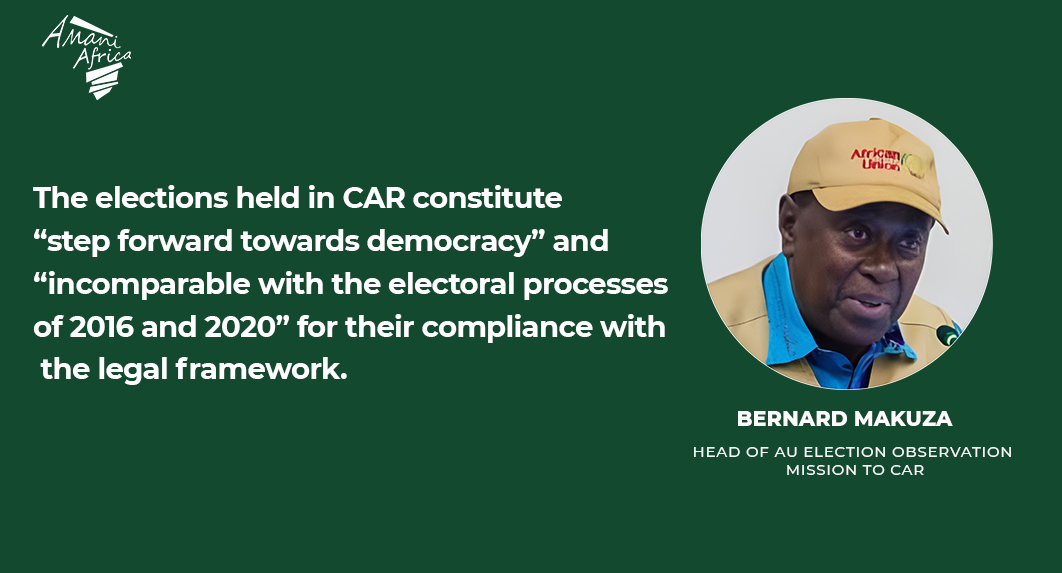
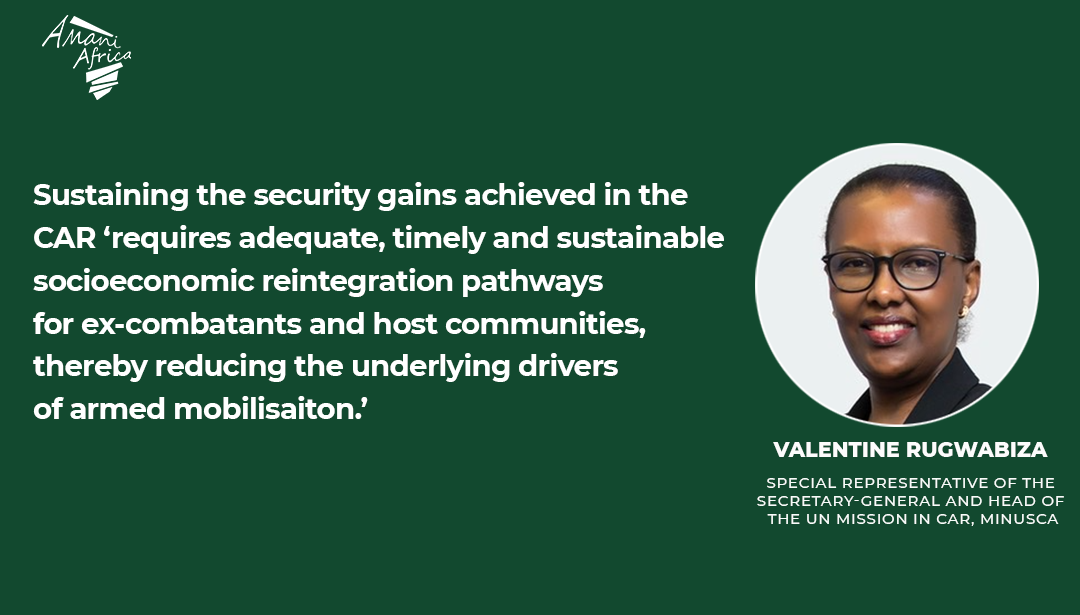
According to the AU, which deployed its observers under the leadership of Rwanda’s former Prime Minister Bernard Makuza, the elections were conducted peacefully overall, with the exception of the Haut-Mbomou prefecture in the southeast, where the security situation has remained precarious largely due to attacks from the Azande Ani Kpi Gbe (AAKG) militia accused of serious human rights violations. The militia carried out attacks against local security forces, state officials, soldiers and police, including on election day. Makuza praised the election both as a ‘step forward towards democracy’ and ‘incomparable with the electoral processes of 2016 and 2020’ for its compliance with the legal framework. The ECCAS also issued a statement supporting the AU’s observations, while noting some logistical challenges and issues related to inclusion in the electoral processes. Similarly, the Special Representative of the Secretary-General and head of the UN Mission in CAR, MINUSCA, Valentine Rugwabiza, told the UN Security Council that elections were conducted ‘in a peaceful and secure manner across most of the country, despite isolated security incidents.’
However, two other presidential candidates challenged the outcome, alleging electoral irregularities. The main opposition coalition, the Bloc Républicain pour la Défense de la Constitution du 30 mars 2016 (BRDC), boycotted the electoral process, citing concerns about its credibility and fairness. It also issued a 12 January statement making similar allegations about the conduct of the elections and calling for dialogue to ease political tensions. Voter turnout was around 52%, reflecting mixed public engagement amid ongoing instability, even as the election technically proceeded peacefully and without widespread unrest reported.
On 8 January, ANE released provisional results for the first round of legislative elections for 140 seats in the National Assembly, with 74 candidates elected. The ruling party, the United Heart Movement (MCU), won the largest share of seats and is expected to secure a majority. The second round of legislative elections for the remaining seats was held on 5 April. On 18 January, ANE also released provisional results for the local elections, with by-elections expected in areas where voting could not take place due to insecurity or a lack of candidates. The holding of these elections is expected to help consolidate peace by supporting the extension of state authority across the country.
Tomorrow’s session is also expected to pay attention to the implementation of the APPR-RCA. The combined elections took place against the backdrop of progress in implementing the 2019 APPR-RCA. In April 2025, two-armed groups—the Retour, Réclamation et Réhabilitation (3R) and the Unité pour la paix en Centrafrique (UPC)—agreed to cease hostilities and rejoin the APPR-RCA, initiating the disarmament and demobilisation of their former combatants. According to the UN, 1,202 former combatants have been disarmed and demobilised since July 2025, bringing the total number of demobilised ex-combatants to 6,000 since the agreement was signed. On 10 July, the CAR government held a meeting in Bangui to mark the official return of 3R and UPC to the APPR-RCA. The event was attended by leaders of both armed groups and a high-level delegation from Chad, which had facilitated the April agreement between the government and the two groups.
The situation in CAR highlights the need for enhanced high-level political attention and international support for sustaining the momentum in the implementation of APPR-RCA. Most specifically, there is a particular need for elevated political commitment and resource provision, as well as well-organised sustainment of the disarmament and demobilisation process, which is critical to prevent relapse back to conflict. Relatedly, consolidating security gains requires high-level political commitment and support for security sector reform in the CAR. For all of these, the contribution of MINUSCA and increased high-level engagement of the AU would be critical.
Despite a noticeable decline in security incidents that the country experienced following the cessation of hostilities by these two armed groups, insecurity persists in some parts of the country. Indeed, during the election, attacks by the AAKG militia in the south-eastern Haut-Mbomou prefecture near the border with South Sudan prevented voting from taking place in the locality. Insecurity is also driven by armed group activities around mining sites and transhumance corridors, as well as cross-border incursions along the borders with Sudan and South Sudan. Particularly, the ongoing conflict in Sudan has affected the CAR, causing increased insecurity in border regions and exacerbating the country’s humanitarian situation through the influx of refugees.
The CAR continues to face serious economic challenges, including large budget deficits and a heavy debt burden. In response, the government has launched an ambitious National Development Plan (2024–2028) aimed at rebuilding the country after decades of conflict. The plan focuses on rehabilitating roads and energy infrastructure, improving healthcare and education, and promoting agricultural and digital transformation to reduce poverty. At an investment roundtable held in Casablanca, Morocco, in September 2025, the CAR government reportedly mobilised nearly $9 billion to support the implementation of the plan.
The expected outcome of the session is a communique. It is expected that the PSC may welcome the ‘peaceful’ and ‘orderly’ conduct and conclusion of the four levels of elections held in CAR as marking a major milestone in the consolidation of peace and the strengthening of the legitimacy of the state and its authority. The PSC may commend MINUSCA for its support for the electoral process and the implementation of the APPR-RCA. The PSC may encourage political organisations disaffected with the elections to resolve any grievances through peaceful means, including dialogue and legal recourse. It may welcome the progress in the peace process and the disarmament and demobilisation of former combatants and encourage other non-signatory armed groups to join the APPR-RCA and the DDR process. It may also encourage the CAR authorities to sustain political support and ensure high-level commitment to the SSR involving the security sector and the implementation of the DDR process in a well-organised and coordinated way, with the provision of all the support for those engaging in the DDR process as a critical step to prevent relapse. In light of the pressure from the influx of refugees from Sudan, the PSC may reiterate its call for urgent humanitarian assistance to address needs on the ground. It may also welcome the National Development Plan and the funds mobilised during the investment roundtable held in Morocco. PSC may also reiterate calls for international financial institutions to provide debt relief to CAR.