
AU’s rejection of Macky Sall’s UN Secretary-General candidacy is a win for Africa’s diplomacy and warrants withdrawal of the candidacy
Date | 8 April 2026
Solomon Ayele Dersso, PhD, Founding Director, Amani Africa
The candidacy of former Senegalese President Macky Sall for the top United Nations (UN) job has unleashed enormous controversy both in his homeland and at continental level since Burundi, the 2026 Chairperson of the African Union (AU), submitted his name as a candidate to the UN on 2 March 2026.
This issue almost plunged Africa and the AU into a major diplomatic and institutional crisis.
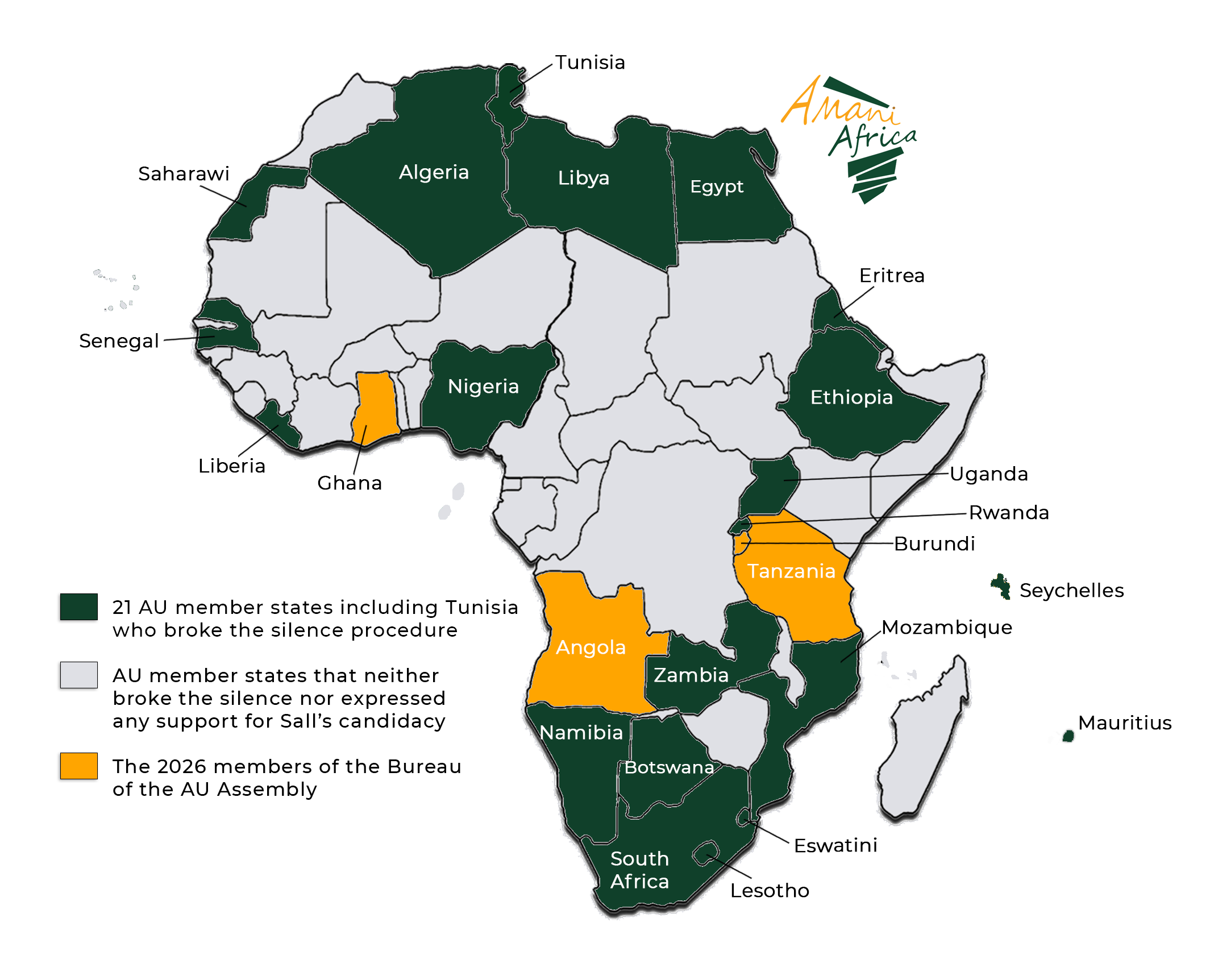
In a development that raised serious questions about the scope of discretion of the Chairperson of the AU and the Bureau and after reports claiming AU support for Sall’s candidacy were exposed, At the behest of Burundi in its capacity as AU Chairperson, the Bureau of the AU Assembly (made up of Burundi, Ghana, Tanzania and Angola, minus a North African representative yet to be agreed by the region) convened on 26 March 2026 to consider the proposal for endorsement of the candidacy of Sall through a silent procedure outside of AU’s established process for on candidatures. At the bureau meeting, two out of four members of the Bureau, including Burundi, reportedly supported the motion. One member reportedly did not participate. The lack of objection meant that Burundi’s motion to table a draft decision of endorsement for AU member states carried the day.
As a follow-up to the Bureau meeting and under the direction of Burundi’s President as AU Chairperson, the AU Commission sent out a letter on the same day, 26 March, addressed to AU Member States carrying a draft decision for endorsing Sall’s candidacy. The letter, referencing Rule 19(1) of the Rules of Procedure of the Assembly on decision-making by consensus or by two-thirds majority, presented the draft decision for adoption through a silent procedure. The letter offered no explanation as to why the established process of considering candidatures through the Ministerial Committee on African Candidatures within the International System on the basis of the AU Executive Council decision EX.CL/213(VIII) was circumvented. Neither was there any compelling reason for displacing the role of the Ministerial Committee nor any consultation that established that AU member states are disposed to support Sall’s candidature and outside of the regular process. Additionally, in an unprecedented departure from established practice, the letter gave AU member states only 24 hours to communicate their views. Also unprecedentedly, it set a threshold of one-third of member states to breaking the silence for the draft decision to be considered as not adopted.
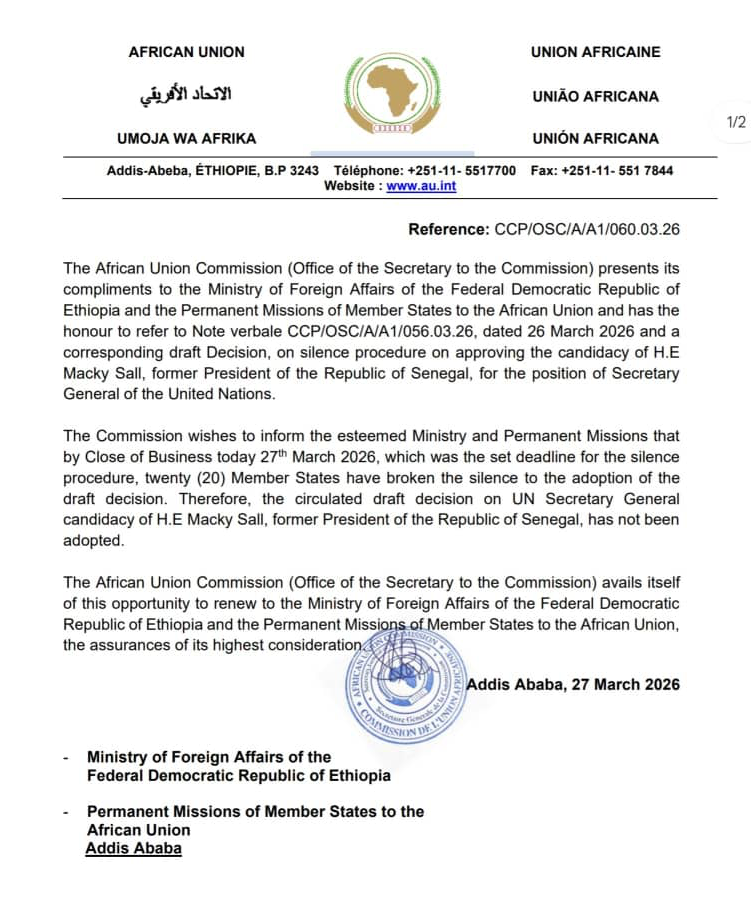
By the close of business on Friday, 27 March, 20 AU member states, representing more than the unprecedently high threshold of 1/3rd majority, broke the silence. The total number of countries that broke the silence increased to 21 after receipt of a communication from Tunisia apparently after close of business on the same day. As a result, the AU Commission stated, in a letter dated 27 March, that the draft decision ‘on UN Secretary General candidacy of H.E. Macky Sall…has not been adopted.’ The fact that more than 1/3rd of AU members broke the silence within the very tight (less than) 24hrs time limit highlighted the resolve of AU member states to avert the institutional crisis the situation posed.
‘Gross breach of AU rules’ and ‘jettisoning of …established practice’ of regional rotation
Both substantive and procedural irregularities led to this outcome. First and substantively, the draft decision would have led to the flouting of the AU’s rules and regular processes on the endorsement of African candidatures in the international system. Not surprisingly, member states that broke the silence, including South Africa, thus observed that ‘the established rules…for submission of States Candidacies appear to have been bypassed.’ This outcome also reflected concerns about the lack of transparency and due process, which are guaranteed under the AU Ministerial Committee on Candidatures. Thus, for Nigeria, as stated in its letter responding to the AU Commission letter of 26 March, the proposal to present Sall as an AU consensus candidate came ‘as a surprise as the candidate is being fielded for such a coveted position…without subjecting it to the scrutiny of the Ministerial Committee of the African Union.’ Rwanda’s Minister of Foreign Affairs went further and stated that ‘a direct rush to a 24-hour “silence procedure”, through which the AU Chairperson would wish to force a 2/3 “silent” majority endorsing his solo and irregular decision, without any attempt to seek an open discussion and a consensus on the African candidate for the position of UNSG, is also a gross breach of AU rules and regulations.’
Second, and procedure-wise, unless the plan was to constrain member states, there was no justification for limiting the timeline for the silence procedure to 24 hours rather than the established standard of at least 48 to 72 hours. Burundi’s Permanent Representative publicly acknowledged that the AU Legal Counsel and the Secretariat objected to the 24-hour timeline. Yet their objection was apparently overruled despite there being no compelling reason for not heeding the opinion of the Legal Counsel and the AU Commission, who are duty-bound to defend and ensure respect for established AU rules and processes. Additionally, as pointed out in the letter by South Africa, ‘the standard practice is that silence procedure is broken if one or more members raise an objection within the designated timeline.’ South Africa’s letter thus held that the requirement that silence can only be broken by one-third of the majority ‘is not standard practice within the international system.’
Third, there is an established, albeit legally non-binding, informal rule and practice of regional rotation that allows alteration of the position of the Secretary-General to candidates from various regional groups of the world. According to this rule and practice, the turn for taking the position of the Secretary-General is for a candidate from the Latin America and Caribbean group. As pointed out in Nigeria’s response, ‘…Africa considers the Caribbean as the sixth region of the continent. By jettisoning this established practice (of regional rotation), the Federal Republic of Nigeria believes the African Union is putting its position and interest in jeopardy now and in the future.’
It is worth noting that the 21 March Declaration of the summit of Community of Latin America and Caribbean States (CELAC), with whom Africa held the first joint high-level forum co-chaired by Burundi and Colombia on the same day committing to strengthen ties between the two regions, affirmed that ‘the time has come for a national of Latin America and the Caribbean to assume the responsibility of holding the position of Secretary- General of the United Nations, in accordance with the principle of equitable geographical balance and diversity in the leadership of the Organization.’ Under the circumstances, let alone endorsement by AU member states Sall’s candidacy on its own undermines the spirit of the CELAC-Africa high-level forum and South-South cooperation as well as the principle of regional rotation. This is never in the interest of Africa, as it will be the turn of the Africa group for the next round of the election of the Secretary-General.
A win for Africa and AU’s institutional stability
The outcome rejecting the proposed endorsement by AU of Sall’s candidacy is a major win for Africa’s diplomacy and AU’s established rules and processes. It prevented the emergence of an unjustifiable precedent that would have scuttled established AU rules and processes on the consideration and endorsement of candidates for leadership positions within the UN and the international system writ large.
Through this decision, AU member states saved from collapse the most important diplomatic device that was in place since the time of the Organisation of African Unity and served Africa well in putting Africans in leadership roles within the international system, including such important UN agencies as WTO, WHO, ILO and UNESCO.
Equally important is the rejection of the draft decision that saved Africa from breaching the informal rule of regional rotation, hence from undermining its own ‘current and future’ interests.
No –the silence of the rest of the AU members is not a signifier of support for Sall
Despite the collapse of the proposal for AU endorsement and Africa’s interests at stake, Sall’s candidacy and campaign continue to be imbued with misinformation and deceitful propaganda. Indeed, Sall’s campaign is doubling down on the claim of having wide support from AU member states, arguing that only a minority of countries registered their objection. Yet, the claim that ‘the silence’ of those who did not respond to the silence procedure is a signifier of wide support for Sall could not be far from the truth. First, even Senegal, from where Sall hails, distanced itself from his candidacy. Second, if Sall was confident about the support from this ‘silent’ majority, he would have subjected his candidacy to the scrutiny of the AU Ministerial Committee.
Despite the fact that the planning for his candidacy started in 2025 and he had the possibility of even having his candidacy considered during the AU summit in February 2026, he did not opt for it. There was no other reason for opting for an irregular and rules upending route for securing AU support other than Sall’s fear that he would not succeed in securing the support of the so-called ‘silent’ majority that his supporters claim he continues to enjoy even after the rejection of his endorsement by the AU.
Honourable path – Withdrawal of Sall’s candidacy
These dynamics, together with the candidacy’s ethically questionable practices involving both misinformation and the bending or circumventing of AU rules and established multilateral practice of particular interest for Africa warrant the reconsideration of the continuation of the candidacy. As chairperson of the AU and the country that sponsored the candidacy, Burundi has a responsibility to take a lead in this regard for reaffirming respect for established AU rules and the practice of regional rotation. In view of all the foregoing and the fact that the next round in the regional rotation for the position of the Secretary-General is for Africa, it is incumbent on Burundi, as Chairperson of the AU, to reconsider its stance and press on Sall that the most honourable path is to withdraw his candidacy. Burundi supported him to the point of leveraging its role as Chairperson. And it stumbled but not irredeemably. By reconsidering Sall’s candidacy, it can restore the erosion of its credibility as AU Chairperson and safeguard Africa’s collective interests, including the multilateral norm of regional rotation.