
African Union’s financing envoy calls for financing sovereignty as AU plans an extraordinary ministerial session
Date | 26 May 2026
The question of financing is taking centre stage in the policy discussions on the African Union’s (AU) role in peace and security. It is in this context that the Eminent Panel of Experts on the review of the African Peace and Security Architecture (APSA) and the AU Champion on Institutional Reform proposed to increase the capitalisation of the Peace Fund from its current $400 million to $1billion, although this did not receive the enthusiastic support of AU member states.
In addition to the near existential financial crisis afflicting the AU Stabilisation Support Mission to Somalia (AUSSOM), the financing challenge facing the AU can also be drawn from the fact that the lion’s share of the peace and security fund of the AU in 2025 was not from member states contributions. When it comes to member states’ contribution to peace operations, the lack of progress in meeting the Johannesburg target of 25% becomes even more glaring. The July 2024 Executive Council decision (EX.CL/Dec.1265(XLV) carrying the 2025 budget indicated that ‘peace support operations with a budget of US$52,929,131’ was ‘funded by International Partners.’
In the context of the major shifts in the nature of international relations involving, among others, the drying up of traditional sources of financing, enhanced self-reliance has become a strategic imperative. This was highlighted in the context of Donald Kaberuka’s recent engagement with the AU. Last March, the African Union (AU) Peace and Security Council (PSC) held consultations with Donald Kaberuka, the AU Special Envoy on Sustainable Financing for the Union and Financing for Peace in Africa. Kaberuka informed member states that times have changed and Africa needs to adapt accordingly. On the preceding day, the High Representative also met with the Chairperson of the AU Commission.
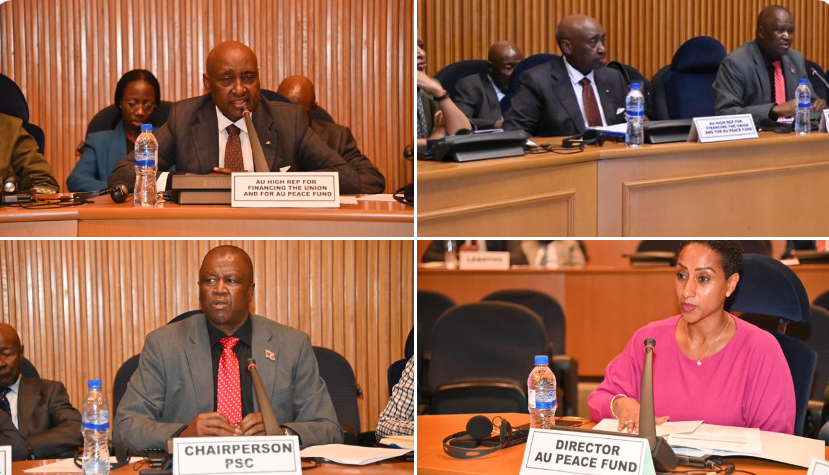
During his engagement with the PSC, Kaberuka underscored the imperative for the AU to rely more decisively on its own financing mechanisms, including the Peace Fund, while expanding partnerships with the private sector and African financial institutions.
He also emphasised the importance of equitable access to UN-assessed contributions through fair burden-sharing arrangements to support African-led peace operations. While this proposition is in line with UN Security Council Resolution 2719, it is worth recalling that as far as AU-led PSOs authorized under Chapter VII by the UN Security Council is concerned emphasis should be put on the legal and institutional responsibility of the UN for bearing the cost of such mission with AU and its member states bearing the burden that is paid with the lives and limbs of troops and the financial costs associated with the mobilization of such troops.
While its sustainability remains to be seen, the Peace Fund Secretariat has initiated efforts to source funds from such sources as the private sector and African financial institutions, as well as high-net-worth individuals. Thus, high-level pledging events convened in 2024 and 2025 mobilised some commitments. For instance, in 2024, Afreximbank pledged $210 million over three years, while Standard Bank Group and Ethiopian Airlines committed $1 million each. In 2025, additional contributions were secured from institutions such as Africa Reinsurance (Africa Re) ($1 million), United Bank for Africa (UBA) ($500,000), and the African Trade & Investment Development Insurance (ATIDI). Despite these contributions, available resources remain inadequate to meet the continent’s growing peace and security needs.
Across his engagements at the AU in March, Kaberuka stressed the broader objective of strengthening the Union’s financial sovereignty, particularly in light of shifting geopolitical dynamics that are placing increasing strain on the financial position of multilateral institutions. In his X post, Kaberuka further noted that while international solidarity remains important, the AU should fund itself, characterising the financing challenge as ‘longstanding’ but now requiring resolution.
One of the important avenues for advancing the aspiration of self-financing lies in the implementation of decision AU/Dec.605(XXVII) of July 2016, which instituted the 0.2% import levy on eligible imports as a sustainable financing mechanism for the Union. However, progress in this regard has been limited. In 2018, the AU reported that only 16 Member States were implementing the Kigali Decision on the 0.2% levy; by 2025, that number had increased by only one.
The dismal state of progress in meeting the Kigali targets is not without consequences. As the Deputy Chairperson of the AU Commission pointed out in her address to the opening of the 50th ordinary session of the Permanent Representatives Committee (PRC) of the AU on 9 June 2025, apart from perpetuating heavy reliance on external funding and thereby deferring the ambition of ownership, the funding challenge significantly ‘constrained the AUC’s capacity to effectively implement the decisions of the Policy Organs and strategic priorities.’ Additionally, this funding constraint, Haddadi pointed out, ‘has significantly hindered the effective implementation of security and safety standards.’
In addition to the adverse impacts of the funding challenges to AU’s mandate, Kaberuka’s engagements took place against the backdrop of decisions adopted by the AU Assembly at its 39th Ordinary Session on financing the Union. The Assembly adopted several key measures aimed at strengthening the Union’s financial sustainability. Among others, it:
- Requested the High Representative for Financing the Union, with the support of the Commission, to undertake further consultations with Member States to strengthen consensus on key strategic financing issues.
- Requested the High Representative to expedite consultations on progress made in the overall financing of the Union.
- Directed the Executive Council to convene an Extra-Ordinary Session, bringing together Ministers of Foreign Affairs and Ministers of Finance of Member States to strengthen the Financing of the Union and the Peace Fund, in line with Decision Assembly/AU/Dec.687 (XXX) of January 2018, not later than November 2026.
- Requested the AU High Representative for Financing the Union to present a report to the above-mentioned Extraordinary Session of the Executive Council.
- Decided to leverage internal financial resources and the support of African Financial Institutions to complement Member States’ contributions in financing the priority programmes of Agenda 2063.
- Directed the Executive Council to invite Chief Executive Officers of African Financial Institutions to participate in the Extraordinary Session to consider funding modalities for the priority programmes of Agenda 2063.
- Requested the Chairperson of the Commission and the AU High Representative for Financing, in close consultation with the Bureau of the Assembly, the PSC and the three African Members of the UN Security Council (A3+), to re-engage and advocate for the implementation of UN Security Council Resolution 2719 (2023) on predictable and sustainable financing for AU-led Peace Support Operations (PSOs).
It remains to be seen if this upcoming executive council extraordinary session will adopt a decision that fundamentally changes the current funding trajectory of the AU.