
Progress made in Silencing the Guns in Africa roadmap: Revitalisation
Date | 11 August 2026
Tomorrow (12 August), the African Union (AU) Peace and Security Council (PSC) will convene to deliberate on the theme ‘Progress made in Silencing the Guns in Africa roadmap: Revitalization’.
The session is expected to commence with opening remarks by Mohamed Khaled, Permanent Representative of the People’s Democratic Republic of Algeria to the AU and the Chairperson of the PSC for August. Bankole Adeoye, the Commissioner for Political Affairs, Peace and Security (PAPS), is expected to deliver a statement. Mohamed Ibn Chambas, the AU High Representative for Silencing the Guns, is expected to deliver a briefing on the agenda item.
It is to be recalled that to translate the vision into practical steps, the Peace and Security Council developed the AU Master Roadmap of Practical Steps to Silence the Guns, which was adopted by the 29th Ordinary Session of the AU Assembly in January 2017. The Lusaka Master Roadmap (2016) provided a framework for addressing the root causes of conflict, focusing on five interlinked areas: political governance, economic development, societal cohesion, environmental sustainability and peace and security. The roadmap emphasises strengthening conflict prevention and resolution mechanisms, advancing post-conflict reconstruction, addressing governance and economic drivers of conflict, fostering democracy and the rule of law, and curbing the proliferation of illicit arms.
The lack of adequate progress to achieve the 2020 timeline led the AU Assembly, at its 14th Extraordinary Session in December 2020, to extend the implementation timeline to 2030 and to review the initiative’s implementation every two years. Subsequently, a Monitoring and Evaluation Mechanism to strengthen implementation and accountability was developed in 2021. It is expected that tomorrow’s deliberation may also include how to approach the 2030 deadline in view of the persistent challenges to peace and security.
The last time the PSC held a session on STGs was at its 1252nd meeting of 18 December 2024. Recognising the need for an assessment of the state of implementation of the STGs as the 2030 deadline fast approaches and in view of the worsening state of peace and security on the continent, the key aspect of the outcome of the session was the call on the AU Commission to convene a high-level reflection or strategic review of the STGs. Subsequently, the AU Commission convened in June 2025 a Mid-Term Strategic Evaluation of the AU Master Roadmap on Practical Steps to Silencing the Guns by the Year 2030.
Tomorrow’s session provides an opportunity to follow up on the previous session of the PSC, including on its request for regular briefing from the AU High Representative at least every two years, and take stock of where the implementation of the Silencing the Guns (STG) initiative stands.
As the continent passed the midpoint of the extended 2030 timeline, the question before the PSC is therefore no longer simply whether progress has been made, but why the trajectory of Africa’s peace and security landscape remains so starkly at odds with the 2030 ambition, where implementation is falling short, and what needs to change to reverse that trajectory.
This question is particularly consequential for the ongoing review of the African Peace and Security Architecture (APSA), since the experience of STG provides a practical test of APSA’s capacity to translate its norms, institutions and tools into effective conflict prevention, timely response, sustained peace processes and peace consolidation. With the Extraordinary AU Summit on strengthening conflict prevention and resolution mechanisms scheduled to convene in Luanda later this month, the session also offers a timely opportunity to connect the STG assessment to the broader APSA review and to shape the Summit’s deliberations around concrete, measurable and time-bound measures to address the implementation gaps. In this sense, the session is expected to seek not another declaratory recommitment to the STG roadmap, but a clearer determination of what must change in the approach and posture of the continent’s peace and security architecture towards the peace and security situation on the continent and how those changes can be translated into delivery during the remaining period to 2030.
Amani Africa’s assessment of the first decade of STG (2013 – 2023) established that the gap between the initiative’s ambition and the realities on the ground had widened considerably. The number of conflict situations on the PSC agenda increased nearly threefold between 2013 and 2023, while the number of internally displaced persons and refugees tripled. The updated data suggests that this deterioration remains largely unchanged.
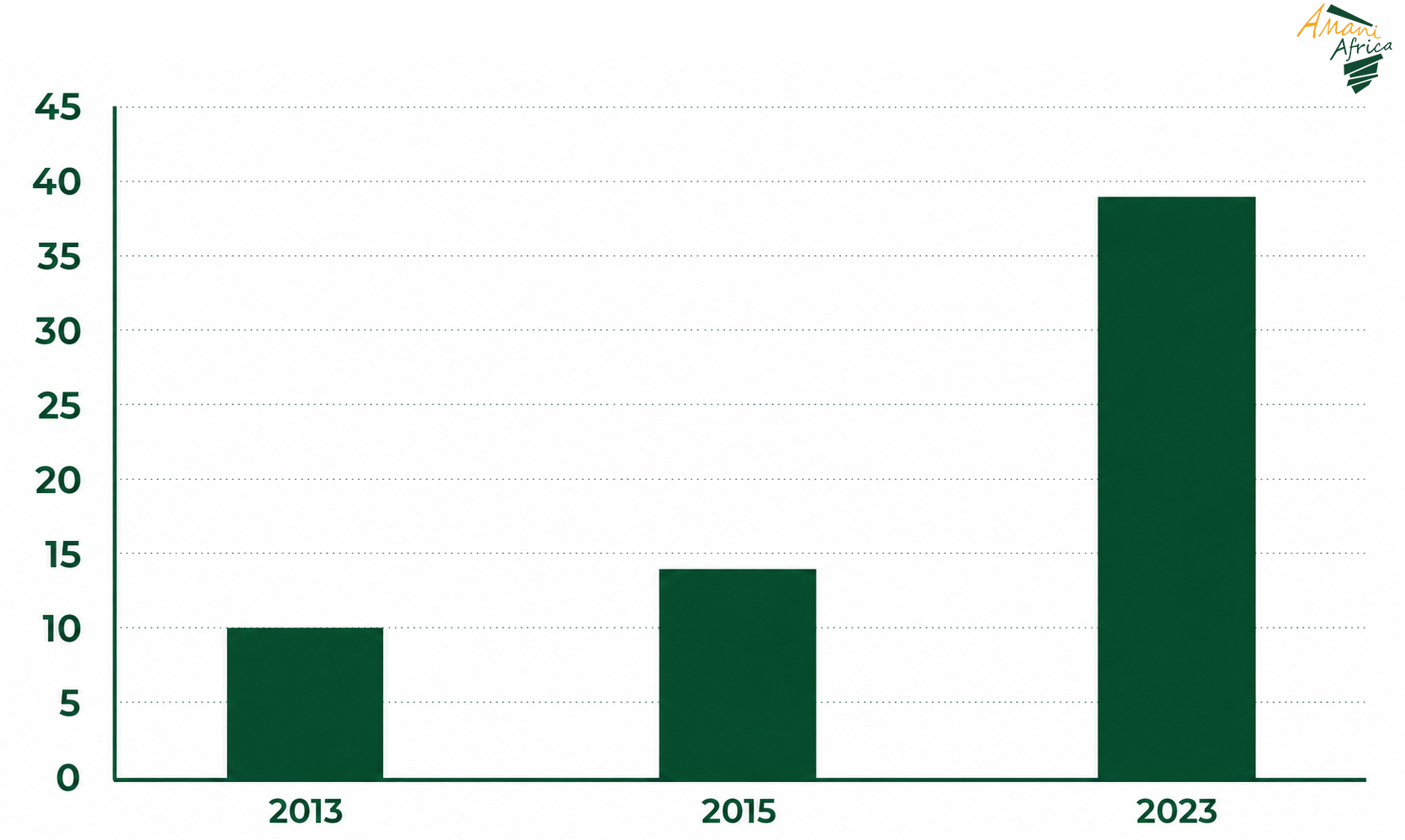
This increase in the number and geographic spread of conflicts is also notable in the increase in the number of situations on the agenda of the PSC, whose proliferation is in part attributable to the unprecedented surge in military coups.
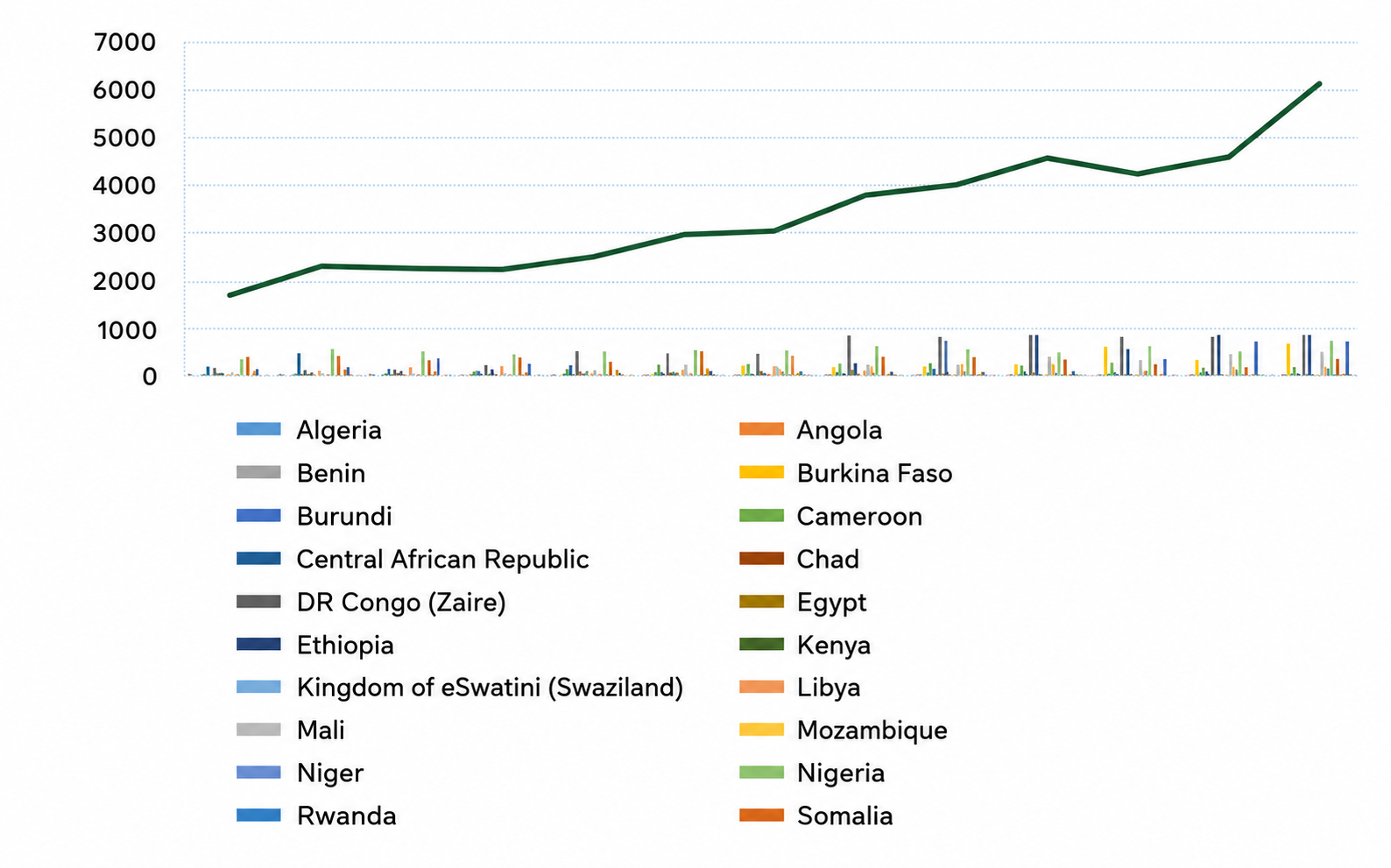
According to the data from different conflict data sets, the most notable trend is the sharp increase in recorded conflict events, rising from 1,671 in 2013 to 6,124 in 2025. Although annual variations exist, the overall trajectory has been consistently upward, particularly after 2019. The nature of conflict has also evolved from concentrated hotspots to a more dispersed continental security challenge. While traditional conflict theatres such as the Democratic Republic of the Congo (DRC), Somalia, Sudan, and the Central African Republic remain major centres of violence, new areas of instability have emerged. The Sahel represents the clearest example, with Burkina Faso experiencing a dramatic escalation from 2 (two) recorded conflict events in 2016 to 657 in 2025. The spread of insecurity into coastal West Africa, including Benin, as well as emerging concerns in countries such as Togo and Tanzania, demonstrates the expanding geographic reach of armed groups and regional insecurity.
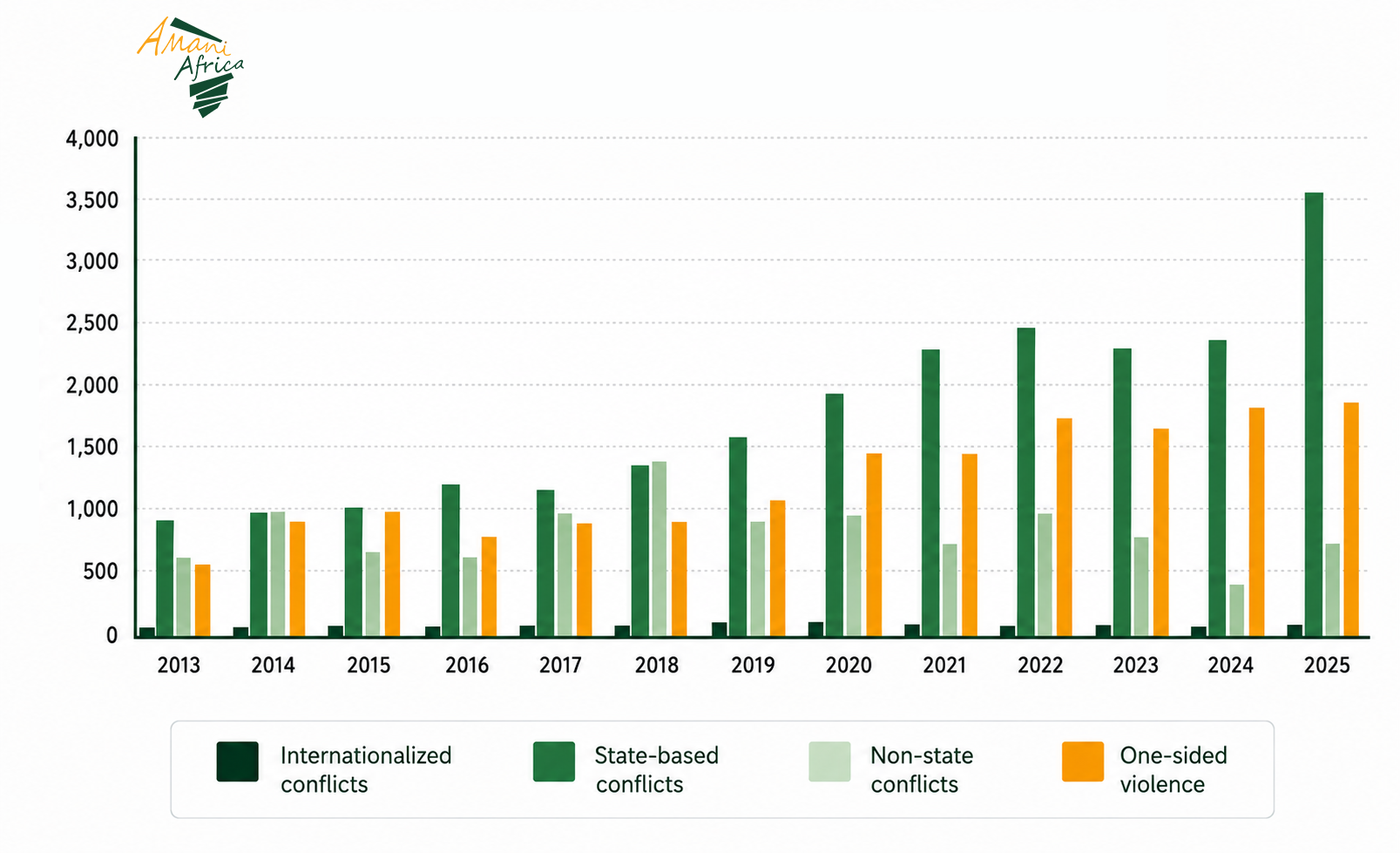
When disaggregating the data by conflict type, the surge is concentrated in just two categories rather than evenly spread. State‑based conflict nearly quadrupled between 2013 and 2025 (906 to 3,573, now 58% of all events), and one‑sided violence against civilians more than tripled (536 to 1,840). By contrast, non‑state conflict (588 to 733) and internationalised conflict rose only modestly. Sudan’s civil war, which erupted in April 2023 between the Sudanese Armed Forces and the Rapid Support Forces, exemplifies both drivers and accounts for much of the sharp 2023–2025 escalation. The RSF’s 2024–2025 siege and October 2025 capture of El Fasher, where UN investigators documented mass executions, sexual violence, and thousands of civilian deaths, provides a direct real‑world instance of the one-sided violence spike. The Sahel reflects a similar dual dynamic: JNIM and Islamic State Sahel Province simultaneously battle state militaries (state‑based) and massacre civilians in contested villages (one‑sided violence). Additional weight comes from the M23 resurgence in the DRC since 2022 and Ethiopia’s 2020–2022 Tigray war, both adding to the state‑based conflict totals in this period.
The humanitarian impact, captured in the graph below, is the direct result of the substantial increase in the incidence, intensity and geographic spread of armed violence, while also particularly affected by the dynamics of specific conflicts.
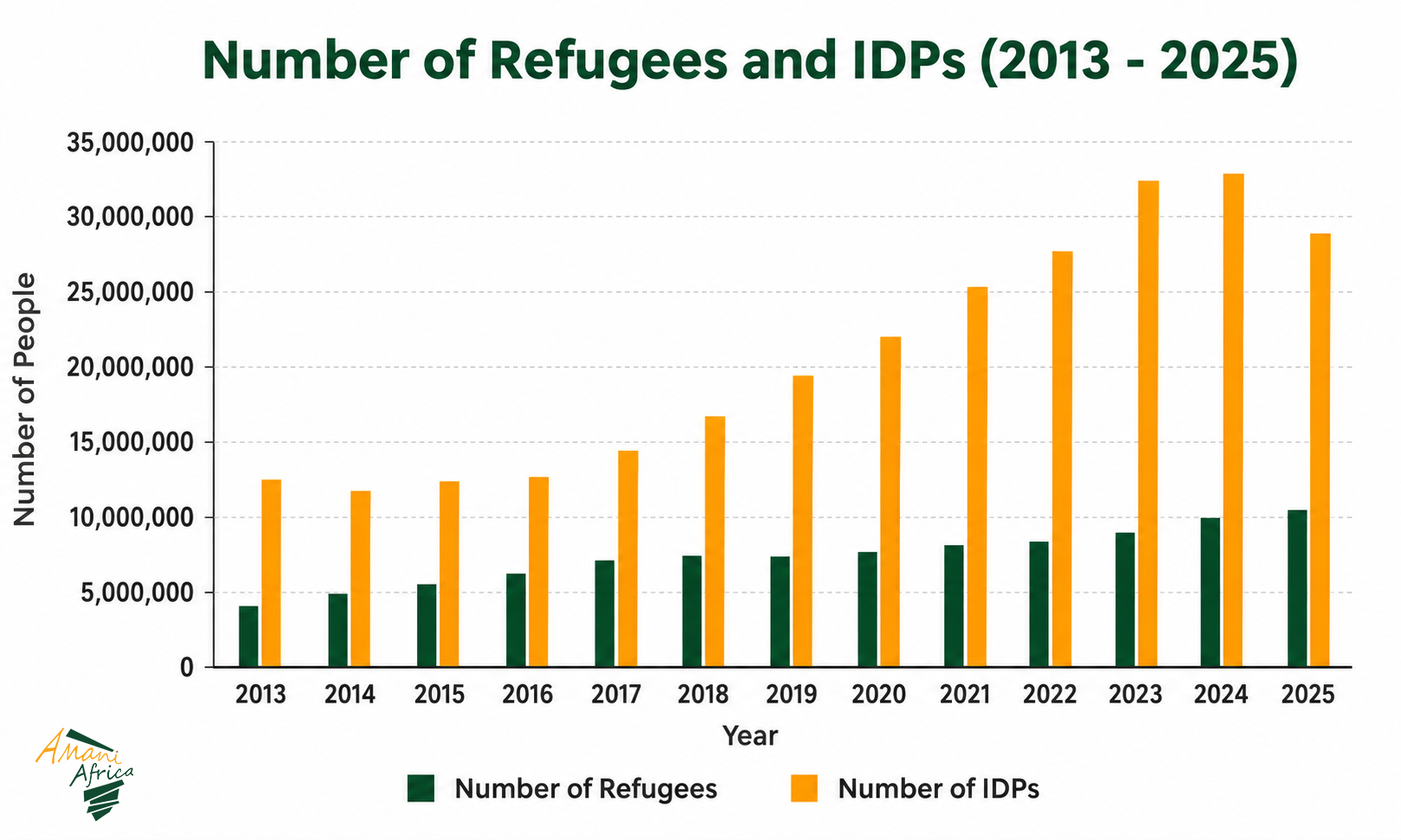
Measured against the pillars of the AU Master Roadmap of Practical Steps to Silence the Guns, the data reveals a widening gap between the ambition of the STGs agenda and the conditions required for its realisation. By AU’s own admission, some of the limited progress achieved is a far cry from the lofty goals and objectives set out in the AU Master Roadmap and the scale of peace and security challenges. Parts of the continent remain mired in conflict, and new challenges to peace and security have proliferated.
The growing number and geographic spread of conflicts are linked to the increased involvement of terrorist and violent extremist groups, deteriorating political governance, the persistence and expansion of armed conflicts, the fragility of peace agreements, and the continued proliferation of arms. These trends show that the challenge extends beyond the failure to end individual conflicts.
Closing this structural gap requires not only addressing the root causes of conflict but also ensuring that early‑warning systems are translated into timely political action. Early warning remains vital, but the persistent gap between warning and political action points to the need to operationalise the Roadmap by making early-warning outputs more systematically actionable. In this regard, the PSC has in its recent sessions emphasised the centrality of early responses to early warning in enhancing its conflict prevention mandate. It is therefore expected that the PSC, building on its 1247th, 1298th session, and 1320th session, will follow up on progress in the operationalisation of its decisions, particularly the dynamic risk-mapping tool and regular horizon-scanning briefings by AUCTC, CISSA and AFRIPOL.
Furthermore, the PSC may also use the opportunity to examine how to ensure that CEWS analysis products directly inform its agenda-setting and decisions, including through regular confidential briefings, periodic horizon-scanning sessions, and by improving AU–REC/RMs information-sharing, while giving greater attention to emerging threats such as digital radicalisation and illicit financial flows that increasingly underpin the evolution and cross-border expansion of conflicts. The central issue for follow-up is therefore how to ensure that early-warning information consistently triggers timely political decisions and preventive action, rather than being repeatedly generated without corresponding response.
These experiences suggest that the challenge for the AU is not simply to expand mediation efforts, but to develop conflict-specific strategies that combine sustained political engagement with security, humanitarian, development and peacebuilding instruments. They also reinforce the importance of African agency and institutional coherence, while external engagement can provide important diplomatic leverage and resources; fragmented mediation can dilute African ownership and create parallel processes. Strengthening AU–RECs/RMs coordination, clarifying the respective roles of regional and continental actors, and ensuring that external engagement complements rather than substitutes African-led processes will therefore be essential to making mediation and preventive diplomacy more effective in the changing conflict landscape.
The experience of the past thirteen years also demonstrates that ending active hostilities does not necessarily amount to silencing the guns. The lesson is that peace agreements should not be treated as the endpoint of conflict resolution. They are the beginning of a longer process of transforming the political, security and socioeconomic conditions that produced conflict in the first place.
This also points to a weakness in the way success in peace processes is often measured. A more meaningful measure of progress would examine whether peace agreements are being implemented, whether political institutions are becoming more inclusive, whether displaced populations can return safely, whether former combatants are effectively reintegrated, whether communities experience improved security and whether institutions are capable of resolving grievances without violence. Amani Africa’s earlier work on PCRD has highlighted the importance of linking security, political governance, humanitarian assistance, socioeconomic reconstruction, justice and reconciliation, and women and youth in sustaining peace. The challenge for the PSC is therefore to strengthen the connection between mediation and post-conflict support, ensuring that the political attention and resources mobilised to secure peace agreements are sustained during implementation.
The expected outcome of tomorrow’s session is a communiqué. It is expected that the PSC will underscore the need for a revitalised and more effective implementation of the Silencing the Guns Master Roadmap, taking into account the prevailing peace and security situation on the continent. The PSC may emphasise the importance of identifying and addressing the political, institutional and operational gaps that have impeded the implementation of the Roadmap, including the persistent gap between early warning and early action. It may call for strengthening the AU’s preventive diplomacy and mediation capacities and adapting approaches to conflict prevention and resolution to the evolving nature of armed conflicts, while enhancing coordination between the AU and RECs/RMs and reinforcing African ownership of peace processes. In view of the widening gap between the STG ambition and developments on the ground, the PSC may call for concrete, measurable and time-bound measures to accelerate implementation during the remaining period to 2030, including more systematic follow-up and accountability for the implementation of STG commitments. The PSC may also decide that a quarterly ministerial-level meeting dedicated to the adoption of measures specific to various conflict situations and constant review and, as necessary, updating of implementation of such measures in order to push significant progress by 2030. The PSC may also consider more concrete and measurable targets to register tangible progress by 2030 and request a report for making a determination on how to adapt and continue the agenda beyond 2030.