

African Union’s 2011 peacemaking in Libya: Lessons for the Review of the African Peace and Security Architecture
Date | 14 September 2026
Dawit Toga, Visiting Sr. Research Fellow, African Leadership Centre, King’s College London
The wave of popular uprisings that swept across most of North Africa in early 2011 marked a major turning point in the political trajectory of the region. Apart from its immediate impact of bringing down governments, it carried huge repercussions for peace and security in Africa and the African Union’s governance and security architectures.
After the popular uprisings of Tunisia and Egypt, Libya, under Muammar Gaddafi’s four-decade rule, became the next domino to crumble. What began as peaceful protests in Benghazi on 15 February 2011 rapidly escalated into an armed rebellion, catalysed by the National Transitional Council (NTC) and subsequently enabled by NATO’s military intervention under UN Security Council Resolution 1973. By October 2011, Gaddafi’s capture and extrajudicial execution marked the regime’s effective overthrow in less than eight months.
More than a decade later, the continent continues to grapple with both the conflict in Libya and its transnational fallout: arms proliferation across the Sahel has exacerbated conflicts and enabled terrorist networks, while the resultant instability of the wider region has generated heightened levels of refugees, asylum seekers and migrant flows across the Mediterranean. The Libyan case thus represents not merely a historical episode but an ongoing regional crisis whose reverberations continue to shape African security governance.
Despite the fact that the AU’s peacemaking initiative had a limited temporal scope, the trials and tribulations of that mediation effort in Libya offer useful insights and lessons on the factors that shape the deployment and relative success of the African Peace and Security Architecture (APSA) mechanisms as well as on the AU’s role in the aftermath of such initiatives. Clearly, that episode of AU’s mediation requires a much bigger examination and this short article seeks to contribute to that by discussing the fundamental questions of the policy challenges that the Libyan crisis posed to the APSA, the policy approach that the AU took on the crisis and the peacemaking instrument that the AU deployed in pursuit of the policy approach it adopted and the various institutional and geopolitical factors that eventually derailed AU’s peace efforts.
Overview of AU’s Mediation Efforts in Libya
The AU’s engagement unfolded amid rapidly changing events and competing international initiatives. Initially, it started as and looked like the popular uprisings sweeping through North Africa, with escalating incidents of violent confrontations. On 23 February 2011, the AU Peace and Security Council (PSC) convened its 261st session, expressing deep concern and strongly condemning ‘the indiscriminate and excessive use of force and lethal weapons against peaceful protesters’, while urging restraint and the need for preservation of the territorial integrity and unity of Libya.
Unlike the popular protests in Tunisia and Egypt, the protests and the push for ending Muammar Gaddafi’s decades of rule did not remain peaceful for long. It quickly descended into armed insurrection, thereby crossing into the realm of armed conflict. This prompted the PSC to convene another and this time around, a landmark session on 10 March 2011. It outlined a policy approach for diplomatic resolution with four pillars: cessation of hostilities, access to humanitarian assistance, protection of foreign nationals, particularly those of African origin and adoption and implementation of political reforms. To lead the diplomatic process, the PSC established the AU Ad Hoc High-level Committee on Libya mandated to ‘facilitate an inclusive dialogue among the Libyan parties.’
While many in the UN, EU and Arab League expressed the view that there was imminent danger of commission of serious atrocities in Libya and moved for intervention, the AU neither shared those views nor called for intervention in Libya. Most members of the PSC were not convinced that there was substantial evidence to support the fear of mass atrocities in Libya, despite Gaddafi’s rhetorical posturing. As such, the PSC opted for dialogue and peacemaking as the avenue for the resolution of the conflict in Libya.
The critical turning point came with UN Security Council Resolution 1973 of 17 March 2011 that purported to enforce the responsibility to protect (R2P). The resolution, passed with support from the three AU members under heavy Western pressure, authorised ‘all necessary measures’ to protect civilians, established a no-fly zone, and mandated coalitions of the willing to enforce the no-fly zone, paving the way for NATO intervention that commenced on 19 March.
This decision came in clear collusion with the AU approach. The resolution, adopted just a week after the AU PSC meeting, effectively marginalised diplomatic efforts and established a framework prioritszing military intervention over the political dialogue for which the AU put in place a mechanism.
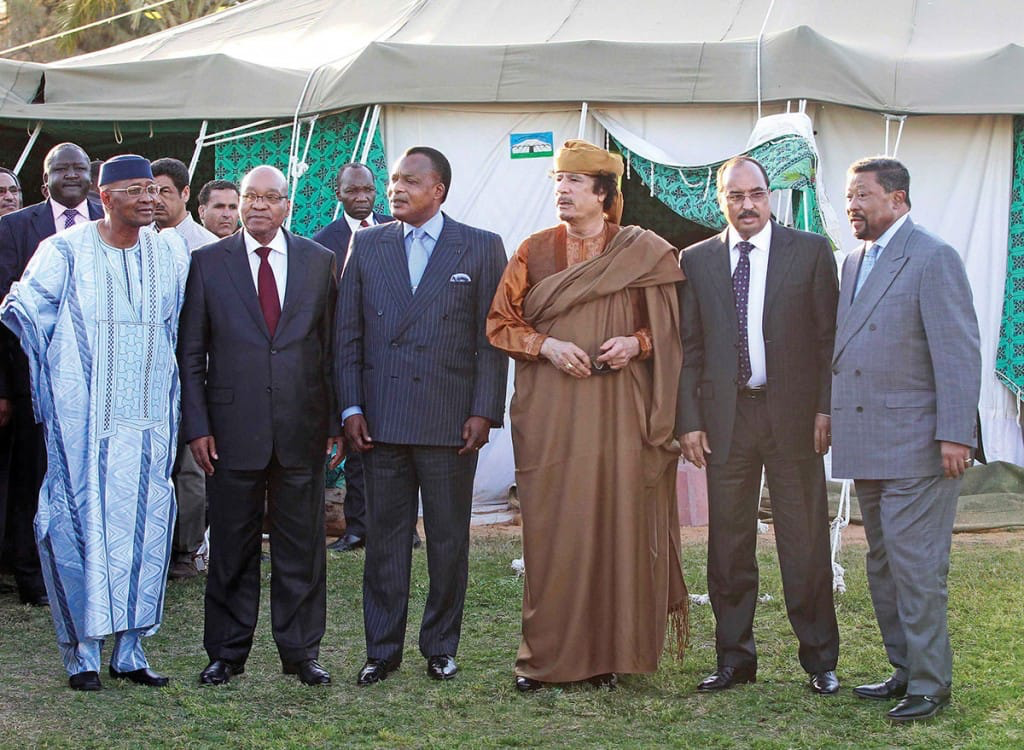
Despite the military campaign, the AU continued pursuing its mediation track. On April 10, a delegation from the Ad Hoc High-Level Committee visited Tripoli for discussions with Gaddafi and travelled to Benghazi for discussions with the NTC. However, the NTC, emboldened by military intervention and international support, flatly rejected the roadmap, insisting Gaddafi and his family must relinquish power without negotiation.
In late June, Gaddafi formally accepted the roadmap, including a commitment not to be part of the negotiation for the formation of a new government nor of the resulting government and communicated this to the Malabo summit, following President Zuma’s May visit to Tripoli. However, the NTC’s position had hardened, and rebels, now enjoying military advantages, saw no reason to compromise. The AU’s belated success in having its roadmap accepted by Gaddafi proved largely irrelevant.
Coordination between UN and AU was limited, if not virtually nonexistent. The first joint meeting occurred four months into the crisis, in May 2011. The AU’s warnings about long-term consequences proved prescient: military intervention would not resolve underlying political issues, would exacerbate humanitarian situations, generate regional instability, and complicate post-conflict reconstruction. These warnings were largely ignored by the P3 (USA, France, and UK), whose priorities quickly shifted from protection of civilians to regime change. This shift closed any possibility for settling the conflict through mediation and political dialogue.
Challenges and Limitations
Four key factors critically constrained the AU’s effectiveness: lack of AU-UN alignment, rejection of a mediated solution by one of the parties, the crowding out of negotiated settlement in favor of a military outcome by major powers, and institutional capacity constraints.
Lack of AU-UN policy alignment and fragmented African position in AU and UN: Despite the fact that three African states were present when Resolution 1973 was adopted and all of them voted for it was a turning point that highlighted a major weakling in the chain of coordination between African actors for the kind of policy coherence and coordination sought to be instituted as envisaged in the Protocol to the AU Constitutive Act on the Establishment of the PSCT. This fallout triggered the establishment of the annual PSC High-level Seminar and the establishment of the A3 mechanism.
The crowding out of negotiated settlement in favor of military outcome: NATO’s military intervention fundamentally altered the political dynamics. Most importantly, the shift in the position of NATO leaders from protection of civilians to regime change through military action meant that the alternative pathway advanced by the AU had little prospect of success. The no-fly zone and air support decisively tilted the military balance, emboldening rebels and hardening negotiating positions.
Rejection of mediation by one of the parties to the conflict: While the organisation successfully secured Qaddafi’s endorsement of the roadmap, it failed to obtain a reciprocal commitment from the NTC. NATO also pressured the NTC not to cooperate with AU mediation. The rebels, benefiting from international military support and diplomatic recognition, had little incentive to engage with an initiative that would not guarantee seizure of power by the NTC on its own.
Institutional Capacity Constraints: The AU’s mediation capacity primarily relies on deploying Special Envoys and High-Level Committees. The Libya approach lacked continuity, expertise, and institutional support. The High-Level Committee’s efforts were intermittent and lacked sustained engagement necessary to build trust and develop viable negotiation strategies. Absence of professional mediation support meant the Committee lacked analytical and operational resources to develop comprehensive strategies, manage complex negotiations, and coordinate effectively. However, even with stronger capacity, it was unlikely that the AU would have succeeded given the alignment of interests between opposition forces and those charging the military intervention in Libya.
Lessons for AU peace efforts from Libya
The Libyan crisis offers critical lessons for AU peace diplomacy, providing insights that can inform ongoing efforts for strengthening the APSA.
Imperative of early and coordinated action with the UN: Regional and global actors must coordinate from the very beginning of a crisis. The absence of early consultation between UN and AU carries significant responsibility for failure to adopt a consensual approach. UN Security Council’s adoption of Resolution 1973 without adequate consultation reflected a coordination breakdown with profound consequences.
Safeguard peace processes from external intervention: The Libya experience shows that AU peace efforts stand little chance of success where external military intervention crowds out the space for peacemaking. Similarly, AU initiatives cannot succeed without the support of international actors, particularly the UN Security Council and major powers. The AU must develop strategies for mobilising international support, building alliances with supportive actors, and ensuring regional perspectives are incorporated into international decision-making.
Securing mandate from all parties: Mediation cannot succeed without buy-in from all conflict parties. The AU must develop strategies to engage non-state armed groups and opposition movements, not just incumbent governments. This requires developing relationships with opposition groups, understanding their interests, building trust through consistent engagement, and developing protocols and procedures for engagement consistent with normative frameworks but responsive to conflict realities. The AU must also develop strategies for managing asymmetric relationships, ensuring all parties have meaningful roles in conflict resolution processes.
African ownership and coherence: Despite its eventual failure, the AU’s effort demonstrated the value of African-led conflict resolution. The principle that solutions must be political. African actors often have a deeper understanding of political dynamics, stronger relationships with conflict parties, and greater legitimacy with local populations. However, for ownership to guarantee success, coherence among African actors and between the PSC and the A3 is a prerequisite.
Implications for APSA Review
The AU’s mediation in Libya was a failure in outcome, but not in effort, principle, or learning. The AU activated its mechanisms, deployed leaders, and articulated a vision of peaceful political transition. The failure was rooted in factors beyond the AU’s control: rebels’ refusal to negotiate, NATO intervention, and the UNSC’s decision to pursue a military rather than diplomatic solution. Even after a decade and a half, the Libyan case remains urgently relevant.
The enduring relevance of Libya for the APSA lies in its illumination of broader challenges facing regional security governance: tensions between normative ambition and institutional and political reality, continental leadership and international engagement, and normative principles and political realities that continue to characterise contemporary conflicts across Africa. The AU’s ability to navigate these tensions, building on the lessons of Libya, will be critical to its effectiveness in fulfilling its mandate for peace and security on the continent.