

Artificial Intelligence: Governance, Peace and Security in Africa
Date | 15 April 2026
Tomorrow (16 April), the African Union (AU) Peace and Security Council (PSC) will convene its 1339th session on ‘Artificial Intelligence: Governance, Peace and Security in Africa’. The session will be held at the Ministerial level.
Following opening remarks by Gedion Timothewos Hessebon, Minister of Foreign Affairs of the Federal Democratic Republic of Ethiopia and Chairperson of the PSC for April 2026, Mahamoud Ali Youssouf, Chairperson of the AU Commission will make the introductory statement. The meeting will then receive briefings from Worku Gachena Negera, Director General of Ethiopian Artificial Intelligence Institute, and Samson Itodo, Chairperson of the African Union Advisory Group on Artificial Intelligence. Bernardo Mariano Junior, Assistant Secretary-General, Chief Information Technology Officer, UN Office of Information and Communications Technology (UNOICT) will also make a statement.
The rapid development of AI and its accelerating deployment across the political, social, economic, cultural, and security fields is attracting growing policy attention. Not surprisingly, there has been a burgeoning engagement on this matter during the past few years on the part of the UN and AU peace and security and governance policy-making bodies. In view of various technical and regulatory gaps and inbuilt flaws associated with AI, the widespread optimism that characterises the adaptation and deployment of AI in Africa requires critical engagement on ways of harnessing its benefits and mitigating its risks, some of which are particular to Africa. It has been reported that AI is projected to add between $ 2.9 trillion and $ 4.8 trillion to Africa’s economy by 2030, presenting an opportunity for the youth who constitute the majority of the African population. Industries from agriculture and healthcare to education and finance are on the brink of major transformation.
In terms of the deployment of AI, the continent faces a ‘non-linear’ development path marked by significant regional disparities. While East and South Africa possess more mature ecosystems, Central Africa remains in a nascent stage due to infrastructure and digital literacy constraints. There are persisting challenges across the continent affecting the potential of AI, including unreliable electricity, fragmented data regulations, a lack of a policy framework and the erosion of local talent to global companies.
Africa currently represents only about 1% of the world’s AI computing capacity. Without intentional investment and strong governance, the continent risks remaining largely a consumer of technologies built elsewhere, systems designed for different environments and not always aligned with African needs and realities.
As noted in the various engagements of the AU and the UN, there is recognition that AI is reshaping the global governance, development and security environment. At the level of the UN, engagement on the implications of AI is gaining momentum both in the UNSC and the UN General Assembly. Among others, the UNGA adopted Resolution 79/239 on Artificial Intelligence in the military domain and its implications for international peace and security. Along with the ongoing effort for developing a global governance framework, these developments and the need for addressing the specific needs and concerns of Africa in relation to AI necessitate that Africa and the AU engage actively, among others, on issues of data protection, addressing the digital divide, developing capabilities for adapting and developing AI for Africa, regulatory and technical gaps, protection of vulnerable groups and deployment of AI in the military domain.
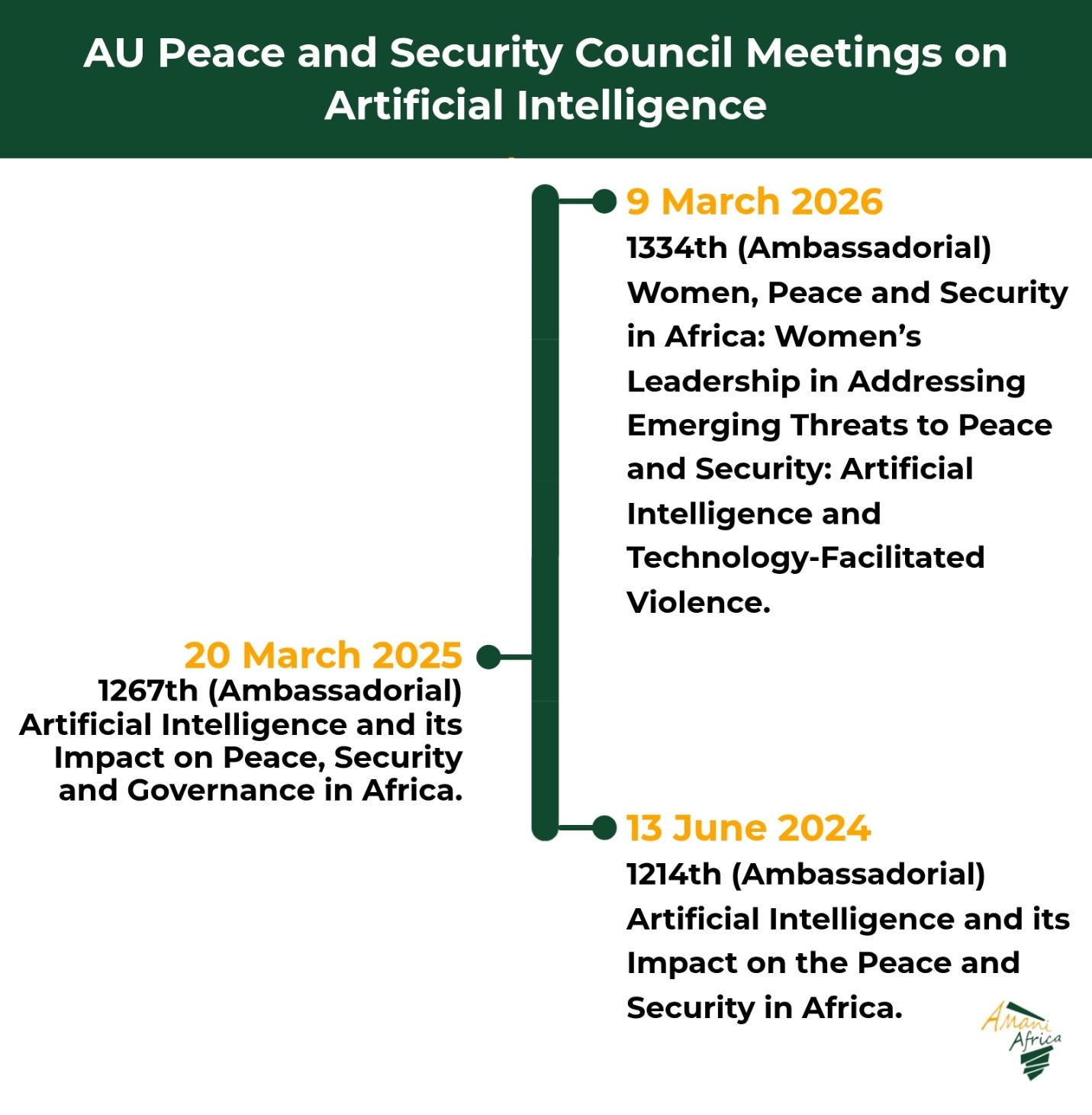
It is against this background that the PSC started convening sessions dedicated to the theme of AI and its governance and peace and security implications. On 13 June 2024 – as part of its 20th anniversary commemoration – the AUPSC held its first session dedicated to ‘AI and its impact on peace and security in Africa’. This 1214th session of the Council underscored AI’s transformative potential for peacebuilding, including its applications in early warning systems, conflict prevention, and post-conflict recovery. Most notably, however, it recognised the risks associated with its rapid development in a regulatory vacuum. The meeting tasked the AU Commission to ‘undertake a comprehensive study on the impact and implications of AI on peace, security, stability, democracy and development in Africa and submit the Report to the PSC as soon as possible.’ It also assigned the AU Commission, in particular the PAPS Department, in coordination with the Department of Infrastructure and Energy, to ‘establish a multidisciplinary Advisory Group on AI, peace, security and good governance in Africa; and to propose options for Continental Artificial Intelligence governance, including its military application and to report to Council every six months.’
Subsequently, the PSC held the first ministerial-level meeting on 20 March 2025 as its 1267th session under the theme ‘AI and its Impact on Peace and Security in Africa’. Building on its initial session (1214th), the 1267th session proposed the mainstreaming of AI in peace support operations, early warning systems, and preventive diplomacy, while also calling for the development of a Common African Position on AI and an African Charter on AI to guide its responsible use. Some progress has since been made in implementing these decisions, notably through the establishment of the AU AI Advisory Group on Governance, Peace and Security in March 2025. In December 2025, the Advisory Group convened in Nairobi, Kenya, to discuss its future plans, including the development of a Common African Position on AI, and to deliberate on emerging AI trends, opportunities and risks in Africa, as well as their implications for governance, conflict prevention and stability. Additionally, a technical workshop on the Strategic Assessment and Review of the Continental Early Warning System was held in November 2025 in Kigali, Rwanda, which resulted in the adoption of a joint AU–RECs/RMs Roadmap to integrate AI into early warning processes.
In March 2026, convened under the theme ‘Women, Peace and Security in Africa: Women’s Leadership in Addressing Emerging Threats to Peace and Security: Artificial Intelligence and Technology-Facilitated Violence,’ the PSC’s 1334th meeting drew attention to the implications of AI on women, peace and security. It served as a useful occasion for highlighting the deleterious consequences of the adoption of new technology, including AI, particularly in accentuating existing patterns of discrimination and prejudice, including technology-facilitated gender-based violence, online harassment, misinformation and disinformation, which undermines women’s effective leadership, credibility, reputation, participation, safety and authority. In this regard, the Council, among other decisions, directed the AU Commission, in particular the AI Advisory Group on Governance, Peace and Security, to ensure the inclusion of issues relating to women in the development of the Common African Position on AI Governance, Peace and Security.
Tomorrow’s meeting is being held just a day before the PSC undertakes a field visit to the Ethiopian AI Institute and the Science and Technology Museum, as part of its activities planned for April 2026. It should be recalled that the 39th Ordinary Session of the Assembly of the Union held in February 2026 endorsed Prime Minister of Ethiopia, Abiy Ahmed, as the AU Champion for AI. Relatedly, one of the Decisions during the Summit – particularly under the briefing by Cyril Ramaphosa, president of South Africa, on the outcomes of the November 2025 G20 leaders’ summit, was ‘to establish an annual AI for Africa Conference,’ following the inaugural Conference convened in Cape Town in September 2025.
It is expected that the upcoming session will build on and further expand the PSC’s consideration of AI and governance and peace and security in Africa. Of particular interest in this respect for tomorrow’s session is the role that Africa plays on the one hand in bolstering national and continental technical and regulatory infrastructure for harnessing the benefits and mitigating the risks of AI for governance, development, and peace and security in Africa and on the other hand in participating actively and contributing to shaping the development of global AI governance systems.
Tomorrow’s session will additionally be an opportunity to follow up on its previous decisions and chart a way forward, particularly during its 1267th session in which it highlighted the importance of setting up a mechanism ‘to monitor and assess the impact of AI on peace and security, such as an AU Watch Center with a mandate to monitor AI developments worldwide and in Africa, and to regularly inform AU Member States, RECs/RMs and the AU on the state of AI, particularly its impact on governance, peace and security in Africa.’ It may also follow on the decision tasking the AU Commission ‘to organise an African forum bringing together relevant partners and stakeholders to discuss AI as a key tool suited to share best practices and strategies for peace, security and governance in Africa’ and ‘to develop training programmes on AI in support of AU Member States in investing in human capital by training and capturing African talents in the fields of AI.’
The expected outcome of the session is a communiqué. The PSC may underscore the need for developing technical and regulatory infrastructure, both at the national and continental levels, to position the continent for both harnessing the benefits and containing the risks of the use of AI in Africa. The Council may also emphasise that AI and its use, including in the military domain, are subject to international law rules, including human rights and international humanitarian laws. It may urge Member States to adopt national legislation aligned with the continental strategy and framework to regulate the use of AI, particularly as it relates to governance, peace and security. The PSC may also encourage the Members of the AU Advisory Group on AI in Peace, Security and Governance Group to expedite the development of the Common African Position on AI and its impact on peace, security, democracy and development in Africa in consultation with all AU Member States. Council may also reiterate the importance of ensuring greater representation of Africa on global AI regulatory and governance bodies and mobilise efforts and complementarity among the various initiatives dealing with the issue of AI at the continental and international levels. The PSC may also encourage all Member States to create conducive conditions for more meaningful and effective engagement of women and youth in digital governance, AI policy, conflict prevention, peacebuilding and decision-making, ensuring equitable access to digital tools, literacy and platforms.