
Sudan Is Still Possible
A UN General Assembly Opportunity to Turn Mediation into Action
The greatest danger facing Sudan at the United Nations General Assembly is not that world leaders will say nothing. It is that they will say all the right things and still fail to act.
Date | 23 September 2026
By Abdul Mohammed
Sudan arrives at this General Assembly as expanding war across the Middle East and the Red Sea consumes diplomatic attention. The conflict with Iran has disrupted the Gulf and global supply routes, while the latest Houthi advance around Bab el-Mandeb has turned the maritime corridor facing the Horn into an active strategic front. Sudan risks being pushed aside precisely as its war becomes more dangerous.
That would be a grave mistake. Sudan sits where the Horn, the Gulf, North Africa and the Sahel meet, and its war is sustained by external weapons, finance, technology and political sponsorship. Neglect will draw it deeper into the wider confrontation.
Yet purposeful movement on Sudan is still possible. The war is not simple or fully “ripe” for negotiation, but the principles are known, the mediation formations exist and extensive consultations have taken place. Political cooperation could convert this groundwork into a practical path forward.
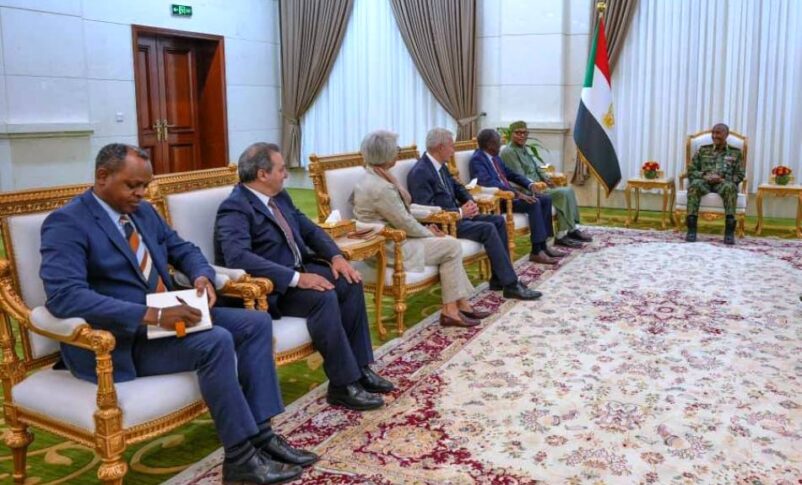
Responsibility rests especially with two sets of actors that already know one another: the mediators and Sudan’s political and civic formations. Their fragile relationship has known tensions, disappointments and measured progress. Yet it is a foundation, reinforced by Track II mediators and facilitators who have kept channels open. It must now be deepened and given common purpose. Each side must ask what more it can do.
To describe Sudan as a comparatively low-hanging fruit must never trivialize its tragedy. Nothing about it is easy. But in diplomatic terms, relative to the gathering storms, Sudan is unusually actionable. The planned face-to-face meeting of the Quad and the Quintet on 24 September could become the moment when consultation gives way to joint action.
A Humanitarian System at the Edge
On 14 September, the World Food Programme reported that almost 20 million people face acute hunger. Its funding had fallen from 645 million dollars last year to 206 million dollars this year, leaving a gap of almost 300 million dollars merely to sustain current operations. Many recipients receive only half rations. The International Organization for Migration warned that the entire humanitarian system could collapse within weeks.
This is no longer only a crisis of access. Aid organizations have delivery capacity they cannot use because resources are disappearing. Red Sea disruption is raising the cost of food, fuel and fertilizer, while severe dryness threatens agriculture in Darfur. The World Meteorological Organization warns that a very strong El Nino may persist into early 2027, bringing failed rains and crop losses in some parts of the Horn and destructive rain and flooding in others. In Sudan’s shattered economy, either shock could sever access, displace more people and spread disease. Combined with war and vanishing aid, it threatens an unprecedented regional famine emergency.
A week ago, the UN Security Council convened its second Informal Interactive Dialogue on Sudan. It confirmed that Sudan still has a diplomatic constituency. But attention is not strategy. A humanitarian system approaching collapse cannot be answered by another cycle of concern without decisions.
The War Trap Has Become a Red Sea Danger
The battlefield has changed, but the logic of the war has not. The Sudanese Armed Forces’ recovery and battle field gains restored confidence and national pride among many Sudanese. But military recovery is not national recovery. The Rapid Support Forces retain depth across much of Darfur, Kordofan remains contested, and fighting and drone attacks are spreading, including in Blue Nile.
Neither belligerent has a credible military path to governing a unified Sudan, yet each can deny victory to the other. Every advance renews hope for a stronger negotiating position; every setback brings new mobilization and sponsorship. Diplomacy is postponed until after the next offensive. This is the war trap: movement without resolution and sacrifice without a realizable national purpose.
Its destination is de facto partition as rival administrations, security structures, war economies and external relationships harden. Sudan needs no formally declared border to be divided by force. A war fought in the name of unity can become the instrument that destroys it. On that path there will be no victors, only the vanquished: the Sudanese people, their national institutions and the country itself.
The Quad members – the United States, Saudi Arabia, Egypt and the United Arab Emirates – are not detached from this upheaval. Their interests and relationships can deepen differences, but they also provide unusual leverage. Cooperation on Sudan would not solve the region’s larger wars. It would show that collective action remains possible even among states divided elsewhere.
Mediation Has Produced a Foundation but Not Yet a Strategy
Sudan does not lack initiatives, envoys or communiques. It lacks a common strategy understood and carried by both the mediators and Sudanese political and civic actors.
The Quad established an important foundation: Sudan’s unity and sovereignty, no viable military solution, a humanitarian truce leading to a permanent ceasefire, and a credible civilian-led political transition. Its effort to secure a truce has stalled, but the objective remains indispensable.
The Quintet – the African Union, IGAD, the United Nations, the European Union and the League of Arab States – has concentrated on the civilian political track. Berlin established shared principles and supported a joint Sudanese call to end the war. Addis Ababa consultations tested positions across political and civic formations. A good-offices mission to Khartoum from 8 to 10 September then listened to the authorities, political actors, the Democratic Bloc, women and youth, and those associated with a proposed dialogue.
These efforts have established a working relationship between the formal mediators and Sudanese political and civic formations. It is intermittent and not consistently trusted, but it is real. Track II mediators and facilitators have strengthened it by sustaining channels, testing ideas and connecting constituencies when official engagement slowed. This foundation creates reciprocal responsibility. Mediators must turn listening into strategy, protect the civilian track and prevent rival initiatives from splintering it. Sudanese formations must convert consultation into a minimum national position capable of sustaining negotiations. Track II actors should support the common architecture rather than compete with it. Each can do more, and each should be accountable for doing so.
This is notable progress, but consultation is not negotiation. It tests consent, maps convergence and helps design a process; it does not create a legitimate dialogue or produce a transition. The next step must command the confidence of armed actors on security obligations and of political and civic communities on Sudan’s constitutional future.
The planned Quad-Quintet meeting on 24 September is the best immediate opportunity to make that transition. It should not create another mechanism. It should make the existing mechanisms work in one direction, drawing on structured Sudanese input before the meeting and returning promptly to Sudanese political and civic actors with a clear programme afterwards.
What the Meeting on 24 September Should Produce
First, the Quad and Quintet should agree on a single political destination: one sovereign Sudan; no sustainable military solution; preservation of legitimate state institutions without permanent belligerent entitlement; and an inclusive, Sudanese-owned process leading to civilian and constitutional government. These propositions already reflect substantial Sudanese and international convergence.
Second, they should adopt an immediate humanitarian rescue and de-escalation package. Measures often called confidence-building should sit inside a political strategy of de-escalation. Confidence is an outcome; the purpose is to break the war’s momentum and open a path to a humanitarian truce and then cessation of hostilities. Initial steps could protect population centres and humanitarian routes; establish local non-attack arrangements; restrain drone attacks and new fronts; open direct military communication; enable detainee releases; and establish verification. The logic is to reduce, reciprocate, verify and expand, converting security openings into political engagement.
Urgent financing must be included. Hunger, displacement and institutional collapse deepen recruitment, predation and fragmentation. Keeping people alive and communities connected is part of preserving the country for peace.
Third, internal de-escalation must be matched by external restraint. War cannot contract while arms, drones, finance, mercenaries and logistics replenish expectations of military advantage. The Quad is uniquely placed to begin an external de-escalation compact. Its members need not agree on every regional question to agree that none benefits from the disappearance of a coherent Sudanese state.
Fourth, they should confirm a disciplined division of labour. The Quad should pursue humanitarian arrangements, military restraint and cessation; the Quintet should advance the civilian political process. The African Union and IGAD should provide the regional bridge, while the Secretary-General’s Personal Envoy connects the tracks. Track II facilitators should sustain discreet channels and offer technical support within this common strategy. This is strategic complementarity, not institutional merger.
Finally, the meeting should produce an action plan, not simply common language. A 90-day programme through December should sit within a six-month horizon, assigning responsibilities and reviews. Within 30 days, the mediators should assess progress with representative Sudanese actors: is violence contracting, is access improving, is external support for escalation diminishing, and is civilian space expanding? The measure of diplomacy is whether politics becomes more authoritative than the battlefield.
The Political Sequence Must Be Protected
The political track also requires clarity. Its stages will overlap as humanitarian, military and political dynamics are managed simultaneously. But flexibility cannot become ambiguity. Each phase needs a defined purpose, an expected product and a clear test of completion.
Preparatory consultations should achieve three things: first, identify convergence and unresolved differences; second, agree the purpose, principles, participation criteria, safeguards and decision rules of the process; and third, secure consent for a credible preparatory mechanism and define how the civilian track relates to negotiations with armed actors. Their product is an agreed process design, not a claim to represent Sudan or govern it.
A credible preparatory mechanism should then organize an inclusive intra-Sudanese political dialogue, with its mandate and criteria agreed before names become a contest over patronage. The dialogue should produce a common anti-war framework, minimum principles for unity and civilian constitutional government, and a representative mandate for the next negotiations. Its product is a shared Sudanese political framework, not a premature government.
The political process should convert that framework into negotiated agreements on transitional authority, security arrangements, accountability and implementation, while connecting it to the humanitarian truce and cessation track. A national dialogue proper belongs to a later, sufficiently grounded phase. It should broaden public ownership, address the social contract, constitution and reconciliation, and help constitute a legitimate post-war order. It cannot substitute for negotiations that stop the fighting.
This clarity also reduces the false contest between an “internal” and an “external” dialogue. Any initiative, whether convened inside Sudan or elsewhere, should subscribe to the same political destination, sequence, standards and safeguards. Different spaces can then reinforce one strategy instead of becoming rival claims that polarize Sudanese and fragment mediation.
Humanitarian and security negotiations must proceed in parallel. Belligerents must deliver restraint, access, cessation and compliance. But arms must not confer ownership of Sudan’s constitutional future. The tracks must be connected without militarizing the civilian process.
A Patriotic Compact to Save Sudan
International cooperation can create space, alter incentives and support a credible process. It cannot manufacture the Sudanese will required to save the country.
Sudanese political and civic formations, professional associations, resistance communities, women, youth, displaced people, refugees and advocates around the General Assembly should converge around a minimum patriotic compact: one Sudan; an end to the war; no political future founded on military victory; preservation of national institutions without permanent belligerent control; equal citizenship; civilian political centrality; justice; and a Sudanese-owned constitutional path.
That compact would be the Sudanese contribution to a common strategy. The mediators should answer it with consistency, transparency and protection and centrality of independent civilian agency. Neither side should wait for perfect conditions or flawless performance by the other. The governing ethic must be reciprocal responsibility: what more can each do, now, to reverse the war dynamics?
This does not require Sudanese to erase differences, equate the belligerents or abandon justice. Negotiation is not absolution. It is the arena in which war can be ended, accountability pursued, one professional national army built and legitimate authority reconstructed. The most urgent divide is between a war that is unmaking the country and the recovery of politics as the means by which Sudanese can disagree without destroying Sudan. Anti-war politics is patriotism in its most practical form.
Joint Quad-Quintet action would be modest against the scale of regional crisis, but its significance could extend beyond Sudan. It would show that states divided by larger confrontations can still cooperate to prevent another country from being consumed by them, restoring a measure of confidence in African, Arab and international peacemaking.
The final responsibility belongs to the Sudanese. Only Sudanese can save Sudan; others can help. There can be no meaningful victor if the country itself is vanquished. On 24 September, the Quad and Quintet should leave with a common programme, named responsibilities and a review date. Sudanese political and civic formations should answer with a minimum patriotic platform and the determination to rebuild a national political arena stronger than the armed camps that displaced it.
The opportunity is real, but it will not remain open indefinitely. Before Sudan disappears from the world’s agenda – and before war makes Sudan disappear into rival territories – its people and their international partners must act together. Sudan is still possible.