

The 3rd international conference on Sudan in Berlin: A turning point for the establishment of a civilian transitional authority?
Date | 14 April 2026
Solomon Ayele Dersso, PhD, Founding Director, Amani Africa
15 April 2026 marks the 3rd-year anniversary of the outbreak of the civil war in Sudan, pitting the Sudan Armed Forces (SAF), headed by General Abdel Fattah Al Burhan and the paramilitary Rapid Support Forces (RSF), led by General Mohamed Hamdan Dagalo (known as Hemedti).
On that same day, the international conference on Sudan will be held in Berlin, hosted by Germany together with the African Union (AU), the European Union (EU), France, the United States (US) and the United Kingdom (UK).
With the US-Israel war on Iran dominating international attention, this conference brings a rare focus to the war in Sudan.
Breaking the Saf-RSF death and destruction trap
The war grinds on unabated. There is little sign of its resolution on the horizon (see here).
There is no prospect of either of the warring parties securing total military victory. Neither a ceasefire freezing of the war (and hence the crystallisation of the partition of Sudan) nor a power-sharing arrangement between SAF-RSF guarantees sustainable peace.
The coalescing of peace efforts into two tracks (the truce/ceasefire track championed by the US-led Quad and the political dialogue track spearheaded by the African Union leaning multilateral organisations making up the Quintet) carries little prospect of changing either the battlefield or the mediation dynamics.
It is long past time to abandon the SAF-RSF-centric template that guided international engagement for the past three years.
During the last three years, the warring parties carried out hostilities with no regard to the rules of war. They both unleashed violence in an atmosphere of near-total impunity. The UN International Independent Fact-Finding Mission for the Sudan concluded that RSF’s violence in Darfur is of such a nature, ‘the hallmarks of which point to a genocide.’
The war has claimed the lives of more than 150,000 people. Living up to Kholood Khair’s apt observation that ‘Sudan’s catastrophe can now only be described in superlatives’, Sudan now bears the status of being ‘the world’s largest hunger, protection and displacement crisis.’ It is now the world’s worst famine, on top of being the world’s largest humanitarian crisis and largest child displacement crisis.
Much of the peace processes in Sudan since the ouster of former President Omar al-Bashir prised the role of the SAF and RSF. This approach has persisted since the outbreak of this war three years ago. It is seen as a pragmatic necessity. Yet, instead of facilitating peace, this SAF-RSF-centric approach (along with growing Sudanese polarisation and deepening external support for the warring parties) has only incentivised the warring parties to persist in the military showdown.
Making the 3rd international conference count
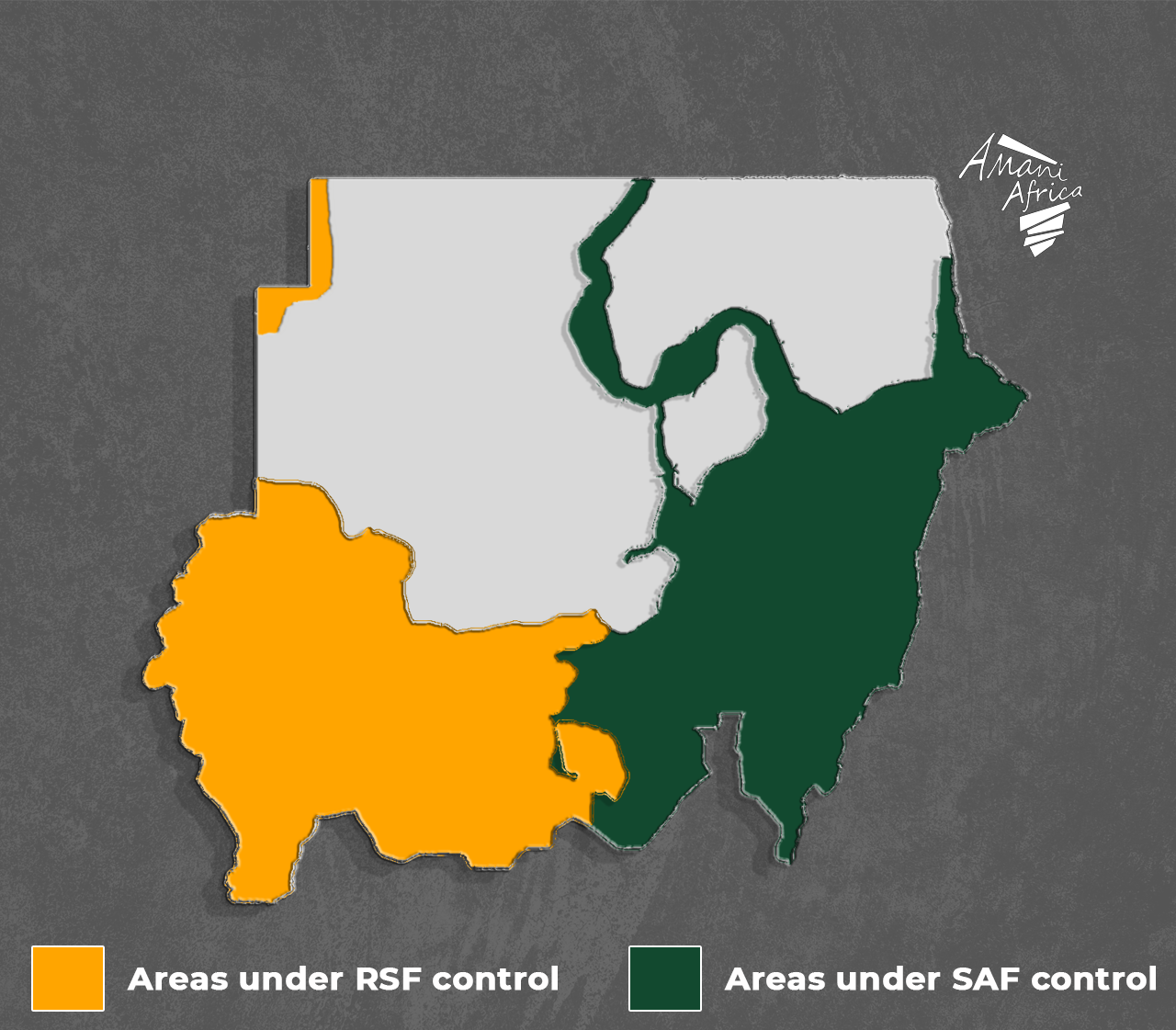
Apart from the enormous human suffering and the destruction it precipitated, this war has now resulted in the de facto partition of Sudan into two between the SAF-controlled northern, eastern and parts of southern Sudan, and the RSF-dominated western and parts of southern Sudan. This has put the very survival of Sudan in grave peril.
As Abdul Mohammed pointed out, ‘without new thinking, a ceasefire risks freezing disaster in place.’ As such, breaking the death and destruction trap that the fighting between SAF and RSF imposed on Sudan requires giving a chance to a new approach – a civilian transitional authority.
The international conference on Sudan in Berlin, marking the 3rd year of the outbreak of the war, can be the forum for setting in motion the process towards the establishment of a civilian transitional authority.
Ahead of this anniversary, Chatham House, the United Kingdom’s international relations think tank, bestowed on Sudan’s Emergency Response Rooms (ERRs) the most befitting recognition with the institution’s 2025 prize. This is a reminder that after three years of war and with no end in sight, the Sudanese civilian realm is the only avenue not only for breaking the stalemate between the two warring factions but also for forcing them into changing their calculations.
Why a civilian-centric process is a strategic necessity
The issue is no longer about including civilians. It is rather whether peace is possible without making them the centre of gravity.
Anchoring the peace efforts on and prioritising the civilian realm constitutes a critical antidote to the accelerating disintegration of Sudan.
Reinforcing the role played by the ERRs in the provision of aid and basic services and helping in maintaining infrastructure, this approach operates as an autonomous state-preservation instrument around which all Sudanese can rally.
The establishment of such technocratic civilian administration by Sudanese social and civic actors and the diplomatic recognition of such government by the international community carry additional benefits.
First, by creating an entity as the main locus of diplomatic efforts and separate from either of the two fighting parties, it ends the glorification of the people with guns. The idea is not that this will dispense with the necessity of engaging the warring parties, but it disrupts the incentive structure.
Second, it thus has the potential to break the logic of total victory and total defeat by which the action of the warring parties is currently dictated.
Third, this would incentivise the warring parties to opt for committing to a ceasefire as a means of limiting their loss in any future dispensation.
Fourth, by the sheer fact of its presence, it is also possible that the warring parties would be put into a position of pursuing their interests by choosing to accept the role of such technocratic civilian administration.
A two-phase transitional framework
As argued previously, the central idea to secure a breakthrough in breaking the SAF-RSF grip on the fate of Sudan is the establishment of a two-phased transitional process. Admittedly, this is easier said than done. Yet the fragmentation that the war unleashed is not insurmountable. The alternative is the perpetuation of the three years of disaster. Given the trajectory of the war, there is neither a cleaner nor an easier approach than this for arresting Sudan’s deepening downward spiral.
Taking further the arguments that analysts such as Alex de Waal made, this two-staged process to a civilian-centric transitional process injects a measure of pragmatism into the proposal of establishing a civilian administration as a way of breaking the SAF-RSF trap.
The first phase involves the establishment of a civilian technocratic transitional administration. This is a government whose only raison d’etre is the salvation of the Sudanese state by creating the space for a Sudanese-led peace process that brings to the centre of diplomatic efforts the agency of Sudanese civic actors. The mandate of this caretaker administration is envisaged to be further limited in three ways. First, it has a limited substantive mandate focusing on facilitating humanitarian support and creating the space for charting a process for an all-inclusive civilian transitional government. Second, its term of office will also be limited in time. Third, to break the transitional governance trap, no member of this technocratic administration will be eligible to participate in the composition of the civilian transitional government.
As a body with such limited emergency and technocratic power for saving the Sudanese state, there is a need for its urgent establishment, whose narrow focus can mitigate, if not dissolve, fragmentation and contestation, which have been used against effective engagement with Sudanese civic actors. The impact of polarisation can also be reduced by mobilising the engagement of Sudanese social and political forces around the definition of the criteria for determining who and what needs to be done during the tenure of the technocratic administration.
Sudanese civilian forces working with the AU and others in the international community can take the lead in initiating the process for the constitution of such a technocratic civilian administration. It is necessary that the upcoming conference on Sudan in Berlin can be the platform for making a declaration of support for such a process, with Sudanese civilian leadership. Among others, the international community will play a critical role not only in extending diplomatic recognition but also, importantly, in providing substantial institutional support for it to restore the effective functioning of such state institutions as the bureaucracy and the Central Bank.
Apart from creating opportunities for silencing the guns, the technocratic civilian administration’s main role is the creation of the conditions for the holding of a national popular convention based on principles and formats to be agreed to by the Sudanese. This is a convention that will bring together various political and social forces of Sudan for the elaboration of a transitional roadmap and the establishment of the transitional government for the implementation of the roadmap, involving various reforms that will culminate in the adoption of a constitution and the establishment of a constitutional government, inaugurating a new dispensation in Sudan.
Whether or not this could work and how it could be made to work depends first and foremost on the Sudanese civic actors and the creativity and willingness of those engaging in the search for peace in Sudan. Barlin could be where the journey towards working on making this civilian-centric approach work begins.