
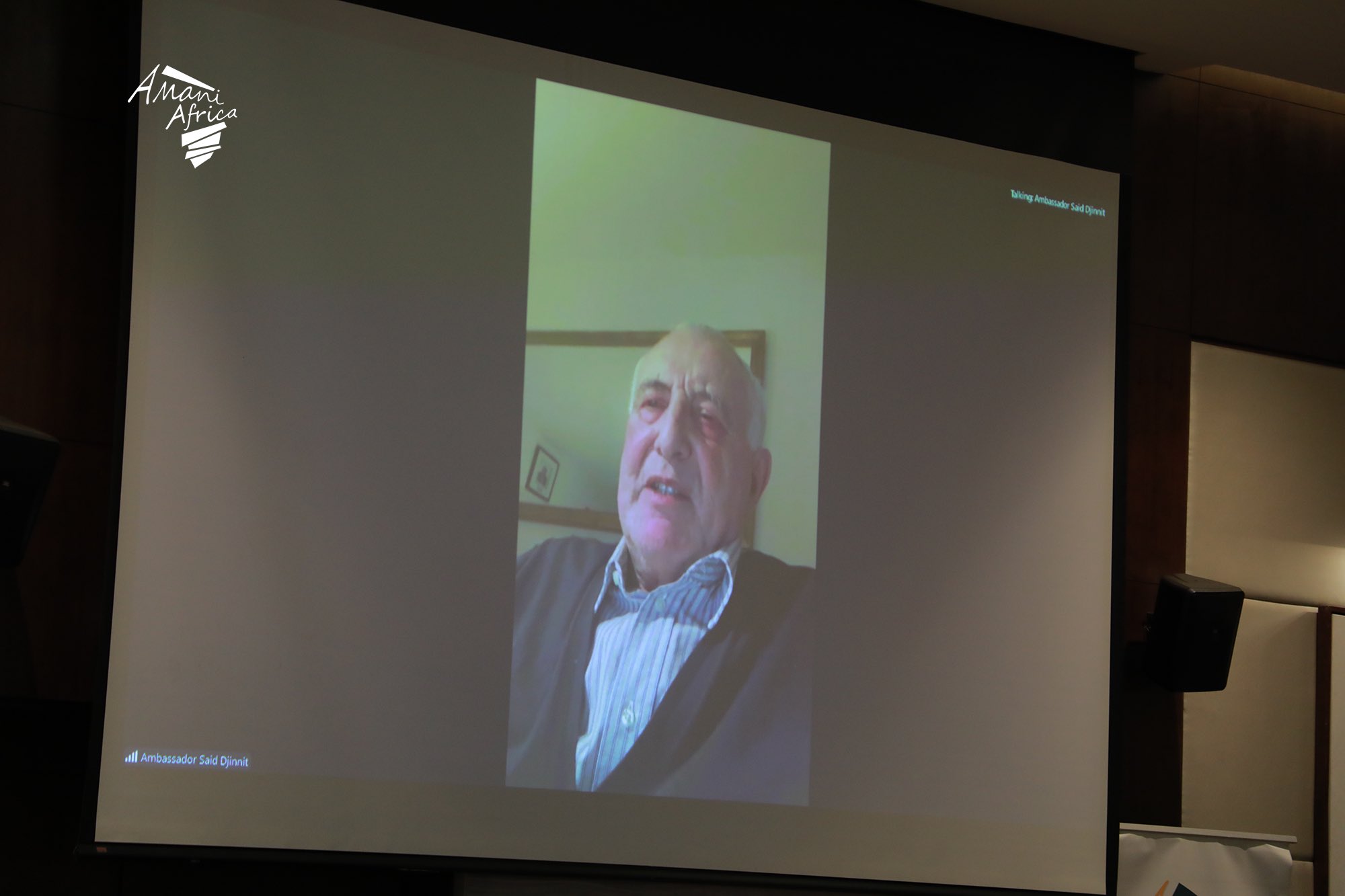
Ambassador Said Djinnit
Building on the legacy of the Organisation of African Unity (OAU), the African Union has, over the years, made sustained efforts to address conflict situations across the continent through its peace, security, and governance architecture, centered on the Peace and Security Council. While important achievements have been recorded, the reality is that peace in many parts of Africa remains elusive. I therefore welcome the initiative to review the African peace, security, and governance architecture currently underway, with a view to re-energizing the AU’s role in conflict prevention and resolution.
For the sake of time, I wish to focus on a few key points and allow me to speak frankly.
First, when the African peace, security, and governance agenda was conceived, it was based on a strong political commitment by Member States to shared values and norms, as well as on their readiness to cooperate in its implementation. This commitment was clearly demonstrated in the early years of the African Union. Unfortunately, we have seen that it has gradually faded and could not be sustained.
This declining commitment is reflected in the limited participation of leaders in AU meetings and, more importantly, in the insufficient cooperation of Member States in responding to early warning signals and engaging in preventive diplomacy. If the AU is to enhance its effectiveness, this issue must be addressed as a matter of priority.
Related to this is the way AU Summits are organized. Summit agendas often leave little space for frank and strategic exchanges among leaders on both progress achieved and shortcomings encountered. In my view, AU Summits should focus on a limited number of important and strategic issues, with other matters handled at ministerial level. We should also revive the practice introduced during the tenure of Salim Ahmed Salim of reducing lengthy opening ceremonies in order to create more time for substantive, closed-door, eye-to-eye discussions among Heads of State in smaller caucus rooms, rather than in large plenary halls where leaders are often solicited for bilateral meetings.
Second, the transformation of the Secretariat into a Commission was intended to strengthen its capacity to act as the guardian of agreed values and norms, ensure follow-up, and implement decisions through mobilizing and galvanizing member states. Over time, however, this expected role could not be sustained. Yet the PSC Protocol clearly provides that the powers of the PSC are exercised in conjunction with the Chairperson of the Commission. In this context, the role of the Chairperson—particularly the power of initiative and proposal—needs to be more clearly defined. Clarifying respective roles would help avoid misunderstandings and enhance accountability.
Third, the effectiveness of the Peace and Security Council itself has eroded over the years. This is due in part to the declining political commitment I have already mentioned, but also to changes in the way PSC membership is selected. The shift from elections based on clear criteria to a largely rotational approach has weakened the authority of the Council and, in many ways, returned us to the shortcomings that existed under the former Central Organ.
Fourth, let me say a word about the Panel of the Wise. When it was created—and I can say this with some authority, as I was closely involved in its establishment—the Panel was envisaged as a strong preventive mechanism, able to act independently and in support of the PSC. The Protocol clearly provided for such a role. It was expected to speak openly and forcefully on issues that many of us—including members of the PSC—often address only quietly. In reality, it was never able to fully take off from the beginning.
Fifth, on unconstitutional changes of government, both the AU and the Regional Economic Communities have lost credibility. This is due not only to inconsistent responses to coups, but also to the failure to address serious governance issues, notably constitutional 9manipulation to retain power and democratic backsliding. In this context, prospective coup makers increasingly act without fear, at a time when democratic commitment are weakening and authoritarian tendencies are growing across the continent.
Finally, while the Peace and Security Council is expected to remain the primary continental body responsible for peace and security, it necessarily relies on cooperation with the United Nations and other international partners. Such cooperation should support—and not compete with—African-led efforts. Competing initiatives and external interference, which have increased significantly in recent years as a result of geostrategic shifts and weakened African commitment, have often complicated conflicts and delayed their resolution.
Strengthening African leadership therefore requires a more assertive Peace and Security Council, but it also requires the cooperation of African parties to conflicts themselves, which too often engage in forum shopping.
In conclusion, this review offers us an opportunity not just to adjust structures, but to restore political commitment, clarify roles, and reaffirm African leadership in peace, security, and governance.
* Presentation delivered during the Amani Africa high-level policy dialogue on the review of the APSA held on 15 December 2025