
Third Annual Joint Consultative Meeting between the AU PSC and ECOWAS MSC
Date | 29 June 2026
Tomorrow (30 June), the African Union (AU) Peace and Security Council (PSC) is expected to convene its Third Annual Joint Consultative Meeting with the Economic Community of West African States (ECOWAS) Mediation and Security Council (MSC), in Abuja, Nigeria.
Following opening remarks by Julius Sandy, Chair of the ECOWAS MSC, and Nasir Aminu, Nigeria’s Permanent Representative to the AU and stand-in PSC Chairperson for June, Bankole Adeoye, AU Commissioner for Political Affairs, Peace and Security (PAPS), and Dr Alieu Omar Touray, President of the ECOWAS Commission, are expected to deliver statements.
The last Annual Joint Consultative Meeting between the PSC and ECOWAS MSC was held on 16 May 2025 in Addis Ababa. The meeting, among others, agreed on the need to continue engaging the three countries of the Alliance of Sahel States (AES); developing a security cooperation framework involving the AU and ECOWAS engagement with these countries; reinvigoration of the Nouakchott Process, the ECOWAS Plan of Action Against Terrorism, the Accra Initiative, the Multinational Joint Task Force (MNJTF) and Gulf of Guinea maritime security initiatives; a Joint Threat Fusion and Analysis Cell under an AU-ECOWAS counter-terrorism coordination platform; closer cooperation between the Continental Early Warning System (CEWS) and the ECOWAS Early Warning and Response Network (ECOWARN); and joint field missions, retreats, chairperson-level consultations, focal points and staff exchanges. Against this background, the third consultation, framed around the theme ‘Strengthening Regional Cooperation in Resources Mobilization to Address Evolving Peace and Security Threats in Africa’, may serve as a test of whether annual dialogue can be translated into measurable follow-up, including through a joint assessment of West Africa’s peace and security situation, particularly terrorism, unconstitutional changes of government (UCG) and transitions; deeper collaboration on financing peace support operations, including discussion on the practical operationalisation of UN Security Council Resolution 2719 for regional peace support needs; and concrete steps for strengthening coordination and coherence between the PSC and MSC within APSA and AGA.
That test comes against a deteriorating security, humanitarian and climate backdrop. The central Sahel remains the epicentre of militant Islamist violence on the continent, with Mali, Burkina Faso and Niger accounting for a major share of fatalities linked to such groups. Yet the threat is no longer confined to the central Sahel. The Lake Chad Basin recorded a 28 per cent increase in fatalities from the previous year, underscoring the continued operational threat posed by Boko Haram and ISWAP. At the same time, insecurity increasingly connects Sahelian theatres, northern Nigeria, the Lake Chad islands and coastal borderlands. These dynamics strengthen the case for closer AU-ECOWAS coordination on counter-terrorism, intelligence sharing and cross-border stabilisation, but also show that regional stabilisation cannot be treated as a purely security question. The PSC’s 1344th session on the impact of climate change on the Lake Chad basin and the Sahel further reinforces the need to connect security responses with local resilience, climate adaptation and conflict-sensitive recovery. Around 55 million people in West and Central Africa are projected to face crisis-level hunger or worse during the June-August 2026 lean season, while more than 13 million children are expected to suffer from malnutrition in 2026. Conflict, displacement, economic turmoil, funding shortfalls and extreme weather risks therefore make humanitarian access, resilience and recovery programming integral to any credible regional response.
Another area that may receive the attention of the consultative meeting is early warning. The AU-ECOWAS early warning cooperation engagement, held from 8-10 June 2026 in Abuja, involved the AU West Africa Regional Desk, CEWS Situation Room, ECOWAS directorates, and the West Africa Network for Peacebuilding (WANEP). It was built on the September 2025 desk-to-desk process for joint conflict analysis and governance monitoring. It is imperative that CEWS-ECOWARN cooperation is linked to political decision-making, preventive diplomacy and rapid response, rather than remain a technical exchange. This is also where the proposed AU-ECOWAS Counter-Terrorism Coordination Platform and Joint Threat Fusion and Analysis Cell become important. The Councils may therefore deliberate on how such mechanisms could be operationalised.
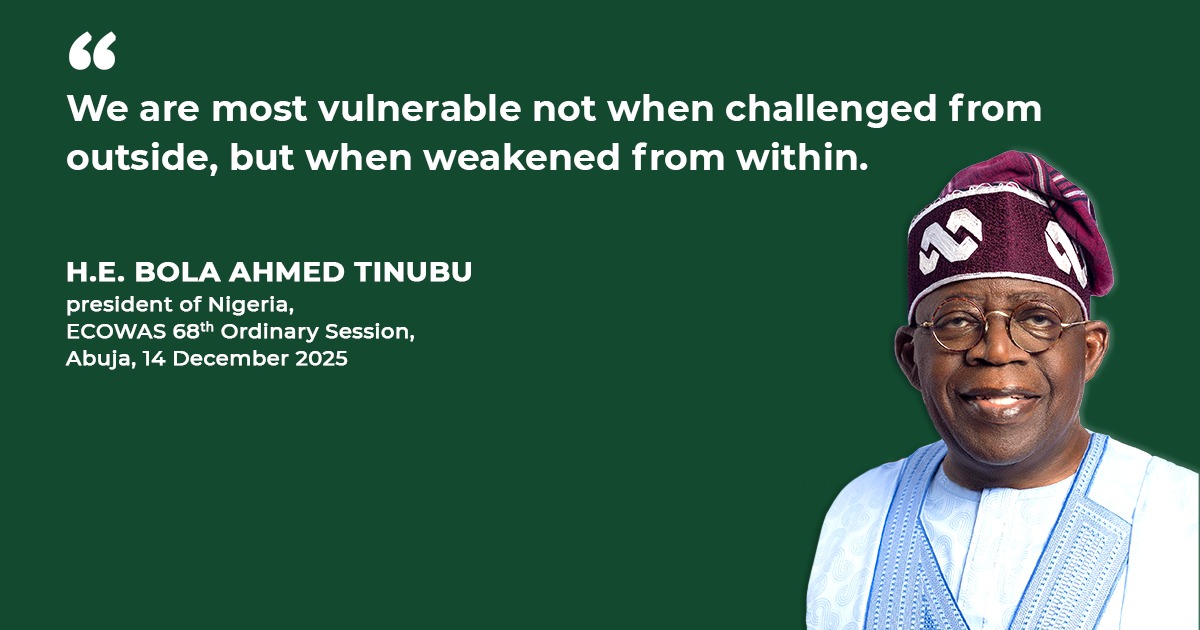
Of immediate political concern is the AES question and its effect on ECOWAS’s institutional cohesion. The previous joint communiqué’s call for engagement with Burkina Faso, Mali and Niger gave institutional expression to the logic of moving from estrangement to engagement. The 67th ECOWAS Ordinary Summit endorsed the appointment of a Chief Negotiator to lead discussions with the three states on an orderly withdrawal process, safeguarding institutional and citizens’ interests and minimising regional disruption. At the same time, the 68th Summit urged Member States and directed the ECOWAS Commission to sustain engagement with Burkina Faso, Mali and Niger to strengthen collaboration on the deteriorating security situation. The AU Commission Chairperson’s consultations with the Ambassadors of the three countries on 27 May 2025, and the Special Representative of the Secretary-General for West Africa and the Sahel’s visit to Niger in April 2026, the 22 May 2025 meeting in Bamako between the President of the ECOWAS Commission and Ministers of the three countries of the AES similarly signalled efforts to keep channels open and cooperate on shared challenges, particularly terrorism. ECOWAS has since begun to give this dialogue a more dedicated form through the appointment of former Guinean Prime Minister and former ECOWAS Executive Secretary Lansana Kouyaté as Chief Negotiator with the AES countries, followed by his engagement with Burkina Faso’s transitional president and current AES Chair, Captain Ibrahim Traoré, in May 2026. While near-term reintegration remains unlikely, it is in the interest of both Councils to prevent the rupture from paralysing practical cooperation on security, stability and free movement. Tinubu’s warning at the 68th Ordinary Session that ‘We are most vulnerable not when challenged from outside, but when weakened from within’ speaks directly to the wider significance of the AES rupture. Beyond the question of membership, it touches on political trust, security coordination and the common regional purpose needed to sustain collective action.
Governance and constitutional order are expected to be another major pillar, as transitions and UCG remain central to West Africa’s stability agenda. The previous meeting encouraged inclusive responses to governance deficits and reaffirmed zero tolerance for UCG, but recent developments, such as the November 2025 military coup in Guinea-Bissau and the December 2025 attempted coup in Benin, demonstrate that UCG remains a persistent challenge in the region.
Peace Support Operations and financing are expected to be crucial issues for deliberation, particularly regarding how AU-ECOWAS cooperation can support more effective resource mobilisation and the practical operationalisation of Resolution 2719 to meet peace support needs. This is particularly relevant in light of the 67th ECOWAS Ordinary Summit’s decisions on missions in The Gambia and Guinea-Bissau, which point to mandate readjustment, final extensions, drawdown and liquidation planning, as well as the 68th Summit’s decisions on Guinea-Bissau, which indicate renewed stabilisation needs, including the protection of political leaders and national institutions. The MNJTF may also serve as a related test case, particularly given the PSC’s concern at its 1347th session over funding gaps and its request that the AUC liaise with the A3 to explore the possible application of Resolution 2719 to fund MNJTF activities.
The expected outcome is a Joint Communiqué. The meeting is expected to welcome the convening of the Third Annual Joint Consultative Meeting as further consolidation of the AU PSC–ECOWAS MSC consultation process and to reaffirm the two Councils’ commitment to collaboration and shared responsibility in addressing peace and security challenges in West Africa and the wider continent. It may also welcome steps to strengthen AU-ECOWAS early warning cooperation and to encourage stronger links among CEWS, ECOWARN, and rapid response. It may also call for clearer coordination mechanisms to operationalise decisions taken by statutory organs, including agreed workstreams, focal points, timelines and reporting arrangements. The Councils may highlight the need for a practical mechanism to facilitate the operationalisation of UNSC Resolution 2719 in ways relevant to West African peace support needs, including the MNJTF, ECOWAS peace support capacities and other regional security arrangements. The communiqué may further encourage the revitalisation of existing cooperation mechanisms, including the Nouakchott Process, the Accra Initiative, the MNJTF and Gulf of Guinea maritime security arrangements, alongside steps towards operationalising the previously proposed AU–ECOWAS Counter-Terrorism Coordination Platform and Joint Threat Fusion and Analysis Cell. It may also stress continued dialogue with Burkina Faso, Mali and Niger, reaffirm ECOWAS as a key pillar of regional integration and continental peace and security, and underscore that stronger AU-ECOWAS coordination is indispensable to addressing the region’s interconnected security, governance and humanitarian pressures.