
Information disorder seriously endangering stability, Amani Africa tells the PSC
Date | 9 October 2026
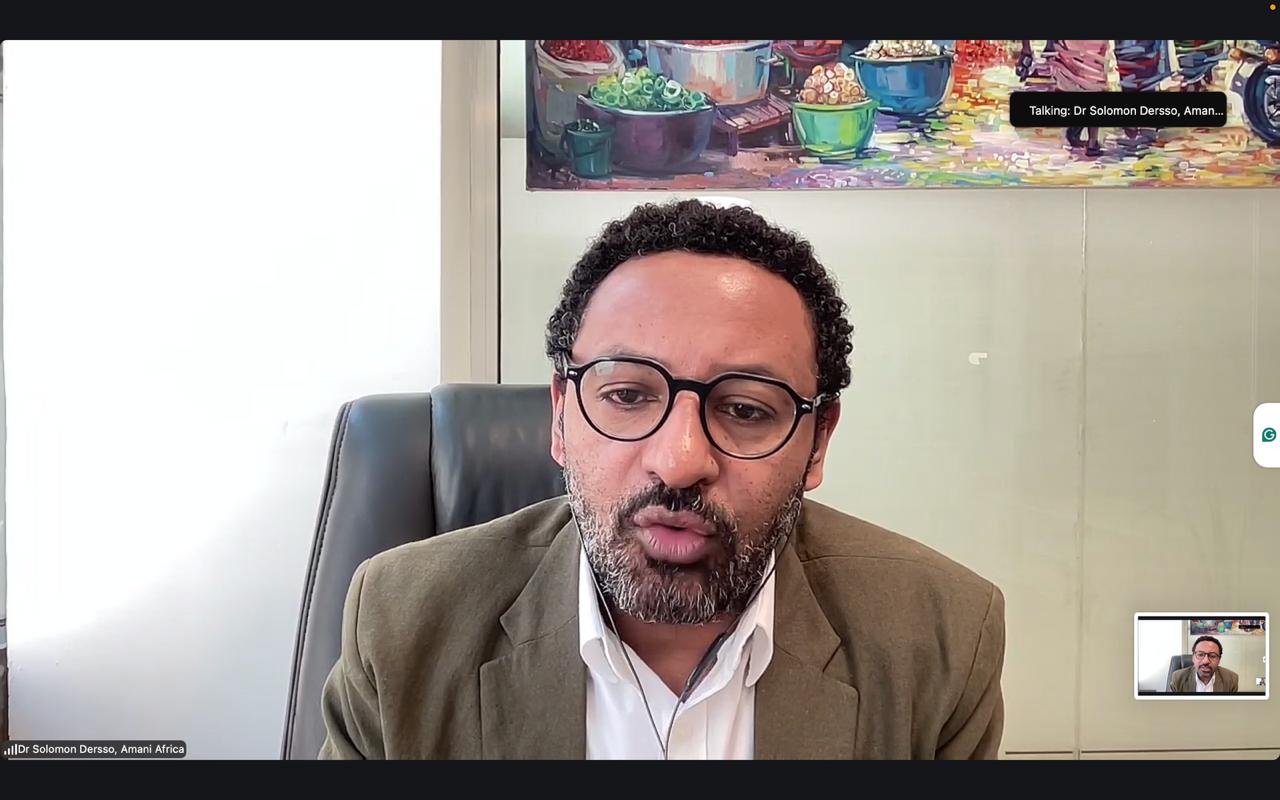
Solomon Ayele Dersso, PhD
Founding Director, Amani Africa
Chairperson of the African Union Peace and Security Council, Ambassador Churchill Ewumbe-Monono
Excellencies, distinguished members of the Peace and Security Council
A very good morning.
It is an honour for me to address you today, representing my organisation, Amani Africa Media and Research Services, an organisation that is dedicated to the advancement of peace and security by contributing to the noble mandate of this august house, our Union’s standing peace and security decision-making body, through policy research, technical support, policy dialogue and strategic communication.
I wish to commend the Chairperson and this Council for dedicating today’s session to a subject that carries enormous implications for peace and security, political stability, economic advancement and democratic governance on the continent. The United Nations Global Principles for Information Integrity warn that the erosion of the integrity of the information space hinders efforts to achieve peace, prosperity and a livable future on our planet. In what signifies this threat from disinformation, South Africa’s Human Rights Commission, a constitutionally established independent body, observed ‘a growing pattern in which information disorder contributes to rights violations, including violence, discrimination, public health harms, and the erosion of democratic participation.’
Poignantly, and as a result, the UN points out that the task of strengthening information integrity may present us with one of the most urgent challenges of our time. Experience on the continent suggest that disinformation and related forms of information disorder poses increasingly grave threat to institutional stability and peace and security.
Information integrity has always been critical to peace and security. In our digital and AI age, it has become the precondition for political stability, democratic governance and a functioning socio-economic order. There is almost no domain of public life or social or economic sector that does not get seriously endangered by the erosion of information integrity. This heightened importance of information integrity, in this digital and AI age, is particularly pronounced for peace and security.
As we have pointed out in the edition of Insights on the PSC dedicated to this session, ‘quality of information affects both the behaviour of conflict parties and the context in which conflicts unfold.’ This makes the absence of information integrity detrimental to peace and security. ‘Without information integrity, it becomes difficult to distinguish between truth and falsehood. In the absence of truth, there can be no trust. In the absence of truth and trust, war and conflict, division and violence thrive. The pursuit of peace is hugely impaired.’
For purposes of the mandate of the PSC, it is worth noting that disinformation gains particular saliency and exacts enormous costs in specific contexts. The experience from the continent shows that there are at least four contexts where disinformation proliferates and gets pervasive, driving violence and instability.
Conflicts and war are the first and major context in which the integrity of information is endangered the most. There is indeed analysis that indicates that African countries experiencing conflict tend to experience the highest levels of disinformation and information disorder. This is not a surprise. As the saying, ‘in war, the first casualty is often the truth’, clearly attests, conflicts have always been accompanied by a fog of competing narratives and propagation of manipulated information. In today’s digital and AI era, this fog has become constitutive of the war itself.
Sudan’s is a live case that illustrates the pervasiveness and impact of the erosion of information integrity. According to a study on the war in Sudan, a disinformation campaign (involving the warring parties, their supporters and external actors) has become a dominant feature of the war in Sudan. This emerged following the huge shift of Sudanese, inside and outside the country, to digital platforms and social media channels for accessing and sharing news and information after the destruction of Sudan’s established information infrastructure during the early stages of the war in April 2023. ‘The result is,’ the study held, ‘an information environment characterised by alternative ‘facts’, misleading narratives and information, and hate speech.’ This has not only endangered the lives of civilians and the operation of humanitarian actors but also undermined peace efforts through sowing division and polarisation.
The second context in which African countries face intense levels of disinformation, including from cross-border operators, concerns elections. Apart from state-sponsored operators as reported in relation to the Sahel, it is reported that a ‘private Israeli group, dubbed ‘Team Jorg,’ has reportedly implemented disinformation campaigns to disrupt 20 African elections since 2015.’ This is indicative of the growing vulnerability of elections to interference by profit-making cross-border operators.
It is particularly when they are closely contested and take place in a context of trust deficit, weak independent media and polarisation along identity fault lines that elections attract the most disinformation. According to a study on Kenya’s 2022 elections, ‘Social media platforms, especially Facebook, Twitter, TikTok and Instagram, along with messaging platforms such as WhatsApp, became the dominant vectors through which election news and disinformation were transmitted during Kenya’s election.’ The study further noted that ‘there were many disinformation narratives that circulated during the election campaign season, some of which used deepfakes and cheapfakes or altered video.’ Lack of confidence in legacy media and polarisation along identity lines played a major role. The 2023 Nigerian elections also attracted intense levels of disinformation as well.
The third context in which African states experience intense levels of disinformation and other forms of information disorder concerns situations involving political and social unrest. An experience that illustrates such a case is South Africa. According to the South African Human Rights Commission, ‘South Africa’s experience shows that information disorder now affects public safety, health, equality, institutional trust and democratic participation.’ ‘The July 2021 unrest, public-health misinformation during the Covid-19 pandemic, racialised conspiracy narratives, gender-based disinformation and digitally mediated hostility toward vulnerable communities all show that disinformation can deepen social division, undermine public trust, distort participation in democratic processes and contribute to discrimination and violence.’ More specifically, in relation to the July 2021 unrest that affected two major provinces, Gauteng and KwaZulu-Natal, in South Africa, the Commission noted that ‘more than 350 people died after incendiary WhatsApp voice notes and fabricated Facebook posts turned a political grievance into days of looting and violence.’ That unrest, induced and accelerated by disinformation, also exacted enormous financial and economic costs on South Africa, estimated at R50 billion.
Health emergencies are the other context in which disinformation and other forms of information disorder become pronounced, particularly in settings facing institutional fragility and weak public trust. This was prevalent on the continent during COVID-19. Today, it constitutes a major challenge in the context of the new Ebola outbreak in the DRC. BBC and other media platforms reported false claims circulating in affected areas include ‘allegations that Ebola doesn’t exist, that health workers are deliberately infecting people or harvesting their organs, and that the Ebola response is a money-making scheme.’ The result has been various cases of ‘attacks on treatment facilities, assaults on health workers, and repeated attempts to interfere with safe burial procedures for people who died from the disease.’
It becomes clear from all these three contexts on the continent in which information disorder becomes acute that traditional approaches to securing peace, safeguarding democratic elections and ensuring political and social stability will be utterly inadequate in this era when digital platforms and AI are reconstituting the information ecosystem.
Responses to today’s conflicts, election contestation and social and political tension need to develop and use instruments that tackle disinformation and other forms of digital and AI-based manipulations. This requires understanding the factors that drive the proliferation of disinformation and information disorder in Africa.
There are at least five major drivers for the proliferation of disinformation and the growing threat such information disorder poses in Africa. First and foremost is the impact of digital technology and AI on the information ecosystem. The scale, reach, speed and sophistication of digital technology mean that false, harmful, manipulated, misleading and synthetic information spreads and reaches a large number of people instantly. With generative artificial intelligence and synthetic media, the production of shallow or deep fakes has become easier and cheaper. Algorithmic systems used by digital platforms, which are wired to expand viewership and facilitate data-driven targeting, accelerate the dissemination of disinformation and enable cross-border influence operations (involving paid influencers, digital avatars and actors involved in geopolitical rivalry on Africa).
Second, more and more people are accessing, producing and exchanging information from and on these digital platforms. In Africa, where the demographic majority on the continent are the youth, they get their news predominantly from such platforms, in a context in which there is a lack of and/or slow pace of local language moderation and verification tools.
The third factor, which interfaces with the second, concerns the prevalence of weak media, digital and information literacy. According to UNICEF, Africa faces the most significant gap in integration of media, digital and information literacy into national curricula. The resultant weak media, digital and information literacy enables the reception of false, manipulated and synthetic information as reliable and its wide circulation.
The fourth driver for the proliferation of disinformation and the growth of the threat it poses is the suppression of credible information. Beyond algorithmic bias, in Africa, credible information gets suppressed through censorship, internet shutdowns, closure of digital platforms and attacks on journalists or media operators.
The final and fifth driver is the inadequacy or lack of laws and institutions that set and enforce standards against disinformation and other information disorder for safeguarding information integrity through advancing access to reliable and accurate information.
In view of the foregoing, here are some policy recommendations for consideration of the PSC.
First, addressing the erosion of information integrity should be integral to the work of all the APSA frameworks across the conflict spectrum. For the PSC, this necessitates its consideration of conflict situations and analysis of trends in the nature, manifestations and scale of disinformation relating to each conflict situation.
Second, there is a need to integrate digital monitoring, fact-checking and media analysis into the Continental Early Warning System and ensure information integrity indicators and analysis inform and form part of mediation support, peacemaking processes and peace support operations.
Third, there is a need for developing a continental framework on information integration and peace and security that set standards for advancing access to reliable information focusing on, among others, a) protection of freedom of opinion and access to information, b) promoting fact-checking and the functioning of free media and independent journalism, c) attributing legal obligation to social media and tech companies operating digital platforms on the continent, including for transparency and platform accountability, d) promoting the adoption of measures by states for advancing digital, media and information literacy, and e) ensuring that Member states establish laws that tackle information disorder and regulatory bodies empowered to enforce such laws.
Fourth, in the context of elections, in addition to integrating media and digital platform analysis in assessing the election environment, one best practice that the AU could build on is the recent initiative of the Electoral Commission of South Africa. Only last month, on 4 September 2026, the Commission promulgated the Electoral Code of Conduct Countering Disinformation in the Local Government Elections. It is therefore proposed that the PSC calls on the AU Commission to use this best practice for promoting the adoption by electoral bodies of a code of conduct countering disinformation in countries heading to elections.
Fifth and finally, while it organises and amplifies conflicts and undermines peace efforts, information disorder carries grave consequences for the safety of civilians, humanitarian actors, reporters & human rights groups. Most notably, vulnerable groups, particularly women, children and minority groups, bear much of the brunt of the consequences of information disorder, as events in Sudan highlight. As such, advancing the protection of civilians and vulnerable groups and compliance with IHL rules should be central to the responses to disinformation and other forms of information disorder.
I thank you for your kind attention!