

The US plan to unplug the UN Support Office in Somalia, the last straw that may break the African Union’s peace operation
Date | 5 July 2026
On 1 July, the United States (US) Mission to the African Union (AU) (USAU) informed the AU that when the renewal of the mandate of the African Union (AU) Support and Stabilisation Mission (AUSSOM) comes up in the United Nations Security Council (UNSC) in December 2026, the US would not support the renewal of the mandate ‘if it includes UNSOS (UN Support Office in Somalia) or any UN logistical and operational support.’
This announcement represents a death knell for a mission that already faces an existential crisis. Yet, depending on how the end of AUSSOM is managed and the level of greater responsibility that Somali leaders are willing to assume, safeguarding the fundamentals of the security gains and avoiding disorganised exit are not impossible.
AUSSOM is the latest iteration of AU’s long-running and largest peace support operations, which came into existence nearly two decades ago in March 2007. Operating in an environment where the UN was unable and unwilling to deploy, the mission, as the primary security entity for the maintenance of international peace and security in Somalia, received UN logistics support from UN assessed contributions since 2009, delivered through the UN Support Office for AMISOM (UNSOA) until 2015 and UNOAS successor, UNSOS, from November 2015 to date.
UNSOS provides a wide range of supplies critical to the functioning of the mission, ranging from life support and operational services, fuel and maintenance, movement and transportation support to reimbursement of contingent self-sustainment costs, all of which are critical to the survival of the mission. Arguably, in the face of the huge financial deficit facing AUSSOM, it is not clear how the mission can survive without these critical supplies from UNSOS.
An operation that registered substantial gains, with immeasurable price, that Somalia struggles to consolidate
AUSSOM and its predecessor missions made substantial contributions in Somalia. Most importantly, they paved the way for the re-establishment of state institutions and authority across a large swath of territory. This was realised by wresting control of such territories from the armed militant terrorist group, Al Shabaab, with several thousand women and men that served under the AU flag for advancing international peace and security paying an immeasurable price with their lives and limbs.
After 19 years, Somalia’s failure to mobilise and deploy security forces capable of consolidating the territorial gains secured by the AU mission at the required scale and pace has resulted in a mission creep, as the AU’s operation had to cover for the responsibilities of both Somalia and the international community. As pointed out in an earlier analysis, the result is that the military approach has come to take primacy and the prolonged presence of the AU peace operation is used to perpetually shortchange the required investment in a political strategy and the effective rebuilding of Somali security forces.
With the mission rendered incapable of pursuing a realistic mission exit plan that can be implemented within agreed timelines, it found itself in the unenviable position of continuing its operations against Al Shabaab not only in the absence of a workable political strategy but also with ever-shrinking sources of funding.
The announcement by the US has come at a time when financial, operational and political sustenance of the mission has increasingly become a major area of policy concern on the part of the AU, as revealed in the analysis of the 1342nd session of the Peace and Security Council (PSC).
Financially, despite the conservative $166.5 million budget of the mission for the June 2025 to July 2026 period, only a fraction of the budget was raised, even after various efforts. To make matters worse, AUSSOM inherited substantial debt from its predecessor, the African Union Transition Mission in Somalia (ATMIS). Outstanding arrears owed to TCCs from 2022 to 2024 amount to $93.9 million. The mission had to find ways of accommodating the $130 million reduction from the approved UNSOS budget of $520 million for the financial year June 2025 to July 2026.
Not surprisingly, this was one of several areas of major concern that the PSC expressed during its most recent meeting relating to AUSSOM during its 1342nd session. Expressing deep concern over the lack of predictable, adequate, and sustainable financing for AUSSOM, the PSC recommended the use of part of the interest accrued from the AU Peace Fund investment, including the Crisis Reserve Facility (CRF), to ‘substantially’ contribute to addressing funding gaps in the mission’s 2025 and 2026 budgets.
Following the communication from the US and the resultant near unviability of AUSSOM without UNSOS, any amount of such manoeuvre on the part of the AU is unlikely to save the mission beyond December 2026.
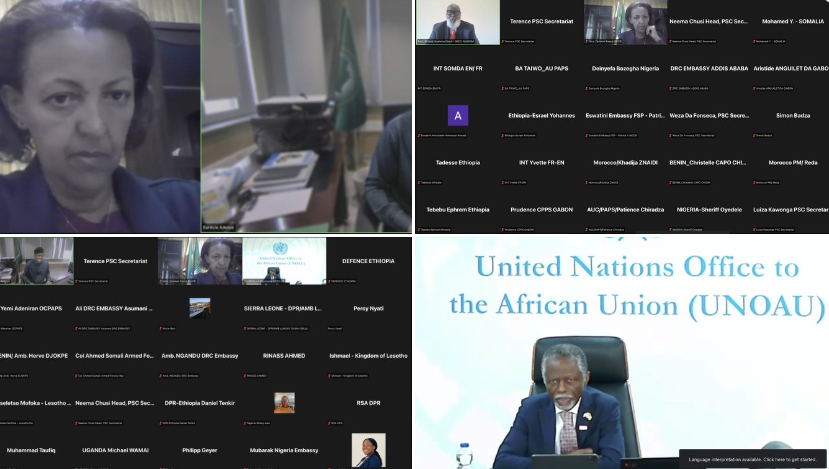
Politically and strategically, the slow pace of mobilisation and deployment of Somali security forces has been the centre of major concern. When the summit of troop-contributing countries (TCCs) was held in Kampala in April 2025, this led the summit to propose the TCCs plus Somalia Peer Review Mechanism as an oversight, accountability, coordination, monitoring and evaluation of AUSSOM and the Somalia Security and Development Plan. However, this proposal was left out of the final outcome of the summit due to opposition from Somalia.
This persisting lack of the requisite progress in organizing, building and deploying security capability for taking over responsibility led the PSC at its 1342nd session to once again urge the government ‘to enhance force generation, regeneration and capacity building, including the recruitment of Community/ Local Defence Forces (LDFs), and mobile forces to hold areas, and undertake operations as part of the clear, hold and build strategy, so as to preserve the gains made and as an overarching factor to inform the exit strategy.’ Recognising the inadequacies on the part of Somalia in holding areas liberated from Al Shabaab, the PSC additionally urged the Government ‘to support effective stabilisation programs in the areas liberated from Al Shabaab…as well as the establishment of effective state institutions.’
These issues correspond with the explanations the US gave for its position that the USAU communicated to the AU in its letter of 1 July 2026. The US stated that ‘[d]espite more than a decade of international support, Somalia has been unable to sustain progress against al-Shabaab, take ownership of its security functions, or undertake serious security sector reform.’ It went on to state that ‘[i]nternal rivalries and political infighting continue to undermine the fight against al-Shabaab and ISIS, and the benefits of international support will remain limited until Somalia’s leaders unite to address the country’s security and governance challenges.’
The options for AUSSOM policy makers
It is anticipated that the letter from the US could trigger the convening of an urgent meeting of the TCCs and the PSC. On 3 July, AU’s Peace Support Operations Division (PSOD) convened ‘an information briefing’ for the Defence Attachés of the TCCs and Police Contributing Countries (PCCs) of AUSSOM.
Ironically, the US letter may end up being the catalyst for the implementation of the call that the PSC made including during its 1342nd session ‘for the Commission to urgently convene a meeting of the AUSSOM TCCs/PCCs at the level of Chiefs of Defence Forces, to discuss on the proposed three options, including their implications on the sustainability of AUSSOM and its operations; and to submit detailed report with their recommendations for Council’s consideration.’ However, the new dynamics that the US letter introduced are sure to necessitate the updating of the options prepared in 2025.
In terms of the next course of actions, the first of the steps that could be taken is to develop a contingency plan for an orderly exit of AUSSOM. The remaining six months should provide the window that the AU could use for revising and implementing the exit plan of the mission.
To avoid major reversal of the gains secured by AU operations, the AU along with the UN and TCCs/PCCs as well as host country would need to develop a plan for a short transitional arrangement of providing security support beyond December 2026. Parallel to that, consideration should be given to enable Somalia in how to leverage the growing bilateral support from countries such as Turkey that Somalia has come to rely on more heavily (see here and here) for filling in some of the vacuum that the departure of AUSSOM may induce. This is also likely to include mobilisation of support for the sustenance and possible expansion by some of the TCCs of AUSSOM of their bilateral deployment.
However, such a shift from a multilateral to a bilateral arrangement would not resolve the fundamental issues that inhibited the translation of the security gains that the AUSSOM and its predecessor missions secured into strategic success in Somalia.
Thus, beyond managing the consequences of the end of UNSOS, the notice that the US gave could be used as an opportunity for the much-needed shift of the primary focus of AU support to be on the primacy of politics in the search for resolving the crisis in Somalia. This would mean adopting as part of the existing plan a strategy for transitioning AUSSOM into a political mission in the same way the AU transitioned its mission in Mali into the AU Mission in Mali and the Sahel (MISAHL).
While the US plan to unplug UNSOS would cripple AUSSOM and induce a short-term policy crisis, paradoxically, it may also end up being the catalyst for ending the complacency and opening up space for putting in place a workable peace plan that both commands the firm support and commitment of various Somali political and social forces and ensures the sustained and well-paced mobilisation and deployment of national security forces for taking over security responsibility. Indeed, such a shift, along with the prioritisation of political strategy, may induce Somalia’s political and social forces to extend far greater support for and invest more resolutely in prioritising national reconciliation and inclusive political settlement than advancing partisan self-interest, thereby perpetually outsourcing national responsibility.