
AU’s rejection of Macky Sall’s UN Secretary-General candidacy is a win for Africa’s diplomacy and warrants withdrawal of the candidacy
AU’s rejection of Macky Sall’s UN Secretary-General candidacy is a win for Africa’s diplomacy and warrants withdrawal of the candidacy
Date | 8 April 2026
Solomon Ayele Dersso, PhD, Founding Director, Amani Africa
The candidacy of former Senegalese President Macky Sall for the top United Nations (UN) job has unleashed enormous controversy both in his homeland and at continental level since Burundi, the 2026 Chairperson of the African Union (AU), submitted his name as a candidate to the UN on 2 March 2026.
This issue almost plunged Africa and the AU into a major diplomatic and institutional crisis.
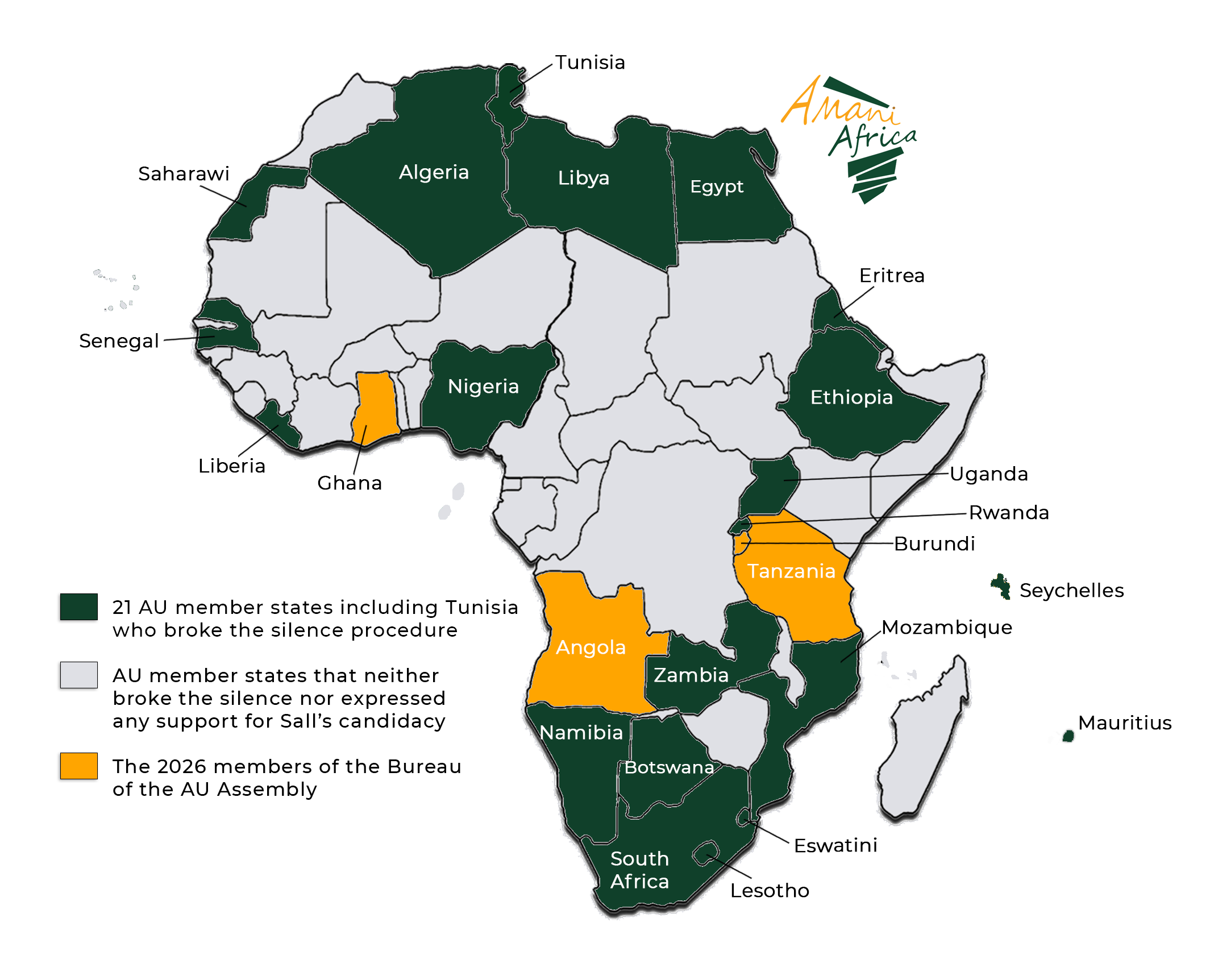
In a development that raised serious questions about the scope of discretion of the Chairperson of the AU and the Bureau and after reports claiming AU support for Sall’s candidacy were exposed, At the behest of Burundi in its capacity as AU Chairperson, the Bureau of the AU Assembly (made up of Burundi, Ghana, Tanzania and Angola, minus a North African representative yet to be agreed by the region) convened on 26 March 2026 to consider the proposal for endorsement of the candidacy of Sall through a silent procedure outside of AU’s established process for on candidatures. At the bureau meeting, two out of four members of the Bureau, including Burundi, reportedly supported the motion. One member reportedly did not participate. The lack of objection meant that Burundi’s motion to table a draft decision of endorsement for AU member states carried the day.
As a follow-up to the Bureau meeting and under the direction of Burundi’s President as AU Chairperson, the AU Commission sent out a letter on the same day, 26 March, addressed to AU Member States carrying a draft decision for endorsing Sall’s candidacy. The letter, referencing Rule 19(1) of the Rules of Procedure of the Assembly on decision-making by consensus or by two-thirds majority, presented the draft decision for adoption through a silent procedure. The letter offered no explanation as to why the established process of considering candidatures through the Ministerial Committee on African Candidatures within the International System on the basis of the AU Executive Council decision EX.CL/213(VIII) was circumvented. Neither was there any compelling reason for displacing the role of the Ministerial Committee nor any consultation that established that AU member states are disposed to support Sall’s candidature and outside of the regular process. Additionally, in an unprecedented departure from established practice, the letter gave AU member states only 24 hours to communicate their views. Also unprecedentedly, it set a threshold of one-third of member states to breaking the silence for the draft decision to be considered as not adopted.
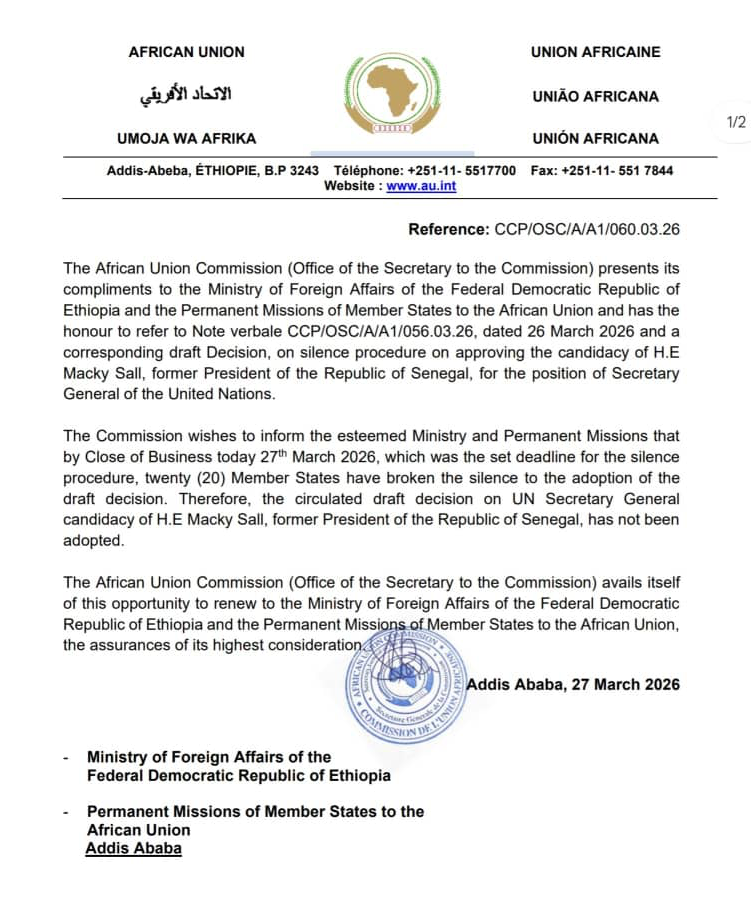
By the close of business on Friday, 27 March, 20 AU member states, representing more than the unprecedently high threshold of 1/3rd majority, broke the silence. The total number of countries that broke the silence increased to 21 after receipt of a communication from Tunisia apparently after close of business on the same day. As a result, the AU Commission stated, in a letter dated 27 March, that the draft decision ‘on UN Secretary General candidacy of H.E. Macky Sall…has not been adopted.’ The fact that more than 1/3rd of AU members broke the silence within the very tight (less than) 24hrs time limit highlighted the resolve of AU member states to avert the institutional crisis the situation posed.
‘Gross breach of AU rules’ and ‘jettisoning of …established practice’ of regional rotation
Both substantive and procedural irregularities led to this outcome. First and substantively, the draft decision would have led to the flouting of the AU’s rules and regular processes on the endorsement of African candidatures in the international system. Not surprisingly, member states that broke the silence, including South Africa, thus observed that ‘the established rules…for submission of States Candidacies appear to have been bypassed.’ This outcome also reflected concerns about the lack of transparency and due process, which are guaranteed under the AU Ministerial Committee on Candidatures. Thus, for Nigeria, as stated in its letter responding to the AU Commission letter of 26 March, the proposal to present Sall as an AU consensus candidate came ‘as a surprise as the candidate is being fielded for such a coveted position…without subjecting it to the scrutiny of the Ministerial Committee of the African Union.’ Rwanda’s Minister of Foreign Affairs went further and stated that ‘a direct rush to a 24-hour “silence procedure”, through which the AU Chairperson would wish to force a 2/3 “silent” majority endorsing his solo and irregular decision, without any attempt to seek an open discussion and a consensus on the African candidate for the position of UNSG, is also a gross breach of AU rules and regulations.’
Second, and procedure-wise, unless the plan was to constrain member states, there was no justification for limiting the timeline for the silence procedure to 24 hours rather than the established standard of at least 48 to 72 hours. Burundi’s Permanent Representative publicly acknowledged that the AU Legal Counsel and the Secretariat objected to the 24-hour timeline. Yet their objection was apparently overruled despite there being no compelling reason for not heeding the opinion of the Legal Counsel and the AU Commission, who are duty-bound to defend and ensure respect for established AU rules and processes. Additionally, as pointed out in the letter by South Africa, ‘the standard practice is that silence procedure is broken if one or more members raise an objection within the designated timeline.’ South Africa’s letter thus held that the requirement that silence can only be broken by one-third of the majority ‘is not standard practice within the international system.’
Third, there is an established, albeit legally non-binding, informal rule and practice of regional rotation that allows alteration of the position of the Secretary-General to candidates from various regional groups of the world. According to this rule and practice, the turn for taking the position of the Secretary-General is for a candidate from the Latin America and Caribbean group. As pointed out in Nigeria’s response, ‘…Africa considers the Caribbean as the sixth region of the continent. By jettisoning this established practice (of regional rotation), the Federal Republic of Nigeria believes the African Union is putting its position and interest in jeopardy now and in the future.’
It is worth noting that the 21 March Declaration of the summit of Community of Latin America and Caribbean States (CELAC), with whom Africa held the first joint high-level forum co-chaired by Burundi and Colombia on the same day committing to strengthen ties between the two regions, affirmed that ‘the time has come for a national of Latin America and the Caribbean to assume the responsibility of holding the position of Secretary- General of the United Nations, in accordance with the principle of equitable geographical balance and diversity in the leadership of the Organization.’ Under the circumstances, let alone endorsement by AU member states Sall’s candidacy on its own undermines the spirit of the CELAC-Africa high-level forum and South-South cooperation as well as the principle of regional rotation. This is never in the interest of Africa, as it will be the turn of the Africa group for the next round of the election of the Secretary-General.
A win for Africa and AU’s institutional stability
The outcome rejecting the proposed endorsement by AU of Sall’s candidacy is a major win for Africa’s diplomacy and AU’s established rules and processes. It prevented the emergence of an unjustifiable precedent that would have scuttled established AU rules and processes on the consideration and endorsement of candidates for leadership positions within the UN and the international system writ large.
Through this decision, AU member states saved from collapse the most important diplomatic device that was in place since the time of the Organisation of African Unity and served Africa well in putting Africans in leadership roles within the international system, including such important UN agencies as WTO, WHO, ILO and UNESCO.
Equally important is the rejection of the draft decision that saved Africa from breaching the informal rule of regional rotation, hence from undermining its own ‘current and future’ interests.
No –the silence of the rest of the AU members is not a signifier of support for Sall
Despite the collapse of the proposal for AU endorsement and Africa’s interests at stake, Sall’s candidacy and campaign continue to be imbued with misinformation and deceitful propaganda. Indeed, Sall’s campaign is doubling down on the claim of having wide support from AU member states, arguing that only a minority of countries registered their objection. Yet, the claim that ‘the silence’ of those who did not respond to the silence procedure is a signifier of wide support for Sall could not be far from the truth. First, even Senegal, from where Sall hails, distanced itself from his candidacy. Second, if Sall was confident about the support from this ‘silent’ majority, he would have subjected his candidacy to the scrutiny of the AU Ministerial Committee.
Despite the fact that the planning for his candidacy started in 2025 and he had the possibility of even having his candidacy considered during the AU summit in February 2026, he did not opt for it. There was no other reason for opting for an irregular and rules upending route for securing AU support other than Sall’s fear that he would not succeed in securing the support of the so-called ‘silent’ majority that his supporters claim he continues to enjoy even after the rejection of his endorsement by the AU.
Honourable path – Withdrawal of Sall’s candidacy
These dynamics, together with the candidacy’s ethically questionable practices involving both misinformation and the bending or circumventing of AU rules and established multilateral practice of particular interest for Africa warrant the reconsideration of the continuation of the candidacy. As chairperson of the AU and the country that sponsored the candidacy, Burundi has a responsibility to take a lead in this regard for reaffirming respect for established AU rules and the practice of regional rotation. In view of all the foregoing and the fact that the next round in the regional rotation for the position of the Secretary-General is for Africa, it is incumbent on Burundi, as Chairperson of the AU, to reconsider its stance and press on Sall that the most honourable path is to withdraw his candidacy. Burundi supported him to the point of leveraging its role as Chairperson. And it stumbled but not irredeemably. By reconsidering Sall’s candidacy, it can restore the erosion of its credibility as AU Chairperson and safeguard Africa’s collective interests, including the multilateral norm of regional rotation.

Consideration of the situation in the Central African Republic
Consideration of the situation in the Central African Republic
Date | 8 April 2026
Tomorrow (9 April), the African Union (AU) Peace and Security Council (PSC) will convene to receive a briefing on the situation in the Central African Republic (CAR).
The session will start with the opening remarks of Hirut Zemene, Permanent Representative of the Federal Democratic Republic of Ethiopia to the AU and Chair of the PSC for April 2026. It will be followed by a statement from Bankole Adeoye, Commissioner for Political Affairs, Peace and Security (PAPS). It is also anticipated that the Special Representative of the AU Commission Chairperson will brief the PSC. The representatives of the CAR, as the country concerned, the Economic Community of Central African States (ECCAS), as the concerned Regional Economic Community/Regional Mechanism, and the UN are also expected to deliver statements.
This session is convened for the first time since the country held presidential, parliamentary and local elections in December 2025. The last time the AU PSC met to discuss the situation in the CAR was on 19 September, in which it took note of the preparations for the harmonised elections and requested the chairperson of the Commission to mobilise the necessary resources to facilitate the completion of the electoral processes.
The December 2025 elections marked a major milestone in the quest for institutional and political consolidation in the CAR. The elections brought together four elections, including the presidential. parliamentary and regional elections in a single electoral process, unprecedented in the recent history of the country. It also included the municipal elections, a key component of the 2019 Political Agreement for Peace and Reconciliation-Central African Republic (APPR-RCA), that took place in the country for the first time since 1988. While reflective of progress registered in the CAR, the organisation and conduct of the elections also benefited from support by MINUSCA. The support involved the transportation of electoral materials to various parts of the country through flights and road convoys, the training of election agents, supervisors and polling station staff and security assistance through strengthened patrols by MINUSCA personnel and provision of vehicles and motorcycles to CAR forces and security personnel.
On 5 January, the National Elections Authority (ANE) announced the results of the presidential election, with incumbent President Faustin-Archange Touadéra winning approximately 76 per cent of the vote. He was widely expected to secure a third term following the controversial 2023 constitutional referendum that removed presidential term limits. The results were subsequently certified by the Constitutional Court on 19 January. The Chairperson of the AU Commission, Mahmoud Ali Youssouf, congratulated Touadéra on his re-election. Touadéra was sworn in for his third term at an inauguration ceremony held in Bangui on 30 March, in the presence of regional leaders, with the AU Commission Chairperson represented by the Chief of Staff of the Commission Souef Mohamed El-Amine. Under the country’s new constitution, the presidential term lasts seven years.
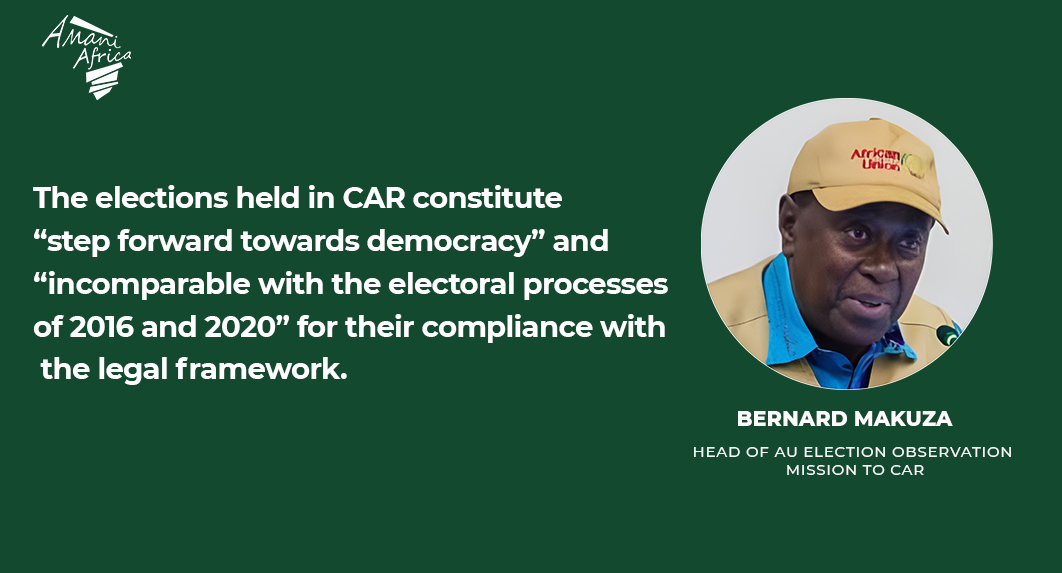
According to the AU, which deployed its observers under the leadership of Rwanda’s former Prime Minister Bernard Makuza, the elections were conducted peacefully overall, with the exception of the Haut-Mbomou prefecture in the southeast, where the security situation has remained precarious largely due to attacks from the Azande Ani Kpi Gbe (AAKG) militia accused of serious human rights violations. The militia carried out attacks against local security forces, state officials, soldiers and police, including on election day. Makuza praised the election both as a ‘step forward towards democracy’ and ‘incomparable with the electoral processes of 2016 and 2020’ for its compliance with the legal framework. The ECCAS also issued a statement supporting the AU’s observations, while noting some logistical challenges and issues related to inclusion in the electoral processes. Similarly, the Special Representative of the Secretary-General and head of the UN Mission in CAR, MINUSCA, Valentine Rugwabiza, told the UN Security Council that elections were conducted ‘in a peaceful and secure manner across most of the country, despite isolated security incidents.’
However, two other presidential candidates challenged the outcome, alleging electoral irregularities. The main opposition coalition, the Bloc Républicain pour la Défense de la Constitution du 30 mars 2016 (BRDC), boycotted the electoral process, citing concerns about its credibility and fairness. It also issued a 12 January statement making similar allegations about the conduct of the elections and calling for dialogue to ease political tensions. Voter turnout was around 52%, reflecting mixed public engagement amid ongoing instability, even as the election technically proceeded peacefully and without widespread unrest reported.
On 8 January, ANE released provisional results for the first round of legislative elections for 140 seats in the National Assembly, with 74 candidates elected. The ruling party, the United Heart Movement (MCU), won the largest share of seats and is expected to secure a majority. The second round of legislative elections for the remaining seats was held on 5 April. On 18 January, ANE also released provisional results for the local elections, with by-elections expected in areas where voting could not take place due to insecurity or a lack of candidates. The holding of these elections is expected to help consolidate peace by supporting the extension of state authority across the country.
Tomorrow’s session is also expected to pay attention to the implementation of the APPR-RCA. The combined elections took place against the backdrop of progress in implementing the 2019 APPR-RCA. In April 2025, two-armed groups—the Retour, Réclamation et Réhabilitation (3R) and the Unité pour la paix en Centrafrique (UPC)—agreed to cease hostilities and rejoin the APPR-RCA, initiating the disarmament and demobilisation of their former combatants. According to the UN, 1,202 former combatants have been disarmed and demobilised since July 2025, bringing the total number of demobilised ex-combatants to 6,000 since the agreement was signed. On 10 July, the CAR government held a meeting in Bangui to mark the official return of 3R and UPC to the APPR-RCA. The event was attended by leaders of both armed groups and a high-level delegation from Chad, which had facilitated the April agreement between the government and the two groups.
The situation in CAR highlights the need for enhanced high-level political attention and international support for sustaining the momentum in the implementation of APPR-RCA. Most specifically, there is a particular need for elevated political commitment and resource provision, as well as well-organised sustainment of the disarmament and demobilisation process, which is critical to prevent relapse back to conflict. Relatedly, consolidating security gains requires high-level political commitment and support for security sector reform in the CAR. For all of these, the contribution of MINUSCA and increased high-level engagement of the AU would be critical.
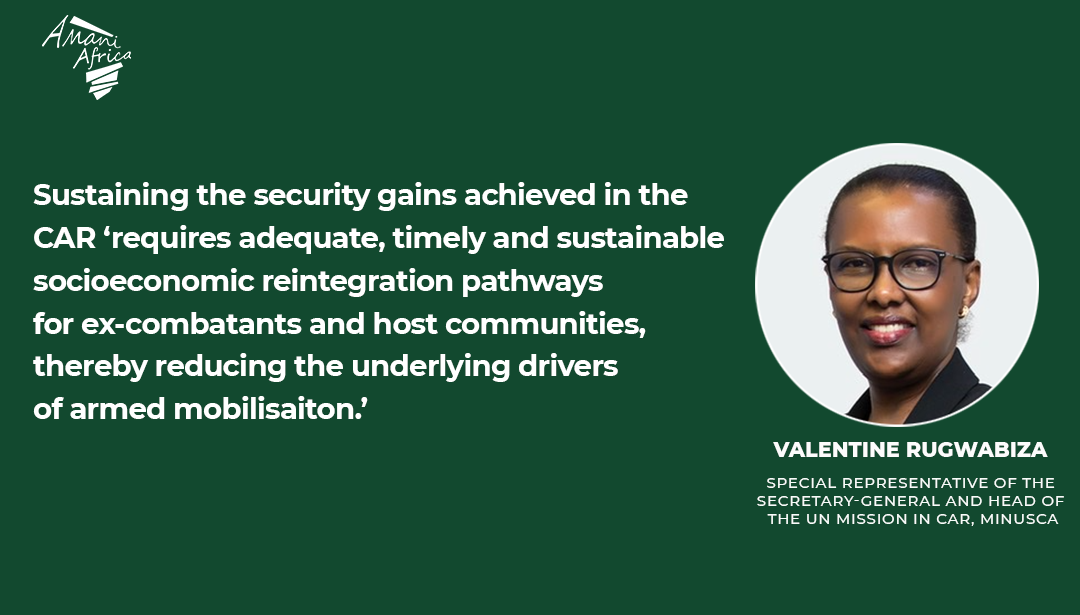
Despite a noticeable decline in security incidents that the country experienced following the cessation of hostilities by these two armed groups, insecurity persists in some parts of the country. Indeed, during the election, attacks by the AAKG militia in the south-eastern Haut-Mbomou prefecture near the border with South Sudan prevented voting from taking place in the locality. Insecurity is also driven by armed group activities around mining sites and transhumance corridors, as well as cross-border incursions along the borders with Sudan and South Sudan. Particularly, the ongoing conflict in Sudan has affected the CAR, causing increased insecurity in border regions and exacerbating the country’s humanitarian situation through the influx of refugees.
The CAR continues to face serious economic challenges, including large budget deficits and a heavy debt burden. In response, the government has launched an ambitious National Development Plan (2024–2028) aimed at rebuilding the country after decades of conflict. The plan focuses on rehabilitating roads and energy infrastructure, improving healthcare and education, and promoting agricultural and digital transformation to reduce poverty. At an investment roundtable held in Casablanca, Morocco, in September 2025, the CAR government reportedly mobilised nearly $9 billion to support the implementation of the plan.
The expected outcome of the session is a communique. It is expected that the PSC may welcome the ‘peaceful’ and ‘orderly’ conduct and conclusion of the four levels of elections held in CAR as marking a major milestone in the consolidation of peace and the strengthening of the legitimacy of the state and its authority. The PSC may commend MINUSCA for its support for the electoral process and the implementation of the APPR-RCA. The PSC may encourage political organisations disaffected with the elections to resolve any grievances through peaceful means, including dialogue and legal recourse. It may welcome the progress in the peace process and the disarmament and demobilisation of former combatants and encourage other non-signatory armed groups to join the APPR-RCA and the DDR process. It may also encourage the CAR authorities to sustain political support and ensure high-level commitment to the SSR involving the security sector and the implementation of the DDR process in a well-organised and coordinated way, with the provision of all the support for those engaging in the DDR process as a critical step to prevent relapse. In light of the pressure from the influx of refugees from Sudan, the PSC may reiterate its call for urgent humanitarian assistance to address needs on the ground. It may also welcome the National Development Plan and the funds mobilised during the investment roundtable held in Morocco. PSC may also reiterate calls for international financial institutions to provide debt relief to CAR.
Open Session on Hate Crimes and Fighting Genocide Ideology in Africa
Open Session on Hate Crimes and Fighting Genocide Ideology in Africa
Date | 7 April 2026
Tomorrow (8 April), the African Union (AU) Peace and Security Council (PSC) will convene its 1337th session as an open session to deliberate on Hate Crimes and Fighting Genocide Ideology in Africa.
Following opening remarks by Hirut Zemene, Permanent Representative of the Federal Democratic Republic of Ethiopia to the AU and Chair of the PSC for April 2026, Bankole Adeoye, Commissioner for Political Affairs, Peace and Security (PAPS), is expected to make a statement. Presentations are expected from Adama Dieng, AU Special Envoy for the Prevention of Genocide and other Mass Atrocities, a Representative of the Republic of Rwanda and the Special Adviser of the UN Secretary-General on the Prevention of Genocide.
The session is being convened pursuant to the PSC decision adopted at its 678th meeting of 11 April 2017, which decided to hold an annual session on the prevention of hate ideology, genocide and hate crimes in Africa in the context of the commemoration of the 1994 genocide against the Tutsi in Rwanda. It also forms part of the AU’s annual commemoration of the 1994 Genocide against the Tutsi in Rwanda, following Assembly Decision Assembly/AU/Dec.695 of 2 July 2018, designating 7 April as the AU Day of Commemoration. This year marks the 32nd commemoration of the 1994 genocide. Coming amid mounting atrocity risks in several conflict settings, this year’s session may be shaped not only by remembrance but also by a sharper focus on prevention.
It is to be recalled that the last session of the Council on this theme at its 1272nd session called on member states to put in place legislative and institutional measures to prevent hate ideology, hate crimes and genocide, to confront genocide denialism and urged improved collection of data on hate crimes including through strengthening of the cyber capabilities of the Continental Early Warning System (CEWS). In addition to encouraging collaboration with digital platforms, the media and civil society to counter content that incites hatred and violence, it also called for the establishment of a continental research centre on hate speech and genocide ideology. Yet many of the priorities identified in that session remain unfinished, and events observed in some conflict situations underscore the urgency of some of the measures.
Among the key unfinished items is also the long-pending review by the Panel of the Wise on the status of implementation of the recommendations issued by the OAU International Panel of Eminent Personalities to investigate the 1994 genocide in Rwanda and the surrounding events. This review carries particular weight given the enduring relevance of the Panel’s own warning that, ‘if there is anything worse than the genocide itself, it is the knowledge that it did not have to happen.’ That conclusion speaks to a central lesson of the 1994 Genocide: the atrocity was not inevitable, but was enabled in part by the failure of both African and international actors to act preventively before the violence escalated and to stop it once it was underway. It was precisely in response to that failure that, during the transition from the OAU to the AU, Africa’s continental body departed from a rigid reliance on non-interference and instead anchored itself in the principle of non-indifference, as reflected in Article 4(h) of the Constitutive Act. In this respect, the memory of Rwanda is not merely historical; it is bound up with the very normative and institutional foundation of the AU. The issue is equally salient for the PSC, particularly in light of Article 7 of its Protocol, which mandates the Council ‘to anticipate and prevent disputes and conflicts, as well as policies that may lead to genocide and crimes against humanity.’
The fight against genocide ideology, together with the observance of the commemoration of the 1994 genocide, is also about reaffirming a collective responsibility to the promise of ‘never again’ and the principle of non-indifference. Indeed, remembrance was not just about paying respect to the victims and survivors, but an occasion to renew commitment to prevention. In that context, Dieng underscored that when honouring the victims of the genocide against the Tutsi, ‘we should be looking back, but we should also be looking forward,’ since ‘the commitment not to forget and the commitment to prevent are two sides of the same coin.’ Developments over the past year, and the realities still unfolding today, have only reinforced the urgency of that message.
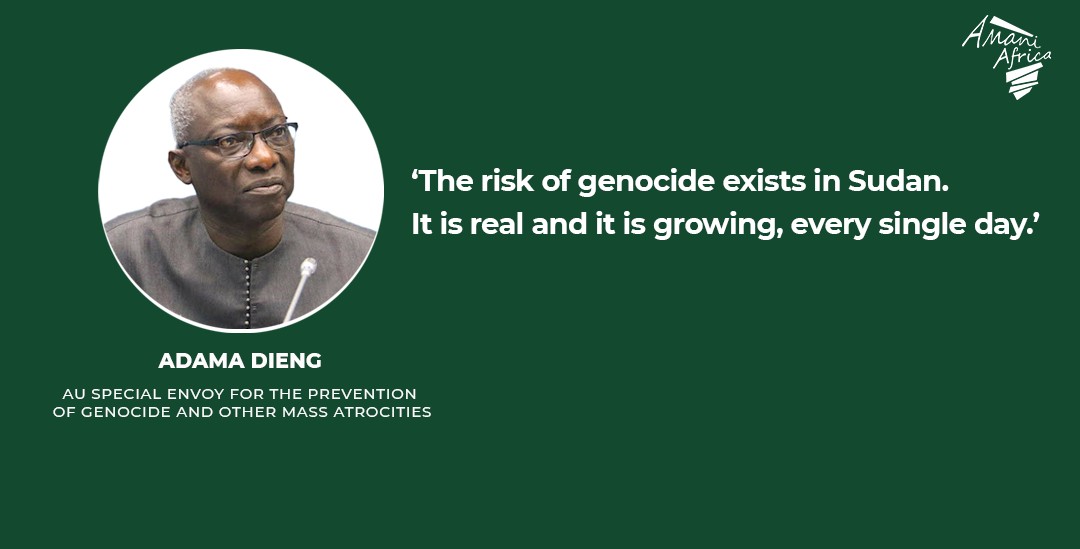
Most notable in this respect is the situation in Sudan. In April 2025, amid rising hate speech and ethnically driven violence in Darfur, the UN Fact-Finding Mission warned that the ‘darkest chapters’ of the conflict may still lie ahead. By February 2026, the same Mission found that the Rapid Support Force (RSF) had carried out a coordinated campaign of destruction against non-Arab communities in and around El Fasher, the hallmarks of which point to genocide. At the Human Rights Council’s 38th Special Session on the situation in and around El Fasher in November 2025, Adama Dieng, presenting a joint statement also on behalf of Mr Chaloka Beyani, UN Special Adviser on the Prevention of Genocide, stressed that ‘the risk of genocide exists in Sudan. It is real, and it is growing, every single day.’ The African Commission on Human and Peoples’ Rights (ACHPR)-led joint fact-finding mission report further underscores Sudan’s relevance to the upcoming PSC session. It documents racially and ethnically motivated violence, including attacks on non-Arab communities such as the Massalit, Fur and Zaghawa, as well as hate speech, incitement and patterns of abuse that may amount to genocide, crimes against humanity and war crimes. For the PSC, Sudan thus stands as the clearest contemporary illustration of the cost of failing to translate early warning into timely political and protective action.
There are also concerns over the Democratic Republic of the Congo (DRC), where the nexus between armed conflict, identity-based mobilisation and hate speech has become increasingly pronounced. By September 2025, the UN Human Rights Office warned that hate speech and ethnically motivated attacks had increased in Kinshasa and the Kasai provinces against people presumed to be associated with the M23. Human Rights Watch (here and here) has also documented the targeting of Banyamulenge communities and pointed to the growing salience of anti-Banyamulenge and anti-Tutsi sentiment within the broader conflict environment. Taken together, these developments illustrate how identity-based hostility, inflammatory rhetoric and communal targeting not only inflame the conflict but also make the resolution of the conflict in eastern DRC more difficult. It would therefore be of interest for PSC members to hear from Dieng on his assessment of the principal risk theatres on the continent and on the practical steps needed to ensure that the AU reverses the betrayal of its foundational promise of ‘never again’.
Beyond Sudan and eastern DRC, developments elsewhere on the continent show that the risks associated with hate speech, exclusionary narratives and identity-based targeting are neither confined to conventional conflict settings nor limited to active war zones. The digital sphere is emerging as an increasingly important risk domain, with Africa-focused analysis warning that artificial intelligence (AI)-generated disinformation, deepfakes and the amplification of hate speech are reshaping the continent’s information environment. A similar preventive concern arises in North Africa, including notably in Libya and Tunisia. In Libya, the UN envoy warned the Security Council of a surge in xenophobic and racist hate speech inciting violence against migrants, asylum-seekers, refugees and humanitarian organisations. In Tunisia, the forcible dismantling of camps housing sub-Saharan African migrants and the deportation of some of them revived concerns over racialised incitement. Taken together, these cases underscore the wider relevance of the upcoming session by showing that the danger posed by hate speech and identity-based hostility cuts across conflict, migration and digital spaces.
It is also expected that emphasis will be put on prevention through education and memory. In April 2025, UNESCO and Rwanda announced measures to strengthen the educational role of genocide memorial sites, including training staff to receive school groups, enhancing exhibitions, developing educational content for use in schools, digitising survivor testimonies and supporting social media campaigns to counter the falsification of historical facts and online misinformation about the Genocide against the Tutsi. During the AU’s 2025 commemoration, speakers similarly stressed the importance of the responsible use of media, both digital and non-digital, as well as AI and education, in preventing genocide and other mass atrocity crimes.
While not central to the immediate conflict-driven risk theatres likely to dominate the session, the UN General Assembly’s recent recognition of the transatlantic slave trade as the gravest crime against humanity carries wider normative relevance for the PSC’s discussion. It reinforces the importance of confronting the historical and contemporary legacies of racialised dehumanisation, denial and exclusion, and lends further weight to the view that remembrance, historical truth and accountability are integral to preventing hate-driven violence and atrocity crimes.
The expected outcome of the session is a communiqué. The PSC may reiterate its concern over the persistent spread of hate ideologies, genocide denialism and incitement to violence in Africa. It may renew its call for AU member states to adopt legislation and institutions for the prevention and punishment of hate crimes and genocide, and to cooperate in the investigation and prosecution of perpetrators. The Council may also call for accelerated follow-up on the strengthening of CEWS cyber capacity, the improvement of hate-crime data collection and the development of partnerships with digital platforms, the media and civil society. The Council may further urge greater attention to contemporary situations where genocide and atrocity risks are manifest, particularly in Darfur, Sudan. It may welcome the continued engagement of the AU Special Envoy, encourage closer collaboration with RECs/RMs, civil society, women and youth actors, and call for follow-up on the Continental Research Centre on Hate Speech and Genocide Ideology, the Panel of the Wise review, and the operational linkage between remembrance, education and prevention.
Open Session on Hate Crimes and Fighting Genocide Ideology in Africa
Open Session on Hate Crimes and Fighting Genocide Ideology in Africa
Date | 7 April 2026
Tomorrow (8 April), the African Union (AU) Peace and Security Council (PSC) will convene its 1337th session as an open session to deliberate on Hate Crimes and Fighting Genocide Ideology in Africa.
Following opening remarks by Hirut Zemene, Permanent Representative of the Federal Democratic Republic of Ethiopia to the AU and Chair of the PSC for April 2026, Bankole Adeoye, Commissioner for Political Affairs, Peace and Security (PAPS), is expected to make a statement. Presentations are expected from Adama Dieng, AU Special Envoy for the Prevention of Genocide and other Mass Atrocities, a Representative of the Republic of Rwanda and the Special Adviser of the UN Secretary-General on the Prevention of Genocide.
The session is being convened pursuant to the PSC decision adopted at its 678th meeting of 11 April 2017, which decided to hold an annual session on the prevention of hate ideology, genocide and hate crimes in Africa in the context of the commemoration of the 1994 genocide against the Tutsi in Rwanda. It also forms part of the AU’s annual commemoration of the 1994 Genocide against the Tutsi in Rwanda, following Assembly Decision Assembly/AU/Dec.695 of 2 July 2018, designating 7 April as the AU Day of Commemoration. This year marks the 32nd commemoration of the 1994 genocide. Coming amid mounting atrocity risks in several conflict settings, this year’s session may be shaped not only by remembrance but also by a sharper focus on prevention.
It is to be recalled that the last session of the Council on this theme at its 1272nd session called on member states to put in place legislative and institutional measures to prevent hate ideology, hate crimes and genocide, to confront genocide denialism and urged improved collection of data on hate crimes including through strengthening of the cyber capabilities of the Continental Early Warning System (CEWS). In addition to encouraging collaboration with digital platforms, the media and civil society to counter content that incites hatred and violence, it also called for the establishment of a continental research centre on hate speech and genocide ideology. Yet many of the priorities identified in that session remain unfinished, and events observed in some conflict situations underscore the urgency of some of the measures.
Among the key unfinished items is also the long-pending review by the Panel of the Wise on the status of implementation of the recommendations issued by the OAU International Panel of Eminent Personalities to investigate the 1994 genocide in Rwanda and the surrounding events. This review carries particular weight given the enduring relevance of the Panel’s own warning that, ‘if there is anything worse than the genocide itself, it is the knowledge that it did not have to happen.’ That conclusion speaks to a central lesson of the 1994 Genocide: the atrocity was not inevitable, but was enabled in part by the failure of both African and international actors to act preventively before the violence escalated and to stop it once it was underway. It was precisely in response to that failure that, during the transition from the OAU to the AU, Africa’s continental body departed from a rigid reliance on non-interference and instead anchored itself in the principle of non-indifference, as reflected in Article 4(h) of the Constitutive Act. In this respect, the memory of Rwanda is not merely historical; it is bound up with the very normative and institutional foundation of the AU. The issue is equally salient for the PSC, particularly in light of Article 7 of its Protocol, which mandates the Council ‘to anticipate and prevent disputes and conflicts, as well as policies that may lead to genocide and crimes against humanity.’
The fight against genocide ideology, together with the observance of the commemoration of the 1994 genocide, is also about reaffirming a collective responsibility to the promise of ‘never again’ and the principle of non-indifference. Indeed, remembrance was not just about paying respect to the victims and survivors, but an occasion to renew commitment to prevention. In that context, Dieng underscored that when honouring the victims of the genocide against the Tutsi, ‘we should be looking back, but we should also be looking forward,’ since ‘the commitment not to forget and the commitment to prevent are two sides of the same coin.’ Developments over the past year, and the realities still unfolding today, have only reinforced the urgency of that message.
Most notable in this respect is the situation in Sudan. In April 2025, amid rising hate speech and ethnically driven violence in Darfur, the UN Fact-Finding Mission warned that the ‘darkest chapters’ of the conflict may still lie ahead. By February 2026, the same Mission found that the Rapid Support Force (RSF) had carried out a coordinated campaign of destruction against non-Arab communities in and around El Fasher, the hallmarks of which point to genocide. At the Human Rights Council’s 38th Special Session on the situation in and around El Fasher in November 2025, Adama Dieng, presenting a joint statement also on behalf of Mr Chaloka Beyani, UN Special Adviser on the Prevention of Genocide, stressed that ‘the risk of genocide exists in Sudan. It is real, and it is growing, every single day.’ The African Commission on Human and Peoples’ Rights (ACHPR)-led joint fact-finding mission report further underscores Sudan’s relevance to the upcoming PSC session. It documents racially and ethnically motivated violence, including attacks on non-Arab communities such as the Massalit, Fur and Zaghawa, as well as hate speech, incitement and patterns of abuse that may amount to genocide, crimes against humanity and war crimes. For the PSC, Sudan thus stands as the clearest contemporary illustration of the cost of failing to translate early warning into timely political and protective action.
There are also concerns over the Democratic Republic of the Congo (DRC), where the nexus between armed conflict, identity-based mobilisation and hate speech has become increasingly pronounced. By September 2025, the UN Human Rights Office warned that hate speech and ethnically motivated attacks had increased in Kinshasa and the Kasai provinces against people presumed to be associated with the M23. Human Rights Watch (here and here) has also documented the targeting of Banyamulenge communities and pointed to the growing salience of anti-Banyamulenge and anti-Tutsi sentiment within the broader conflict environment. Taken together, these developments illustrate how identity-based hostility, inflammatory rhetoric and communal targeting not only inflame the conflict but also make the resolution of the conflict in eastern DRC more difficult. It would therefore be of interest for PSC members to hear from Dieng on his assessment of the principal risk theatres on the continent and on the practical steps needed to ensure that the AU reverses the betrayal of its foundational promise of ‘never again’.
Beyond Sudan and eastern DRC, developments elsewhere on the continent show that the risks associated with hate speech, exclusionary narratives and identity-based targeting are neither confined to conventional conflict settings nor limited to active war zones. The digital sphere is emerging as an increasingly important risk domain, with Africa-focused analysis warning that artificial intelligence (AI)-generated disinformation, deepfakes and the amplification of hate speech are reshaping the continent’s information environment. A similar preventive concern arises in North Africa, including notably in Libya and Tunisia. In Libya, the UN envoy warned the Security Council of a surge in xenophobic and racist hate speech inciting violence against migrants, asylum-seekers, refugees and humanitarian organisations. In Tunisia, the forcible dismantling of camps housing sub-Saharan African migrants and the deportation of some of them revived concerns over racialised incitement. Taken together, these cases underscore the wider relevance of the upcoming session by showing that the danger posed by hate speech and identity-based hostility cuts across conflict, migration and digital spaces.
It is also expected that emphasis will be put on prevention through education and memory. In April 2025, UNESCO and Rwanda announced measures to strengthen the educational role of genocide memorial sites, including training staff to receive school groups, enhancing exhibitions, developing educational content for use in schools, digitising survivor testimonies and supporting social media campaigns to counter the falsification of historical facts and online misinformation about the Genocide against the Tutsi. During the AU’s 2025 commemoration, speakers similarly stressed the importance of the responsible use of media, both digital and non-digital, as well as AI and education, in preventing genocide and other mass atrocity crimes.
While not central to the immediate conflict-driven risk theatres likely to dominate the session, the UN General Assembly’s recent recognition of the transatlantic slave trade as the gravest crime against humanity carries wider normative relevance for the PSC’s discussion. It reinforces the importance of confronting the historical and contemporary legacies of racialised dehumanisation, denial and exclusion, and lends further weight to the view that remembrance, historical truth and accountability are integral to preventing hate-driven violence and atrocity crimes.
The expected outcome of the session is a communiqué. The PSC may reiterate its concern over the persistent spread of hate ideologies, genocide denialism and incitement to violence in Africa. It may renew its call for AU member states to adopt legislation and institutions for the prevention and punishment of hate crimes and genocide, and to cooperate in the investigation and prosecution of perpetrators. The Council may also call for accelerated follow-up on the strengthening of CEWS cyber capacity, the improvement of hate-crime data collection and the development of partnerships with digital platforms, the media and civil society. The Council may further urge greater attention to contemporary situations where genocide and atrocity risks are manifest, particularly in Darfur, Sudan. It may welcome the continued engagement of the AU Special Envoy, encourage closer collaboration with RECs/RMs, civil society, women and youth actors, and call for follow-up on the Continental Research Centre on Hate Speech and Genocide Ideology, the Panel of the Wise review, and the operational linkage between remembrance, education and prevention.
Monthly Digest on The African Union Peace And Security Council - February 2026
Monthly Digest on The African Union Peace And Security Council - February 2026
Date | February 2026
In February, under the chairship of the Arab Republic of Egypt, the African Union (AU) Peace and Security Council (PSC) had a scheduled Provisional Programme of Work (PPoW) consisting of four substantive sessions, covering five agenda items. All four substantive sessions happened as planned, including two informal consultations.
Out of the four substantive sessions, one session, had two agenda items, focused on country-specific situations, while the rest addressed thematic issues. The two agenda items were the only sessions held at the ministerial level during the month, while the rest were conducted at the level of permanent representatives. It is also worth noting that, among all the sessions, only one was held in an open format.
Provisional Programme of Work of the Peace and Security Council for April 2026
Provisional Programme of Work of the Peace and Security Council for April 2026
Date | April 2026
In April, the Federal Democratic Republic of Ethiopia will assume the Chairship of the African Union (AU) Peace and Security Council (PSC). The Provisional Programme of Work (PPoW) for the month outlines five substantive sessions covering a total of six agenda items. With the exception of one session scheduled at the ministerial level, all meetings are expected to be convened at the ambassadorial level. Of the six agenda items, two are country-specific, while the remaining four focus on thematic issues. In addition to these sessions, the PSC is also expected to undertake a field mission to South Sudan and travel to Kuriftu for the 5th Annual Joint Retreat with the African Peer Review Mechanism (APRM).
On 8 April, the PSC will convene its first substantive open session on ‘Hate Crimes and the Fight Against Genocidal Ideology in Africa’, a meeting likely to be framed both as a standing thematic session and as a remembrance session taking place in close proximity to the AU’s annual commemoration of the Genocide against the Tutsi in Rwanda. Institutionalized as an annual open session since the PSC’s 678th session, this year’s discussion is expected to build on the outcome of the Council’s 1272nd session held on 2 April 2025, which emphasized accountability, the fight against impunity, stronger national legal and institutional frameworks for prevention, enhanced early warning including cyber monitoring of online disinformation, and closer cooperation with digital platforms, media, and civil society. It is recalled that the AU appointed Adama Dieng as the first AU Special Envoy for the Prevention of the Crime of Genocide and Other Mass Atrocities in April 2024.
On 9 April, the PSC will hold its second session on the situation in the Central African Republic, shifting from the pre-election focus of its 1302nd session of 19 September 2025 toward a post-election assessment. While its previous meeting noted progress in electoral preparations, encouraged continued political engagement and confidence-building, and expressed deep concern over the humanitarian situation driven by insecurity, the upcoming session is likely to assess the aftermath of the polls. The confirmation of President Faustin-Archange Touadéra’s victory in January 2026 came amid opposition allegations of fraud. It may also be noted that the December polls, described by the UN as the ‘most extensive electoral operation’ ever undertaken in CAR and including the first municipal elections since 1988, marked an important political milestone, though one whose gains remain fragile. Council is likely to examine the management of post-election grievances while considering the need for continued political dialogue and institutional support. On the security front, some reduction in fighting was registered during 2025 following ceasefire and disarmament steps involving Union for Peace in the Central African Republic (UPC) and Retour, Réclamation et Réhabilitation (3R). Yet, armed group activity, grave child-rights violations, attacks affecting civilians, and constraints on humanitarian access have persisted.
On 16 April, PSC is scheduled to convene a session on ‘Artificial Intelligence: Governance, Peace and Security in Africa’. On 20 March 2025, the PSC held its 1267th ministerial-level session on ‘Artificial Intelligence and its Impact on Peace and Security in Africa’, building on its earlier dedicated session (1214th) on the issue held on 13 June 2024. That initial session highlighted both the opportunities and risks associated with AI in peace and security contexts and tasked the AU Commission with undertaking a comprehensive study and proposing governance frameworks. The 1267th session further advanced these deliberations by proposing the mainstreaming of AI in peace support operations, early warning systems, and preventive diplomacy, while also calling for the development of an African Common Position on AI and an African Charter on AI to guide its responsible use. Some progress has since been made in implementing these decisions, notably through the establishment of the AU AI Advisory Group on Governance, Peace and Security. In December 2025, the Advisory Group convened in Nairobi, Kenya, to discuss its future plans, including the development of a Common African Position on AI, and to deliberate on emerging AI trends, opportunities, and risks in Africa, as well as their implications for governance, conflict prevention, and stability. Additionally, the Strategic Assessment and Review of the Continental Early Warning System, held in November 2025 in Kigali, Rwanda, resulted in the adoption of a joint AU–RECs/RMs Roadmap to integrate AI into early warning processes. It is expected that the upcoming session will build on and further expand the PSC’s consideration of AI and governance, as well as peace and security in Africa. Following this session, the PSC is scheduled to undertake a field visit on 18 April to the Ethiopian AI Institute and the Science and Technology Museum.
On 20 April, the Council will convene for a briefing by the A3 on its activities. Since 1 January 2026, the DRC and Liberia have joined Somalia as part of the United Nations Security Council’s African members (A3) for the 2026 – 2027 period. The briefing is happening in line with longstanding commitments to strengthen coordination between the AU and the UNSC. This engagement originates from the first conclusion of the High-Level Seminar (HLS) on peace and security in Africa held in Algiers in December 2013, which established that the A3 would provide quarterly briefings to the PSC on African issues on the UNSC agenda. This commitment was later reaffirmed during the 11th Oran Process in 2024 and was subsequently reaffirmed during the 11th Oran Process in 2024 and further institutionalised through the adoption of the Manual on the Modalities for Enhancing Coordination between the PSC and the A3 at the PSC’s 1289th session on 24 July 2025, formalising requirements for regular reporting and structured engagement. In this context, the A3 are expected to brief the Council on their coordinated engagements in the UNSC over the past quarter, including efforts to harmonise positions, deliver joint statements, and assume a more assertive role within the UNSC, including as penholders or co-penholders on African files. The session is also likely to assess how effectively the A3 have navigated UNSC dynamics to influence deliberations and outcomes on key situations such as the Democratic Republic of Congo, Sudan, and the Sahel.
Before convening its final session for the month, the PSC is scheduled to undertake a field mission to South Sudan from 23 to 25 April. This will mark the Council’s second visit since the renewed escalation of political and security tensions that continue to threaten the already fragile gains of the Revitalised Agreement on the Resolution of the Conflict in South Sudan (R-ARCSS). The mission comes at a critical juncture, as the country moves, under very tense security conditions, towards the planned elections in December 2026, amid persistent delays in implementing key provisions of the peace agreement, including transitional security arrangements, constitutional-making, and the unification of forces. Against this backdrop, the visit is expected to provide the PSC with an opportunity to directly engage with national stakeholders on the state of the transition, press on follow-up to its decisions, including the release of political prisoners and the return to political dialogue, and explore avenues for rebuilding trust among the parties.
The final session of the month, scheduled for 27 April, will consider two agenda items. The first will be addressed in an open session dedicated to deliberations on Peace Support Operations (PSOs) in Africa. Building on its previous engagements, the Council is expected to provide the PSC with an opportunity to take stock of ongoing deliberations on the future, effectiveness, and sustainability of AU-led and AU-mandated PSOs. In particular, the Council is likely to reflect on the shifting landscape in which these operations are deployed, including increasingly complex conflict environments, the rise of asymmetric threats, and the impact of evolving geopolitical dynamics on multilateral peace operations. It is expected that the session will reflect on how to reposition and repurpose AU-led peace operations in light of changing realities in terms of models, funding, and political legitimacy. The session is also anticipated to draw on emerging insights from the independent study on the future of peacekeeping commissioned by the UN Department of Peace Operations, with a view to distilling lessons relevant to the African context, particularly regarding mandate design, adaptability, partnerships, and the protection of civilians. However, a central focus of the discussion will likely remain the perennial question of financing AU PSOs.
The second agenda item will focus on the Council’s consideration of its field mission report to South Sudan.
As the final activity of the month, the PSC is scheduled to convene its 5th Annual Joint Retreat with the African Peer Review Mechanism (APRM) on 29 and 30 April. It is recalled that, at its 1274th session, which considered the conclusions of the 4th Joint Retreat, the PSC requested the AU Commission and the APRM Continental Secretariat to ensure the implementation of the agreed conclusions and to report back at the subsequent retreat. This request builds on earlier decisions, including at the PSC’s 1191st session, where the Council called for the development of a matrix to track the implementation of past retreat outcomes for review and adoption. Against this backdrop, the upcoming retreat is expected to assess progress made in implementing previous conclusions and advance discussions on key priority areas, particularly early warning and conflict prevention.
Beyond the substantive sessions and activities, 7 April will feature the Flag Day ceremony for the newly elected members of the PSC, during which the flags of the newly constituted Council will be installed in the PSC Chamber. The ceremony will be accompanied by a briefing from the Chairperson of the African Union Commission (AUC), as well as an exhibition marking the International Day for Mine Awareness and Assistance in Mine Action. Commemorated annually on 4 April pursuant to United Nations General Assembly resolution A/RES/60/97 of 8 December 2005, the International Day for Mine Awareness and Assistance in Mine Action has been observed by the PSC through dedicated sessions since 2019.
Beyond Communiqués: Charting the path for making the PSC fit to restore AU's agency in peace & security
Beyond Communiqués: Charting the path for making the PSC fit to restore AU's agency in peace & security
Date | 30 March 2026
Solomon Ayele Dersso, PhD, Founding Director, Amani Africa
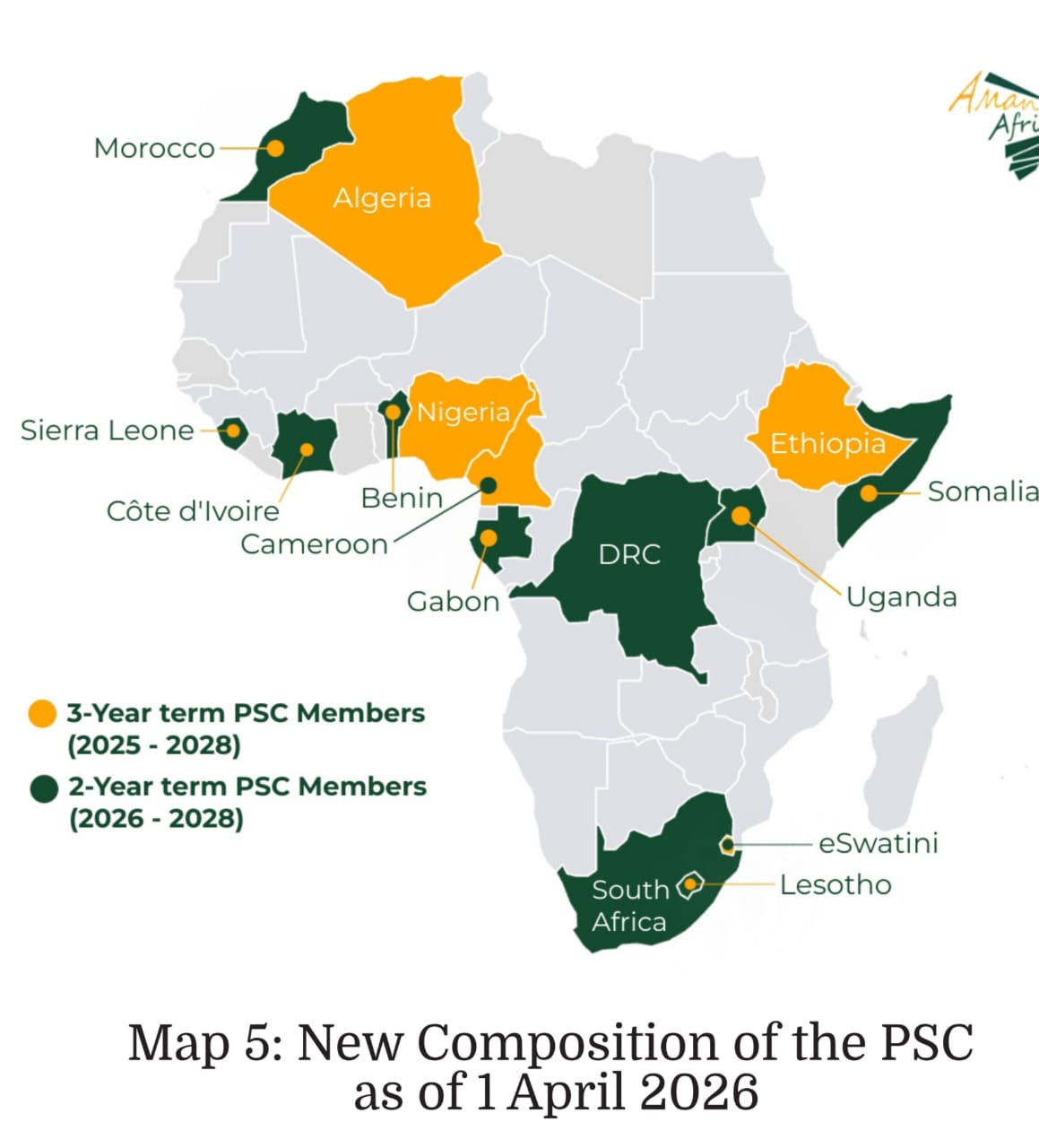
Ahead of the 1 April 2026, when the states elected during the 39th ordinary session of the African Union (AU) Assembly, including Somalia, which was elected for the first time, assume their seats in the Peace and Security Council (PSC), the AU is holding the induction of newly elected and returning members of the PSC in the Kingdom of Eswatini, starting today, 30 March 2026. In view of the expansion and entrenching of conflicts and crises on the continent and the need for a more effective role for the AU, a pressing issue for the newly constituted PSC is how to shift from the failing business-as-usual approach to its work and make itself fit for the peace and security needs of the continent in a time of major global shifts.
As extensively documented in, among others, the review of the PSC for 2025, the PSC did not garner a meaningful level of influence in either limiting the dynamics of conflicts on its agenda or in shaping peace processes relating to those conflict situations. As a result, the PSC and the AU are ignored or otherwise displaced. Such is the case in Sudan, South Sudan, the Sahel and the DRC. For example, the six sessions that the PSC held on Sudan were of no consequence either in avoiding the de facto partition of Sudan or in contributing to the emergence of a credible civilian process that the AU is meant to lead on. Even in terms of the mechanisms it decided to institute, neither the mechanisms for investigating external interference in Sudan nor the presidential committee came into operation. In DRC, AU’s role in advancing peace got displaced, with the Luanda process giving way to the Washington DC and Doha processes.
The declining effectiveness of the PSC mirrors a broader erosion of political commitment to continental collective security. It is also importantly a product of PSC’s work, becoming more performative than consequential, at times its engagement dominated by thematic issues and often no effective action on specific conflict situations. Poor agenda setting and the reduction of PSC activities into a routine ritual-like processes are among the factors that account for this state of affairs in which the dire conflict situations are not approached with the urgency and seriousness they deserve.
Making the PSC fit for purpose and relevant to the peace and security situation of the continent requires changing these conditions. The agenda setting of the PSC and the policy deliberation of the PSC should prioritise and deploy the limited diplomatic institutional resources exclusively for addressing existing conflicts and preventing the eruption of new ones. The PSC should thus have as a standing agenda on the most critical conflict situations, such as Sudan, South Sudan, the Sahel, DRC and Somalia at least, on a quarterly if not on a monthly basis, during which the AU Commission presents reports for adapting AU engagement to the rhythm and needs of the conflict dynamics.
In the interest of optimising its very finite resources and ensuring sustained engagement on addressing these priority conflict situations with resolve and impact, the PSC should also adopt a moratorium on having thematic issues on its agenda.
Further to the foregoing, the PSC should also use its sessions for substantive deliberations rather than the ritualistic process of making formulaic statements, issuing communiques and meeting again to repeat the same cycle. It is necessary for the PSC to review its working methods on its decision-making process for making it results-oriented rather than the current focus on output, involving the adoption of a communique for every meeting. Not every PSC meeting has to result in the adoption of a communique, but it provides a platform for building consensus and negotiating on actionable decisions, deliberating on advancing implementation and undertaking strategic review. It is also necessary that PSC members focus on negotiating and adopting actionable decisions as opposed to the declaratory ones that dominate outcomes of PSC deliberations. To this end, they should negotiate on the actionable decisions required to respond to new developments, either in the conflict situation or in the peace process relating to that conflict situation. They should also use such negotiation sessions for clarifying on the financial and institutional implications of such decisions as well as on the modalities of implementation and clear assignment of responsibility for implementation and timelines for reporting back on follow-up and implementation.
Additionally, the effectiveness of the PSC is also affected by the willingness and ability of its members to shoulder the responsibilities of PSC membership as set out in Article 5, particularly its sub-paragraph 2. The current approach to PSC membership that puts a premium on rotation to the detriment of Article 5(2) criteria is undermining the effectiveness of the Council. It has limited the PSC’s normative and political weight, creating an enormous gulf between PSC decisions and their effective follow-through.
A criteria-based approach is essential to the PSC’s credibility, ensuring members demonstrate commitment, diplomatic capacity, and adherence to AU norms, preventing deliberations from becoming mere symbolism. Eroded standards have also diminished peer accountability, fostering weak enforcement, selective engagement, and inconsistent follow-through, much like past consensus-driven arrangements lacking commitment. Restoring effectiveness demands recommitment to criteria-based membership rooted in political credibility, capacity, and norm respect, bolstering authority and collective responsibility.
Not any less important for the credibility and effectiveness of the PSC is the need to align its current posture and practice with the statement of commitment it adopted during its solemn launching in 2004. Of significance in this respect is the commitment that ‘we shall ensure that the authority vested in the Peace and Security Council is fairly and proactively exercised.’ (emphasis added) The lack of alignment in recent times between the practice of the PSC and this commitment is one of the factors for the erosion of the credibility of the PSC. This has manifested itself not only in inconsistent application of AU policies and norms, such as in relation to unconstitutional changes of government, but also in the lack of fairness in the attention given in dealing with various conflict situations.
The PSC should also be proactive in its engagement with key peace and security events on the continent. This entails that the PSC operates as the first to speak on African peace and security issues and to ensure that it occupies the space for holding a leadership role. These (speaking first and holding the policy space) are necessary both for setting the agenda and exercising agency in peace and security decision-making on the continent.
All of the foregoing, however, requires the recommitment of PSC member states to the values and principles of the AU Constitutive Act and the Protocol Establishing the PSC. It also requires reestablishing the primacy of collective responsibility and solidarity over individual national interest in setting the program of work of the PSC and steering the deliberations and decision-making processes of the Council. Not any less important is the need for exercising a higher sense of responsibility both on the part of member states and the AU Commission, such as through making the requisite preparations for PSC sessions, upholding and ensuring respect for AU norms and principles and respecting decisions of the PSC, including in the timely submission of reports or updates.