

Indifference of Africa and the rest of the world is allowing the warring parties to push Sudan to total collapse
Indifference of Africa and the rest of the world is allowing the warring parties to push Sudan to total collapse
Date | 15 April 2024
Solomon Ayele Dersso, PhD
Founding Director, Amani Africa
Tefesehet Hailu
Researcher, Amani Africa
One year ago today, a conflict broke out in Sudan, triggered by a rivalry between two former allies, Abdel Fattah al-Burhan, the head of the Sudanese Armed Forces (SAF), and Mohamed Hamdan Dagalo (widely known as Hemedti), the leader of the paramilitary Rapid Support Forces (RSF).
In April 2019, Burhan and Hemedti used the widespread mass protest that brought Sudan to a standstill to overthrow al-Bashir and declare a three-year transitional military rule.
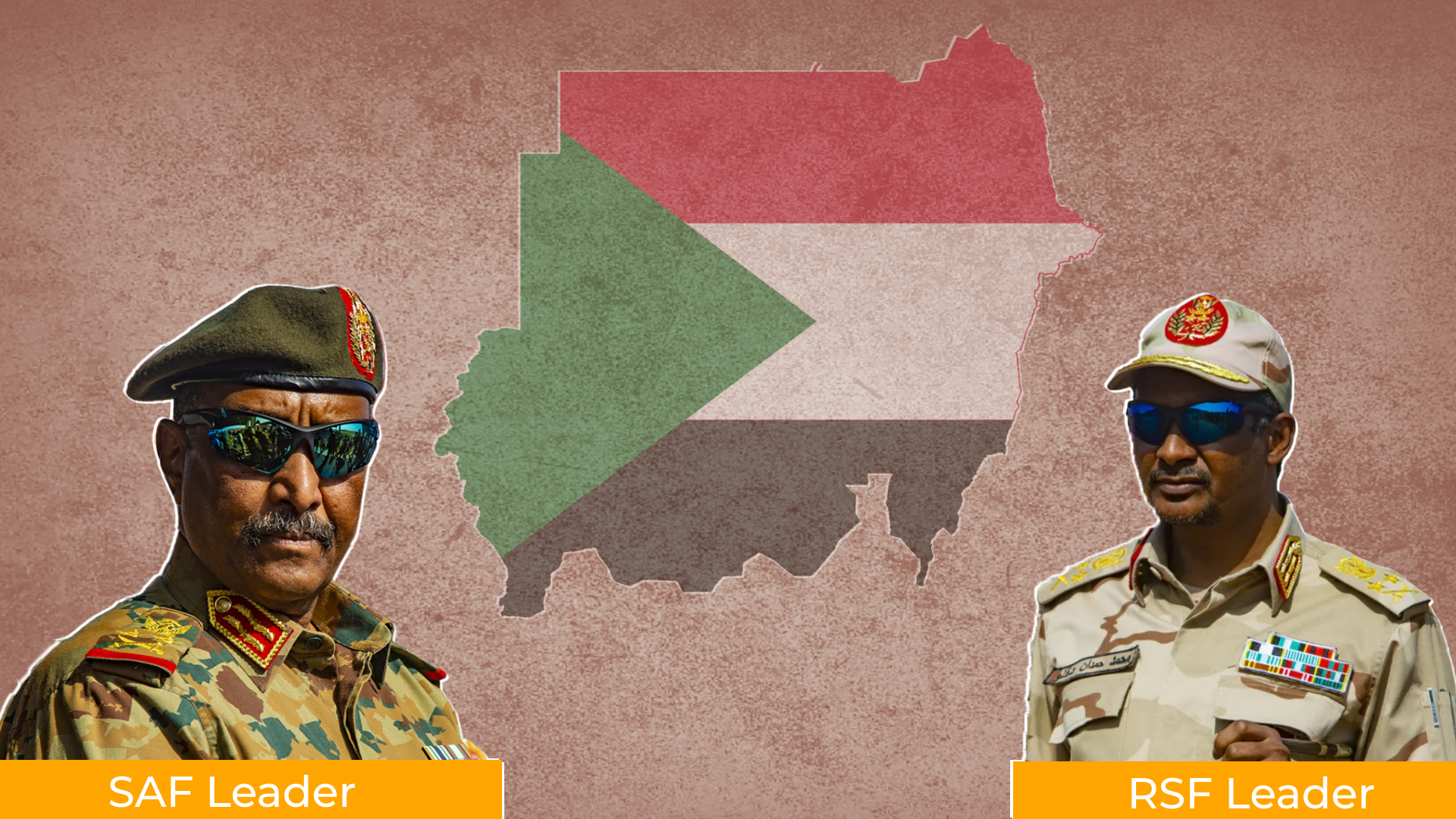
Despite the establishment of a power-sharing government in August 2019 after AU-backed mediation initiated following Sudan’s suspension from the AU in June 2019, the two generals staged another coup ousting the civilian government in October 2021 just before handing over control of the sovereign council to the civilian arm of the power-sharing government.
In subsequent months, the resort of the two generals to resolve their rivalry for prominence plunged Sudan into its latest civil war. After one year of near-total war, Sudan’s collapse, which is imminent and inevitable, would unleash a disaster of catastrophic proportions for Sudan, Africa, and international peace and security.
The capital of Sudan, Khartoum, a sight of some of the most indiscriminate and brutal fighting is reduced to rubbles. Many of its residents, who survived indiscriminate attacks and deprivation of access to basic needs, are forced to flee. Most hospitals, schools, houses, and business centers are shattered to the ground.

Darfur, a region severely affected by the war, endured atrocities and faces imminent risk of such atrocities that are reminiscent of the genocidal violence that the region experienced two decades earlier.
The fighting is engulfing the entire country as it also expanded to South Kordofan, Blue Nile, Gazirah, Gedaref and the White Nile regions.
Exacerbating an already dire situation and escalating the imminent risk of collapse, in the recent fighting, the circle of actors involved in the fight has expanded beyond the two main conflicting parties. Armed groups in South Kordofan and Blue Nile and those in Darfur have joined the fray.
Caught in the crossfire are the people of Sudan, who endure unspeakable horrors at the hands of the warring factions. Although not as brutal in Darfur, the RSF unleashed its violence on civilians in the other territories it seized as 2023 was coming to a close.
RSF is not alone in inflicting suffering on civilians. SAF’s air force rains down terror from above, indiscriminately bombing civilian areas in a ruthless bid to regain control.
As a war without respect for any rules, the violence against civilians also involved widespread killings, forced displacement, deprivation of access to basic needs and humanitarian assistance, and the use of sexual violence including rape.

The ongoing war has claimed a reported 14,000 lives’. The number of people forcibly displaced inside and outside the country is fast approaching the ten million mark. Sudan has the world’s largest displacement crisis and the largest child displacement crisis.
24.8 million Sudanese are in need of humanitarian assistance, yet there is no humanitarian access.

Adding to this grim reality, the Famine Early Warning System Network raises a red flag, warning of an impending famine threatening parts of West Darfur, Khartoum, and the Greater Darfur region. According to the World Food Programme, nearly five million individuals are on the brink of experiencing famine.

The conduct of the warring parties along with the failure and indifference of Africa and the rest of the world, in complete disregard of AU’s principle of non-indifference, is pushing Sudan to the brink.
It remains unclear how long Sudan can sustain the continuation and escalation of this war without complete collapse. Indeed, unless something dramatically changes in terms of the effort to arrest the escalating war, it is difficult to foresee how Sudan can avoid complete collapse.
Sudan’s collapse will not be like anything we have seen before. Unlike Somalia which borders only three states, Sudan borders seven countries. Sudan is at the crossroads of various geopolitical regions of Africa.
It is in the middle between North Africa and Africa South of the Sahara. It borders countries in Central Africa, North Africa and East Africa regions. It strudels the Horn of Africa, North Africa and Central Africa regions. It is the bridge between Gulf countries and East Africa. It is strategically located on the Red Sea. Considering the fraught situation on this strategic waterway for international maritime trade, any additional complications would carry huge global economic and geostrategic consequences.
Sudan’s collapse would obviously mean protracted suffering for the people of Sudan first and foremost. It would mean more death, mayhem and suffering. More people would be displaced and flee outside of the country.
Given its history and location, a collapsed Sudan is appealing not just to terrorist groups in the region but to global jihadist terrorist organizations such as ISIS.
The establishment of a foothold by terrorist groups in Sudan could end up creating a belt of terrorist networks stretching from the Southwestern Sahel near the Atlantic coast across the Sahel to the Red Sea.
Sudan’s collapse would reverberate across the conflict ridden Horn of Africa and Central Africa regions. It could make an already dire situation catastrophic. It would have a serious knock on the political and conflict situations in the fragile neighboring states of the Central African Republic, Chad, and South Sudan.
The stakes for Sudan, the region, and the international order could not be more grave. Beyond addressing the life and death humanitarian situation for people caught up in this total war through directing funding to local humanitarian actors and establishing internationally protected humanitarian corridors, there is nothing more urgent than preventing Sudan’s collapse and its catastrophic ramifications.
As Sudan enters its second year of this devastating war, the question is whether the African Union, countries in the region, and international actors appreciate the urgency and gravity of the imminent danger of state collapse in Sudan and whether they are able and willing to do all that it takes to avoid it.
Are they willing and able to halt the supply of weapons to the warring parties and cutting off their funding sources? How about establishing a rigorously monitored and enforced ceasefire? How about for setting up a technocratic transitional government with a time-bound and limited mandate to foster conditions for an inclusive transitional process?
If the AU, its member states and the wider international community care about Sudan, the region, and international peace and security enough, this is the moment to show it. If the AU and its partners are serious about AU’s flagship program of Silencing the Guns, now is the time to muster the will and resolve necessary to demonstrate their seriousness by taking the necessary measures to avert the collapse of Sudan.
The time for making statements and expressing concern is long over. It is time to act and act decisively.
The content of this article does not represent the views of Amani Africa and reflect only the personal views of the authors who contribute to ‘Ideas Indaba’
Unblocking the obstacles to effective Continental Early Warning System (CEWS)
Unblocking the obstacles to effective Continental Early Warning System (CEWS)
Date | 15 April 2024
Tomorrow (16 April), the African Union (AU) Peace and Security Council (PSC) will convene its 1208th session to discuss the theme of ‘unblocking the obstacles to effective Continental Early Warning System (CEWS)’ with a joint briefing by the Committee of Intelligence and Security Services of Africa (CISSA), African Centre for the Study and Research on Terrorism (ACSRT), and African Union Mechanism for Police Cooperation (AFRIPOL).
Following opening remarks by Jainaba Jagne, Permanent Representative of The Gambia to the AU and stand-in Chair of the PSC for the month of April, Bankole Adeoye, Commissioner for Political Affairs, Peace and Security (PAPS) will make a statement. The representatives of CISSA, ACSRT, and AFRIPOL are expected to deliver briefings.
This session comes within the framework of PSC’s 1014th (2021) session, which requested CISSA, ACSRT and AFRIPOL to provide quarterly briefings to the Council on emerging threats to peace and security on the Continent in the effort to strengthen conflict prevention and early warning mechanisms. Previously, during its 360th (2013) session, the PSC had agreed to receive a periodic update, at least once every six months, on the state of peace and security on the continent, using horizon scanning approaches. In recent years, the security threats of terrorism, unconstitutional changes of government and climate change have dominated such briefings.
The last time the PSC received a briefing on continental early warning and security outlook was at its 1170th session in August 2023. In that session, the PSC requested the Commission to ‘urgently review and adapt all AU counter-terrorism legal frameworks to ensure that they are in sync with the existing international counter-terrorism legal frameworks.’ The session specifically called for future early warning briefings to address the persistence of terrorism, particularly in the Sahel, and to propose actionable strategies for mitigating security challenges in the region. As a follow-up to this specific request, tomorrow’s briefing may provide highlights on the state of terrorism in the Sahel as part of the broader horizon scanning of the emerging and existing security threats in the continent.
ACSRT’s database indicated a staggering 99% surge in terrorist attacks and a 53% rise in terrorist-related deaths recorded between January and December 2023, compared to the corresponding period in 2022. The Sahel stands out as the most severely affected region, not only within Africa but also globally, accounting for almost half of all deaths from terrorism worldwide, per the 2024 Global Terrorism Index (GTI) report. Central Sahel countries of Burkina Faso, Mali and Niger, notably the tri-border area described as the ‘Liptako-Gourma’, have seen the most significant increase in the impact of terrorism among the Sahelian nations, with Burkina Faso now ranked first on the GTI. (For more details on the state and dynamics of terrorism in the continent, see Amani Africa’s analysis on the theme). Besides terrorism and violent extremism, the electoral landscape of the continent also remains an issue requiring closer follow-up, with elections planned in twenty Member States for 2024.
The central focus of tomorrow’s session ‘the obstacles to effective early warning’ and unblocking them requires serious consideration. As the Chairperson noted to Amani Africa’s ‘in the words of the PSC Chairperson’, this session will look into ways of enhancing and fully operationalizing the CEWS to strengthen anticipation, preparedness and early response to conflicts across the continent.
As envisaged under article 12 of the PSC Protocol, the main purpose of the early warning system is the provision of timely advice on potential conflicts and threats to peace and security to enable the development of appropriate response strategies to prevent or resolve conflicts in the continent. Experience shows that despite the institutional and technical advances made in operationalizing CEWS, the actual operation of CEWS in providing early warning and those responsible for taking action in initiating timely responses leaves a lot to be desired. As a result, AU’s engagement in peace and security is generally characterised by firefighting as opposed to detecting and preventing violent conflicts and crises from breaking out.
Broadly speaking, the challenges to CEWS can be grouped into two: technical and institutional and political. The technical aspect of early warning and analysis concerns the development of methodologically sound and substantively rigorous and solid early warning reports. Related to this is the process not only for the collection of quality data but also for an informed analysis and interpretation of the early warning data.
The other technical issue is determining the point at which a crisis/situation warrants the attention of the PSC for early action. This is not an easy matter. Developing clear and objective criteria and ensuring their consistent application remains critical for an effective preventive mechanism. In light of this, the PSC’s 11th (Cairo) retreat emphasised the importance of establishing a ‘trigger mechanism and indicators’ to facilitate the role of the PSC in assessing the need for early action. This was echoed during the 1073rd session, where the PSC called upon the Commission to develop and urgently submit such mechanism and indicators for consideration. However, it remains unclear whether this request has been followed-up on.
The other challenge that traverses the technical and political domains is the lack of effective flow of information between the early warning mechanism and those responsible for initiating early response, the Chairperson of the AU Commission and the PSC. Cognizant of this challenge, the conclusions of PSC’s 13th (Mombasa) retreat on its working methods emphasised leveraging the horizon scanning briefings and informal consultations as platforms for the Commission and the PSC to exchange particularly ‘sensitive’ early warning information. The retreat’s conclusions envisage monthly early warning meetings between the PSC Ambassadors/Charge d’Affaires and the Commissioner for PAPS, as well as quarterly consultations between the PSC and the Chairperson of the Commission. While there are efforts to convene the informal interactions, there is still much to be desired in terms of regularizing the monthly and quarterly early warning briefings between the Commission and the PSC.
The political challenge relates to a) the extent to which the CEWS operates consistently across different country or regional situations and most importantly b) the reluctance, if not outright rejection, of Member States, and even the Regional Economic Communities and Regional Mechanisms (RECs/RMs). As noted by the PSC during its 1073rd (2022) session, there is a persistent denial of credible early warning reports of looming crisis and conflict situations, often invoking of sovereignty, thus obstructing timeous early action including deployment of preventive diplomacy and mediation. There are also instances where the principle of subsidiarity has been invoked by the RECs/RMs to prevent the situation from reaching the agenda of the PSC. While Member States have the obligation to commit themselves to facilitate early action by the PSC and/or the Chairperson of the Commission pursuant to article 12(6) of the PSC Protocol, there is a need to enhance quiet/back channel diplomacy with Member States signalling potential crises.
From a perspective of overcoming these challenges, one of the key issues is ensuring confidence and trust in the early warning. This is crucial not only for dealing with some of the technical challenges but also some of the political ones, as well as it would contribute to limiting the scope for denial. The other issue is determining the nature of the response and how the response/early action is pursued. It may be advisable that at the early stages of a crisis, the early action is pursued discretely and using non-intrusive methods. It is only when the crisis has reached a boiling point and discrete measures would not be fitting that more public preventive diplomacy is deployed. It is at this stage that consideration should be given to putting the matter on the agenda of the PSC.
Meanwhile, there is also need for the AU to reinvigorate the CEWS which suffered a major institutional setback when its structure was removed from the PAPS department structure established as part of the institutional reform of the AU. This needs to be revisited. The role of the CEWS (which is based on human security considerations) cannot be replaced by CISSA, ACSRT or AFRIPOL, whose approach, by the very nature of their institutional and technical formation, largely draws on and is informed by state security analytical tools including intelligence.
It is also important for the AU to leverage, reinvigorate and sharpen some of its preventive tools. For instance, despite the expectation of a regular engagement between the PSC and the Panel of the Wise pursuant to 665th (2017) session, which requested quarterly briefings from the Panel of the Wise, such interactions have not been regular and remain to be fully institutionalized. The Continental Structural Conflict Prevention Framework and its tools, the Country Structural Vulnerability Resilience Assessment (CSVRA) and the Country Structural Vulnerability Mitigation Strategies (CSVMS), are largely ignored despite its potential to strengthen the CEWS by addressing structural causes of conflicts.
The expected outcome of the session is a communiqué. PSC may also follow-up on the implementation of previous decisions meant to strengthen the continental early warning system and bridge the gap between early warning and early action. In this respect, echoing the Mombasa Retreat Conclusions, it may urge the Commission to regularize the interactions between the Chairperson of the Commission as well as the Commissioner for PAPS, and the PSC. It may also call for the reinstatement of the CEWS structure as per Article 12 of the PSC Protocol as a measure for reinvigorating early warning and early action. The PSC may also reiterate the conclusions of the Cairo retreat on the establishment of transparent threshold for identifying the point at which early action is activated. The PSC may further request the Commission to streamline the quarterly briefings by the Panel of the Wise with the continental early warning and security outlook briefing. To facilitate more substantive engagement, the PSC may request the submission of a comprehensive report that provides an in-depth analysis on not only thematic issues but also country-specific crises/situations, along with concrete recommendations for early response.
Annual Activity Report of Amani Africa 2023
Annual Activity Report of Amani Africa 2023
HIGHLIGHTS OF THE YEAR
2023 has been a year that registered substantial expansion in Amani Africa’s work. We have continued to enhance our work involving the production of knowledge and analysis and the provision of timely information on matters AU and its PSC.
In 2023, we have been able to expand not only the range of issues our work covers but also our products and their impact. We have introduced new products such as the Amani Africa resources hub, Ideas Indaba and Amani Africa Dispatch. We also upscaled the range of partnerships and engagements with state, intergovernmental and non-state stakeholders including those beyond the continent.
A moment of reckoning for the AU in Chad as interim leader declares candidacy for presidential election
A moment of reckoning for the AU in Chad as interim leader declares candidacy for presidential election
Date | 9 April 2024
Going against a commitment he made to an African Union (AU) delegation that visited Chad following the seizure of power by the military, Chad’s interim leader Mahamat Idriss Deby Itno declared his candidacy to run for the presidential election slated for 6 May 2024. Considering clear rules of relevant AU norms and equally clear decisions of AU’s Peace and Security Council (PSC), Deby’s candidacy raises the difficult policy question of whether the AU will continue with ‘its exceptional treatment of Chad’ or enforce relevant AU norms and its own decisions.
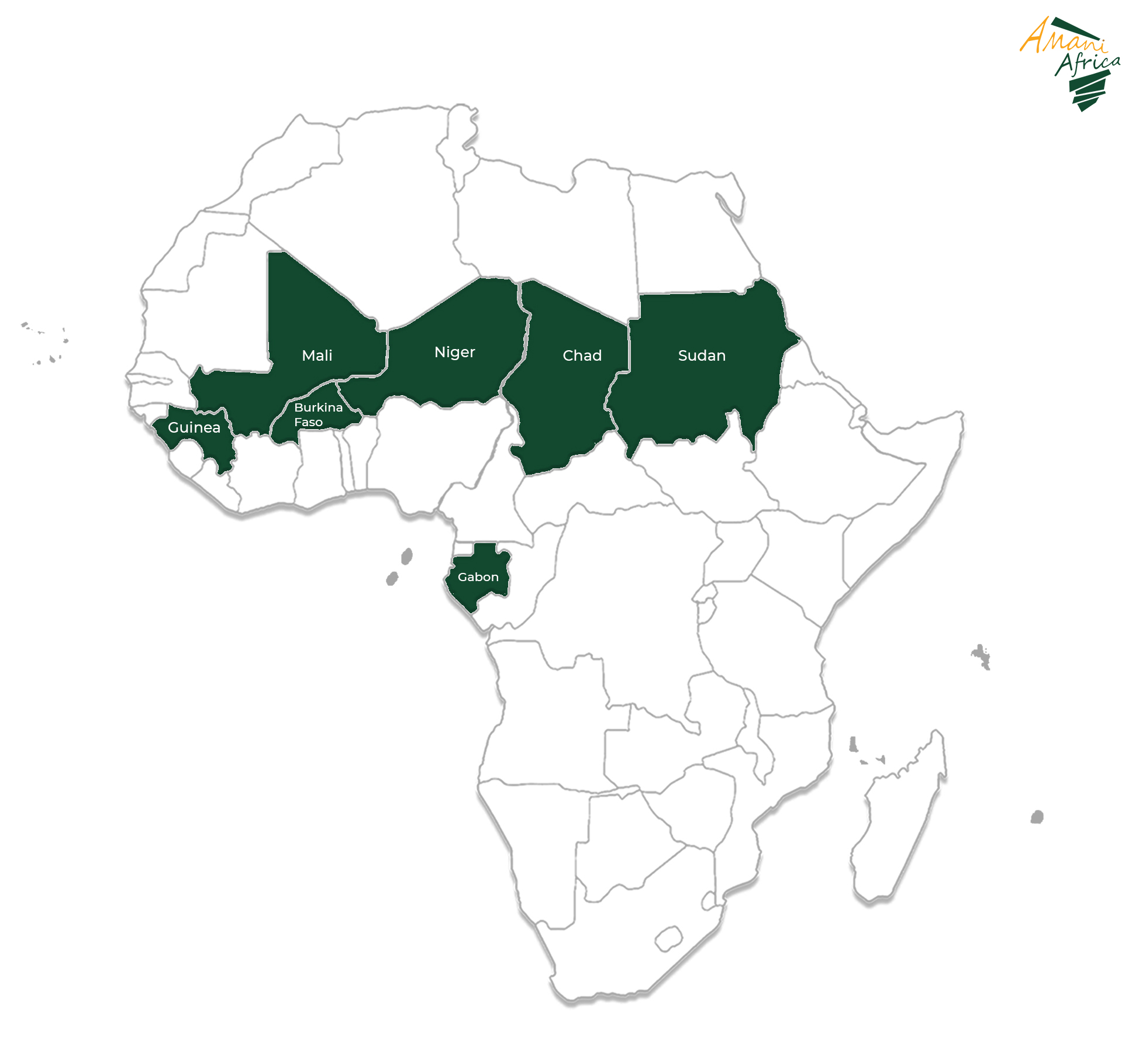
How this policy question is handled will set the tone for the six other countries (Burkina Faso, Gabon, Guinea, Mali, Niger and Sudan) that are in transition and suspended from the AU on accounts of military coups.
On 20 April 2021, the military in Chad stepped in to grab power after the death of then President Idriss Deby Itno from wounds he suffered during a visit to troops on the frontlines fighting against an armed rebel group, the Front for Change and Concord in Chad (FACT), which was reportedly marching towards Chad’s capital, N’Djamena. After suspending the Constitution and dissolving the Government and Parliament, the military spokesperson announced a decree establishing a Transitional Military Council (TMC) to lead the country and designating Mahamat Idriss Deby, the son of the deceased president, as head of the Council.
Under AU norms, such seizure of power by the army constitutes an unconstitutional change of government (UCG) banned and sanctioned by various AU legal instruments including, AU’s grand norm, the Constitutive Act of the AU. The various instruments banning UCG, including the Lome Declaration of 2000, the African Charter on Democracy Elections and Governance (ACDEG), and the Peace and Security Council (PSC) Protocol make it clear that any UCG is subject to automatic sanction and they don’t envisage exception. This has also been supported by the large body of AU practice in responding to UCG since the turn of the century.
The various instruments banning UCG, including the Lome Declaration of 2000, the African Charter on Democracy Elections and Governance (ACDEG), and the Peace and Security Council (PSC) Protocol make it clear that any UCG is subject to automatic sanction and they don’t envisage exception. This has also been supported by the large body of AU practice in responding to UCG since the turn of the century.
In an emergency session it convened on 22 April 2021, the AU, through its standing peace and security decision-making body, the PSC, failed to designate the event in Chad as an UCG. This was despite the fact the PSC, in the communique it adopted, expressed ‘grave concern over the establishment of the Transitional Military Council.’ Subsequently and after deploying a ‘fact-finding mission’ comprising of ‘the members of the PSC and the AU Commission’ (a composition contrary to established international practice and undercut the impartiality of the PSC), the PSC used the excuse of ‘the complexity of the current political and security situation in Chad’ for persisting with not designating the military power grab in Chad as a UCG.
While there were two earlier instances in which the PSC withheld the automatic application of the consequences of the designation of a situation as UCG, namely suspension from the AU (in November 2014 and April 2019 concerning Burkina Faso and Sudan, respectively), this is the first time that the PSC failed to characterize a military seizure of power as UCG. In doing so, the PSC dealt a major blow to its credibility, exposing the AU to legitimate charges of applying double standards and being inconsistent.
This is the first time that the PSC failed to characterize a military seizure of power as UCG.
The major casualty of PSC’s failure on Chad was the deterrence effect of the AU norm against coups. PSC’s failure to enforce the norm on Chad broke the practice of consistent enforcement and the attendant international diplomatic censure that gave the norm its force. In so doing, it sent a message to others watching the events in Chad that this was a season to stage a coup and get away with it. It is no wonder that some countries against whom the PSC enforced the anti-coup norm challenged the legitimacy of the AU’s action given its failure to uphold the same rule in neighbouring Chad. Indeed, countries such as Mali, which are facing complex security threats, share the same, if not more, challenges as Chad, and have a point in criticizing the AU for not giving them a pass as it did for Chad.
The major casualty of PSC’s failure on Chad was the deterrence effect of the AU norm against coups.
Despite letting Chad get away with its UCG, the AU in the PSC decision of 14 May 2021 expressly stated its expectation that the authors of the unconstitutional seizure of power in Chad will not auto-legitimize their hold to power by having themselves ‘voted’ during elections held for restoring constitutional order. In this respect, the PSC demanded ‘the Chairman and members of the TMC to abide with the avowed commitment, not to contest or take part in the upcoming national elections towards democratic rule.’ It even went further stating that ‘the Military will be held fully accountable in this respect.’ Subsequently, in the communique adopted at its 1016th meeting of August 2021, the PSC reiterated ‘that the members of the Military Transition Council shall not be eligible to be candidates for the elections at the end of the Transition.’ In the communique of its 1106th session held on 19 September 2022, the PSC was emphatic stating it ‘unequivocally reiterates that all members of the TMC shall be ineligible to participate as candidates for the elections at the end of the transition’ (emphasis in the original).
The PSC demanded ‘the Chairman and members of the TMC to abide with the avowed commitment, not to contest or take part in the upcoming national elections towards democratic rule.’ It even went further stating that ‘the Military will be held fully accountable in this respect.
It is thus clear from the various pronouncements that any attempt by the members of the TMC to run for election is set as a clear redline as the PSC makes. For this, the PSC draws legal authority from the AU Assembly Decision of 2010 (Assembly/AU/Dec.269(XIV) and the ACDEG.
A sign of a potential breach of the redline set for the junta in Chad emerged in October 2022. Following a national dialogue convened for charting a roadmap for the transition, the national dialogue forum announced on 1 October 2022 to extend the transition period by another 24 months in contravention of the timeframe established by the PSC. Even more gravely, the national dialogue forum further agreed to allow the head of the TMC and its members to participate in the elections at the end of the transition period. This pronouncement is not only a clear contravention of the decision of the PSC, emphatically reiterated several times, but also a clear rule in the extant AU norms including Assembly/AU/Dec.269(XIV) that bar coup-makers from participating in elections.
Instead of encouraging it to cooperate and abide by agreed commitments set in the various PSC decisions, these developments suggest that the junta in Chad took PSC’s initial failure to enforce the norm on UCG as a license for pursuing its ambition of legitimizing itself by ‘getting voted into power’. Yet, the reading of the various PSC communiques on Chad and the commitment that the head of the TMC made to a delegation of the AU suggest that the PSC would enforce the anti-coup norm against Chad in the event of the contravention of this redline. It thus came as no surprise that when the PSC convened a session on Chad on 11 November 2022, a key aspect of the agenda was whether to suspend the country given the new developments arising from the conclusions of the national dialogue. Indeed, the report that the AU Commission Chairperson submitted to the session presented the suspension of Chad from the AU as one of the possible courses of action available to the PSC.
It thus came as no surprise that when the PSC convened a session on Chad on 11 November 2022, a key aspect of the agenda was whether to suspend the country given the new developments arising from the conclusions of the national dialogue.
As documented in the November 2022 Monthly Digest on the PSC, after long hours of debate, the session was adjourned without a consensus among members of the PSC on the actions to be taken vis-à-vis the developments in Chad that are in clear breach of PSC’s decisions. While the provisions that ban UCG are clear and the existing PSC decisions of its 996th and 1121st sessions affirm the importance of upholding AU principles including the ineligibility of members of the TMC for elections that will be held for restoring constitutional order, the PSC was divided on the issue of the suspension of Chad.
In response to media reports accusing the Chairperson of the AU Commission of seeking to punish Chad in proposing suspension as one course of action in the report he presented, the spokesperson of the Chairperson stated on 12 November, apart from noting that no member of the PSC challenged the report, the statement rightly put blame for the mishandling of the situation in Chad on PSC member states stating that ‘Some felt that the authorities of the Transition should continue to be given exceptional treatment, others stated that they should be sanctioned by suspending the country via the rules invariably followed and implemented in matters of unconstitutional change of government. The PSC failed to reach an agreement on the matter during its meeting held on 11 November.’ (emphasis added) Despite holding a second meeting on 30 November to conclude the consideration of the developments in Chad that started on 11 November, the members of the PSC were not able to bridge their differences.
Apart from noting that no member of the PSC challenged the report, the statement rightly put blame for the mishandling of the situation in Chad on PSC member states stating that ‘Some felt that the authorities of the Transition should continue to be given exceptional treatment, others stated that they should be sanctioned by suspending the country via the rules invariably followed and implemented in matters of unconstitutional change of government. The PSC failed to reach an agreement on the matter during its meeting held on 11 November.’
This marks the second time that the PSC was unable to enforce on Chad a norm it applied against others. One of the arguments made at the time was that the PSC could only act when any member of the TMC stood for election.
In a Press Statement it issued, the PSC reiterated in general terms its previous decisions on Chad and reaffirmed its total rejection of UCG. Despite not stating them explicitly, the PSC, in reiterating its previous decisions (of which ineligibility of members of the TMC to elections is key), signalled that suspension. While avoided for now, suspension is still a possibility that the PSC may resort to. This is to happen when any member of the TMC decides to stand as a candidate for the elections expected to be organized at the end of the transitional period.
With elections set for 6 May 2024 and the declaration by Deby of his plan to run for the presidential elections, there is now no possibility of kicking the can down the road. The AU and its PSC are now faced with only one option- to end its ‘exceptional treatment of Chad’ and sanction it by suspending it from the AU, ‘by the rules invariably followed and implemented in matters of unconstitutional change of government’ and its own various decisions. Failing to do so would wipe out any of the PSC’s residual credibility on this matter and firmly suggest the continental body’s lack of conviction for its own decisions.
The AU and its PSC are now faced with only one option- to end its ‘exceptional treatment of Chad’ and sanction it by suspending it from the AU, ‘by the rules invariably followed and implemented in matters of unconstitutional change of government’ and its own various decisions. Failing to do so would wipe out any of the PSC’s residual credibility on this matter and firmly suggest the continental body’s lack of conviction for its own decisions.
One avenue that the PSC may opt for to maintain a semblance of credibility, if it is unable to suspend Chad, it is to decide that the AU should not deploy election observers to the upcoming elections in Chad.
Beyond the legitimacy crisis for the PSC, there are more reasons why the issue of how the PSC deals with this case matters for the AU and its policy on UCG. How the PSC handles this case is not without consequences for other cases. Indeed, if the PSC is unable to enforce the rule on non-eligibility concerning Chad, it would be the end of any future application of this rule as well. And most immediately, this would also mean that the AU would have no standing to apply this rule for stopping any of the military leaders in the six other countries (Burkina Faso, Gabon, Guinea, Mali, Niger and, Sudan) from becoming candidates for elections that will be held at the end of the transitional period in those countries.
If the PSC is unable to enforce the rule on non-eligibility concerning Chad, it would be the end of any future application of this rule as well. And most immediately, this would also mean that the AU would have no standing to apply this rule for stopping any of the military leaders in the six other countries (Burkina Faso, Gabon, Guinea, Mali, Niger and, Sudan) from becoming candidates for elections.
The content of this article does not represent the views of Amani Africa and reflect only the personal views of the authors who contribute to ‘Ideas Indaba’
Briefing on the situation in the Lake Chad Basin, MNJTF operations and Regional Stabilisation Strategy implementation
Briefing on the situation in the Lake Chad Basin, MNJTF operations and Regional Stabilisation Strategy implementation
Date | 7 April 2024
Tomorrow (8 April), the African Union (AU) Peace and Security Council (PSC) will receive a briefing on the situation in the Lake Chad Basin and the operations of the Multinational Joint Task Force (MNJTF) in the region.
Following opening remarks by Ambassador Jainaba Jagne, Permanent Representative of the Republic of The Gambia to the AU and stand-in Chairperson of the PSC for April 2024, Bankole Adeoye, Commissioner for Political Affairs, Peace and Security (PAPS) is expected to make a statement. As per the usual practice, the Executive Secretary of the Lake Chad Basin Commission (LCBC), Mamman Nuhu, is expected to brief the PSC.
The last time the PSC received a briefing on this issue was on 30 January 2024 when it renewed MNJTF’s mandate for one year until 1 February 2024. At that meeting, the PSC requested the AU Commission and the LBC to renew the provision of AU support to MNJTF for one year and to report regularly on the activities of the MNJTF. Tomorrow’s session could focus on the state of operation of the MNJTF, the security situation in the Lake Chad Basin and the implementation of the regional stabilization strategy.
On the security front, despite the progress registered by the MNJTF over the past years in degrading Boko Haram, the threat in the Lake Chad Basin from the two main Boko Haram splinter groups, Jama’tu Ahlis Sunna Lidda’awati wal-Jihad (JAS) and Islamic State West Africa Province (ISWAP), remains high. Boko Haram-related incidents have reportedly surged recently resulting in an increased number of civilian casualties. As a recent research report on the two Boko Haram splinter groups highlighted, the militant groups still command thousands of fighters and hold swathes of territory. In terms of territory, JAS controls much of Lake Chad and the Mandara mountains and ISWAP has strong control, particularly in rural areas of central Borno and eastern Yobe state in Nigeria.
The continued insecurity in the region has also exacerbated the humanitarian situation with more than 11.2 million people in need of humanitarian assistance, including over 5.5 million people facing acute food insecurity and some 758,000 children experiencing severe malnutrition, according to the UN. Additionally, most schools in the conflict-affected areas are dysfunctional due to the level of insecurity, thus denying children access to education. The region is also host to hundreds of thousands of internally displaced people, refugees, and returnees. This situation has been further compounded by the ongoing conflict in Sudan, which has increased the number of displaced people crossing into Chad.
MNJTF has been playing an important role in fighting Boko Haram and stabilizing the region to allow the free movement of people and revive socio-economic activities. The joint task force has recently announced operational successes in neutralizing several Boko Haram elements and capturing many others. It also reportedly disrupted the group’s supply lines capturing a lot of weapons and ammunitions. Some MNJTF soldiers paid the ultimate sacrifice in this process, while others suffered injuries.
However, despite continuing military operations particularly by Nigeria under the MNJTF, there remain concerns about the level of effective coordinated operation by all members of the MNJTF. It was reported that the MNJTF operation planned for 2023, Lake Sanity 2, did not take place. Additionally, the MNJTF continues to face several other challenges. One of the challenges it faces relates to political instability facing some of the contributing countries such as Niger. Apart from the souring of relations with Nigeria after the July 2023 coup, Niger declared suspension of its participation in the MNJTF. According to the UN Secretary-General’s Report to the UNSC in January 2024, following Economic Community of West African States (ECOWAS) sanctions on the Niger, ‘the de facto authorities in the Niger prohibited Multinational Joint Task Force troops based at Mallam Fatori, Nigeria, from crossing the border, and the Force Commander of the Task Force from visiting the Niger. They also temporarily suspended some reporting to the Task Force headquarters.’
The MNJTF also faces, similar to other operations on the continent, the lack of adequate, predictable, and sustainable funding. Therefore, the task force needs the continued support of the region and the international community. The lack of adequate resources to support recovered areas is a further challenge that complicates the situation. A recent UN assessment in the region concluded that ‘economic hardships continued to drive vulnerable young persons towards illegal activities, including joining extremist groups’ and that ‘insecurity had disrupted traditional transhumance routes, affecting local economies and exacerbating resource competition, food insecurity and displacement.’
In this connection, the implementation of the Regional Stabilization, Recovery, and Resilience Strategy for Areas Affected by Boko Haram in the Lake Chad Basin Region developed by the LCBC with the support of the AU is expected to be another focus of tomorrow’s PSC meeting. The LCBC has been benefiting from the support of the UN Development Programme (UNDP) which since 2019 has been facilitating the implementation of the strategy through its regional stabilization facility. Through the regional stabilization facility, more than 1.36 million people reportedly benefitted from stabilization interventions including more than 76,000 people who received vital livelihood support through grants, capacity-building opportunities, and cash-for-work initiatives, according to UNDP. Additionally, health and education services have resumed; infrastructure has been rehabilitated; access to energy has expanded; and more than 400,000 displaced persons have returned home. The first phase of the regional strategy’s implementation was concluded last year and the second phase has started this year.
Despite some of these positive developments, however, challenges abound underscoring the need to accelerate and adjust the implementation of the regional strategy which is considered the key to addressing the underlying causes and drivers of extremism, violence, and underdevelopment. It is to be recalled that following the fourth meeting of the steering committee for the Regional Stabilization, Recovery and Resilience Strategy for Areas Affected by Boko Haram in the Lake Chad Basin Region, in Abuja, Nigeria on 27 September 2023, the Regional Strategy was extended for a further period of one year. Additionally, the meeting directed the LCBC to consider an adjusted regional strategy for validation by the Council of Ministers in August 2024. It would thus be of interest for the PSC to learn about the progress being made in developing the adjusted regional strategy and how the adjustment would advance the effectiveness of the MNJTF.
At tomorrow’s meeting, the PSC may call for the mobilization of international assistance to support the implementation of the regional strategy to promote peace, security and development in the Lake Chad Basin. The Lake Chad Basin Governors’ Forum for Regional Cooperation on Stabilization, Peacebuilding, and Sustainable Development was held in N’Djamena from 5-7 July 2023 and highlighted the need to support socio-economic development and enhance community-based reintegration and transitional justice initiatives across the region. The Forum also expressed continued support for the Multinational Joint Task Force, while underscoring the need to adhere to human rights standards in security operations. Furthermore, they stressed the imperative of finding durable solutions for refugees and internally displaced persons in the region.
Another issue that would be of interest to PSC members in tomorrow’s session is the role of the MNJTF in providing support in such areas as the delivery of humanitarian assistance and the rebuilding of state authorities in areas recovered from terrorist groups. In terms of the role of the MNJTF beyond its kinetic activities, it would be of interest for PSC members to receive updates on its decision from its 1126 session. It is to be recalled that the PSC called for ‘restructuring of the MNJTF into a multidisciplinary force with robust police and civilian components that takes into consideration a comprehensive approach to addressing terrorism’.
Another important focus of tomorrow’s PSC meeting is the adverse effects of climate change in the Lack Chad Basin with worsening drought and receding water levels in Lake Chad. This has weakened the livelihood of the people of the region and exacerbated communal violence. The LCBC has been supporting regional countries in mitigating the impact of climate change, preserving biodiversity, and managing scarce water resources. Tomorrow’s PSC meeting will be held in advance of the third annual international forum on the development of the Lake Chad Basin which is scheduled to take place in N’Djamena from 28-30 May 2024. This forum is supported by the World Bank which funds the Lake Chad Region Recovery and Development Project (PROLAC). The forum seeks to promote and strengthen regional cooperation between the Lake Chad Basin countries in mitigating the adverse effects of climate change, promoting socio-economic development, and fostering regional integration. Several topics are expected to be discussed during the upcoming forum, including how to enhance community resilience and strengthen inclusive management of natural resources.
The expected outcome of tomorrow’s session is a communiqué. The PSC is expected to express concern over the continued threat posed by Boko Haram in the Lake Chad Basin region. While commending the MNJTF for its successful operations against the terrorist group, the PSC may underscore the need for reinforcing the close coordination and active participation of all the participating countries of the MNJTF. With respect to the conduct of military operations by the MNJTF, the PSC may call for enhanced compliance with human rights and IHL rules to avoid civilian casualties that undermine the effectiveness of such operations. The PSC may welcome steps taken by ECOWAS and Nigeria to ameliorate tension with countries affected by coups and may in this respect call on Niger to continue its collaboration and active participation in the MNJTF to avoid reversal of gains achieved through the MNJTF. It may emphasize the critical role of the Regional Strategy for the Stabilization, Recovery and Resilience for supporting affecting communities and restoring state authority in newly recovered areas. The PSC may also recommend a summit of the MNJTF countries for reinvigorating the MNJTF and the implementation of the Stabilization Strategy. The PSC also may call for ensuring comprehensive plans are put in place for the socio-economic revival of affected areas including within the framework of the Stabilization Strategy. The PSC may also welcome the upcoming convening of the third annual international forum on the development of the Lake Chad Basin. Having regard to the adverse impacts of climate change in the region, including aggravating insecurity and instability, the PSC may underscore the importance of investing in measures for mitigating the impacts of climate change including through the provision of humanitarian and adaptation support for affected communities.
Monthly Digest on The African Union Peace And Security Council - February 2024
Monthly Digest on The African Union Peace And Security Council - February 2024
Date | February 2024
In February, under the chairship of The Kingdom of Morocco, the African Union (AU) Peace and Security Council (PSC) had a scheduled program of work consisting of twelve sessions and an informal meeting. After multiple revisions of the programme, only five sessions were convened.