

Peace Support Operations in Africa
Date | 26 April 2026
Tomorrow (27 April), the African Union (AU) Peace and Security Council (PSC) will convene an open session on Peace Support Operations (PSOs) in Africa.
The session is expected to commence with an opening statement by Hirut Zemene, Permanent Representative of Ethiopia to the AU and Chair of the PSC for April 2026, followed by introductory remarks from Bankole Adeoye, AU Commissioner for Political Affairs, Peace and Security (PAPS). Statements will also be delivered by El-Ghassim Wane, former Special Representative of the United Nations Secretary-General in Mali, Head of MINUSMA, and UN Assistant Secretary-General for Peacekeeping, as well as former AU Director for Peace and Security; Dagmawit Moges, Director of the AU Peace Fund; and Parfait Onanga-Anyanga, Special Representative of the Secretary-General to the AU and Head of the United Nations Office to the AU (UNOAU).
Tomorrow’s session is one of the signature events of Ethiopia’s chairship, given its history and contributions to peacekeeping. It comes against the background of major challenges afflicting AU-led PSOs from the breakdown of the political consensus on which they are predicated to the resultant weakening of diplomatic, financial and logistical support and political coherence necessary for deployment and successful conduct of PSOs.
Since its operationalisation in 2004, the PSC has remained consistently engaged on PSOs, which continue to constitute a critical tool in the AU’s peace and security architecture. The first PSO to be deployed under the mandating authority of the PSC was the African Union Mission in the Sudan (AMIS) in 2004. Since then, PSOs in Africa have featured on the agenda of the PSC both through mission-specific sessions and thematic sessions dedicated to peacekeeping in Africa. Over time, its thematic focus has focused on key strategic issues, including the operationalisation of the African Standby Force (ASF) (with over 15 dedicated sessions since 2007), financing of AU PSOs, and broader systemic challenges affecting peace operations on the continent.
Two recent sessions are particularly noteworthy. At its 851st session (May 2019), the Chairperson of the AU Commission submitted a report assessing the evolving context of AU PSOs, identifying key operational and strategic challenges, drawing lessons from past and ongoing missions, and proposing measures to enhance effectiveness. More recently, the 986th session, held at ministerial level on 18 March 2021 under Kenya’s chairship, reaffirmed these concerns under the theme ‘Peacekeeping Operations in Africa: Emerging Challenges and Critical Lessons for Sustainable Peacekeeping Operations.’
Africa remains the main theatre for peacekeeping operations, hosting a wide range of deployments, including those of the UN, AU, RECs/RMs, as well as bilateral arrangements. Over the past two decades, the AU has also authorised, mandated, or endorsed around two dozen peace support operations, according to Amani Africa data (see map below). In addition, regional mechanisms and ad hoc coalitions have in recent years come to step in to fill the gap that emerged in situations where neither the AU nor the UN were able to deploy in a timely manner, particularly in response to insurgencies with regional implications. The Southern African Development Community (SADC), for example, deployed missions in Mozambique and eastern DRC, while ECOWAS has undertaken interventions in contexts such as the Gambia and Guinea-Bissau. Alongside these, ad hoc coalitions such as the Multinational Joint Task Force (MNJTF) and the G5 Sahel Joint Force have been deployed. These arrangements have often emerged as gap-filling responses by affected states, reflecting both the evolving nature of security threats and the limited capacity of continental and regional mechanisms to act promptly and adapt rapidly. In parallel, bilateral deployments have also increased, including Rwanda’s deployment in Mozambique and the Central African Republic and various bilateral deployments in Somalia alongside the AU mission.
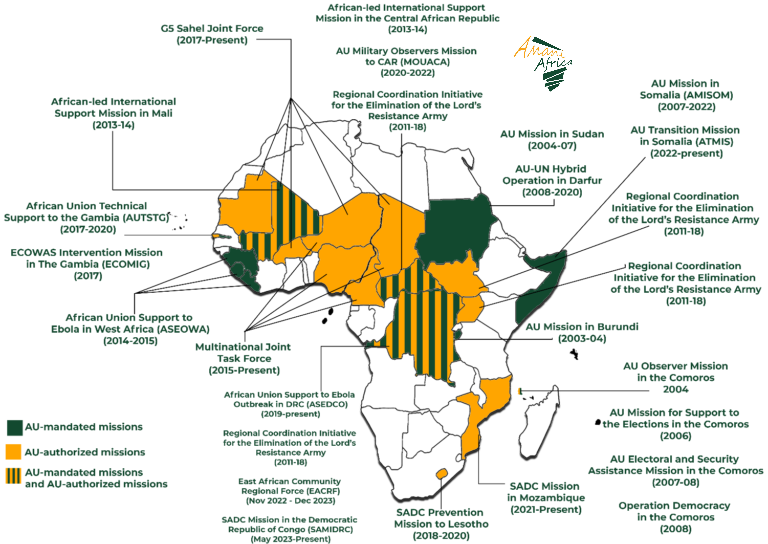
The various deployments have contributed meaningfully to stabilising conflict-affected contexts. However, recently, there has been a trend of steady decline in the deployment of PSOs in Africa, not only in the context of the AU but also the UN. The UN has not deployed a new mission on the continent since 2015, while the AU has not initiated any major PSO deployment under its command since its missions to Mali and the Central African Republic (CAR) in 2013. This is not due to a lack of situations requiring PSOs, but rather reflects the fact that the AU has become significantly behind the curve in mobilising timely engagement in situations directly implicating its peace and security mandate and the timely consensus and support required for deploying under its command, as well as in adapting to the evolving security threats on the continent.
In this context, several emerging trends and challenges over the past decade are shaping the effectiveness of PSOs in Africa, and are expected to feature in tomorrow’s deliberation.
One of the key issues likely to receive attention in tomorrow’s deliberation is the changing peace and security landscape, which calls for some adaptation of PSOs. Since around the mid of 2010s, Africa’s security environment has shifted significantly, with contemporary threats increasingly driven by fragmented non-state actors and asymmetric warfare by terrorist groups, rather than conventional civil wars. While the emergence of ad hoc deployments to fill in the ensuing gap contributes to managing the urgent security needs, they tend to be security-heavy, bereft of the tools necessary for addressing the underlying governance and socio-economic challenges. Often, they also operate outside the multilateral normative framework, with limited institutional anchoring within the AU framework.
Despite efforts to explore how to adapt the ASF, engagement on AU PSOs remains largely episodic, with limited efforts to develop new operational models aligned to current security dynamics and institutional and financial constraints. Systemic lessons and insights are not consistently carried forward to inform the AU’s approach to current and future PSOs.
Conflicts on the continent have become increasingly complex, often rooted in political contestation, governance crises, and deep-seated socio-economic challenges that do not lend themselves to purely military solutions. There is therefore a need to reconsider the growing tendency among policymakers to frame responses to Africa’s peace and security challenges—particularly those involving terrorism and insurgency—primarily in military terms. While military operations may be necessary in some contexts, they cannot substitute for a coherent political strategy. In this regard, the 2025 Lessons Learned Forum on AU PSOs and the ASF reaffirmed that military action must be directly aligned with, and supportive of, clearly defined political end states. In the absence of such a strategy, PSOs risk becoming protracted and ineffective, as illustrated by the ongoing challenges facing the AU deployment in Somalia. The principle of the ‘primacy of politics’ should therefore remain central in all conflict resolution efforts, with political processes at the forefront of design, implementation, and exit strategies for PSOs.
Financing remains a major challenge, particularly for large, multidimensional missions. This is most evident in the current AUSSOM deployment, which has been operating under significant financial strain, with mounting debt and without predictable, adequate, and sustainable funding—conditions that have directly affected its effectiveness. The issue of financing the AU, including its PSOs, has gained increasing political attention, including at the most recent AU Summit held in February, where the Assembly, in light of these challenges, decided to convene an extraordinary session of the Executive Council dedicated to financing no later than November 2026.
At the AU, there is growing interest in expanding the use of the Peace Fund. But given the limited scope of the Fund’s endowment, only smaller and limited-scope PSOs may be financed through AU resources, including the Peace Fund. Large and resource-intensive multidimensional missions authorised by the UN Security Council under Chapter VII of the UN Charter require the shouldering of the financial burden by the UN and other international partners, given that the maintenance of international peace and security remains a primary responsibility of the UN Security Council. The adoption of UN Security Council Resolution 2719 in December 2023 was premised on this consideration and marked an important milestone in AU–UN cooperation on peacekeeping. Yet, its implementation has been affected by shifting geopolitical dynamics. Changing policy towards PKOs and security priorities among partners, notably the US and EU, as well as the UN’s liquidity crisis affecting peacekeeping operations, has stifled implementation of resolution 2719 and further intensified financial pressures on AUSSOM.
Beyond financing, effective PSOs require adequate logistics, intelligence, and equipment, particularly in asymmetric environments where capabilities such as counter-IED measures are essential.
Coordination challenges also persist among the AU, RECs/RMs, the UN, and host states. The growing number of regional and ad hoc deployments risks fragmenting APSA. While AU–UN complementarity remains essential, both institutions retain distinct comparative advantages and should operate in a coordinated rather than substitutive manner. As noted by El-Ghassim Wane, the UN remains indispensable for multidimensional peacekeeping and supporting transitions to sustainable peace, while the AU is often better positioned to undertake early engagement using robust peace enforcement and counter-terrorism operations, with UN support, as well as smaller-scale stabilisation missions. Some of the models identified in the study on the future of peacekeeping that Wane led create opportunities for the AU in this respect.
Tomorrow’s deliberation is expected to explore concrete pathways for addressing them, building on some of the existing efforts, such as the lessons learned forum. This requires adopting a more systematic and sustained engagement by the PSC rather than an episodic one. Consideration may also be given to a comprehensive review of AU PSOs and the ASF framework—without reopening foundational instruments such as the Constitutive Act and the PSC Protocol—to ensure they remain responsive to evolving realities. Such a review should focus on developing adaptable PSO models aligned with current security and financial constraints, institute processes for systematically integrating lessons learned into policy, planning and practice, strengthening coordination with RECs/RMs, the UN, and international partners, and, while firmly anchoring operations in coherent political strategies. Given the need for strategic and high-level political support for PSOs, consideration may also be given to designating a dedicated AU-led PSOs Champion to sustain high-level attention.
The expected outcome of the session is a communiqué. The PSC may reaffirm the indispensable role that PSOs play in the maintenance of peace and security in Africa. It may further express concern over the multifaceted challenges facing PSOs in Africa, including political, operational, and financial constraints, and may consider the above measures, as well as modalities for follow-up, as part of efforts to address these challenges and enhance the effectiveness of PSOs on the continent. It may commission an independent, time-bound study on the future of PSOs in Africa, drawing inspiration from the recent UN initiative. It may also underscore the need for PSOs to be designed and implemented as part of a broader, integrated approach encompassing diplomacy, mediation, peace-making, and peacebuilding. The PSC may also consider developing an annual ministerial forum on AU PSOs, similar to the UN Peacekeeping Operations Ministerial, as a strategic platform for mobilising strategic, financial, logistical, and technical support for AU-led PSOs.