

Briefing on the Sahel region
Briefing on the Sahel region
Date | 29 September 2025
Tomorrow (30 September), the African Union (AU) Peace and Security Council (PSC) is scheduled to convene a ministerial-level session to receive a briefing on the situation in the Sahel region.
The Chairperson of the PSC for September 2025, Angola’s Minister of External Relations Amb. Tete Antonio is expected to preside over the session and deliver the opening statement. Bankole Adeoye, AU Commissioner for Political Affairs, Peace, and Security (PAPS), is also expected to make a statement. Additionally, the Special Representative of the AU Commission for Mali and the Sahel, and Head of the AU Mission in Mali and the Sahel (MISAHEL), Mamadou Tangara, may brief the PSC.
Since its last meeting on the issue in May 2023, conditions in the region have not improved. The threat facing the countries from the raging conflict involving terrorist groups remains existential. Armed groups and terrorists have intensified their attacks, involving increased use of advanced weaponry, including drones and improvised explosive devices (IEDs).
The al-Qaeda-affiliated Jama’at Nasr al-Islam wal Muslimin (JNIM) undertook major attacks during May 2025 across Burkina Faso, Mali and Niger. In Burkina Faso, the deadly attack that claimed the lives of more than 300 people led to the seizure by JNIM of the capitals of two regional provinces, Djibo in the Soum province and Diapaga in the Tapoa province. Throughout the first half of 2025, militant groups also launched major assaults on military barracks in several other towns. In April, the military junta led by Captain Ibrahim Traoré claimed to have foiled a coup plot, accusing neighbouring Côte d’Ivoire of involvement.
The dire security situation in Mali has also shown intensifying persistence, with a surge in attacks by Tuareg rebels and Islamist militant groups such as Jama’at Nusrat al-Islam wal-Muslimin (JNIM) and the Islamic State in the Greater Sahara (ISGS), particularly in the northern and central regions of the country. On 15 September, at least 40 fuel tankers were reportedly destroyed when al-Qaeda-linked insurgents—who had declared a blockade on fuel imports—attacked a convoy of over 100 vehicles under military escort. JNIM’s takeover of the strategic town of Farabougou in central Mali in August was also seen as a huge setback for the Malian Junta. Since July, JNIM has intensified its operations near Mali’s borders with Niger and Mauritania, targeting military and security infrastructure in the western part of the country. JNIM’s attacks on the Dioura military camp in the Mopti region, reportedly killed at least 40 soldiers.
In neighbouring Niger, the Tillabéri region—bordering Mali and Burkina Faso—has seen a sharp rise in terrorist attacks in recent months. Earlier this month, an ambush in the region resulted in the deaths of 14 soldiers, according to the Nigerian Ministry of Defence. In another incident, 22 civilians were killed during an attack on a baptism ceremony. In June, Islamist militants attacked a mosque, killing more than 70 people and injuring at least 20 others. In March, Niger announced its decision to withdraw from the Multinational Joint Task Force (MNJTF), which combats the terrorist threat in the Lake Chad Basin.
Terrorism and violent extremism are increasingly spreading from the Sahel states to coastal West Africa with a surge of cross-border attacks affecting several countries, including Benin, Côte d’Ivoire, Ghana, and Togo, among others. In light of this development, the Economic Community of West African States (ECOWAS) has decided to activate its standby force to combat the growing threat and regional insecurity. This issue was also raised during a meeting between the PSC and the ECOWAS mediation and Security Council in May, in which the two sides agreed to expedite the operationalisation of the AU Standby Force and the ECOWAS Standby Force.
Although there had been tensions between ECOWAS and the three Sahelian States that decided to withdraw their membership from the regional bloc, ECOWAS has been seeking to maintain constructive engagement with them. In May, the foreign ministers of the three countries met with the President of the ECOWAS Commission in Bamako to prepare for negotiations on future relations. The ECOWAS Summit in June decided to appoint a Chief Negotiator to lead the discussions with the three countries to ensure an orderly withdrawal. In recent months, regional leaders have also undertaken visits to the Sahel states. This includes Ghana’s President John Dramani Mahama, who visited Mali, Niger, and Burkina Faso in May, and Sierra Leone’s President Julius Maada Bio, who travelled to Burkina Faso earlier this month in his capacity as the current Chair of ECOWAS.
Despite differences over military seizure of power in these countries, there is increasing recognition that the threat facing these countries represents a threat to the entire region and needs to be faced collectively. During their annual consultative meeting in May, the PSC and ECOWAS expressed deep concern over ‘the worsening insecurity resulting from the spread of terrorism and violent extremism in West Africa, particularly, in the Sahel region, with potential expansion to the littoral states.’ Going beyond expression of concern and perhaps for the first time in recent years, PSC and the ECOWAS Council agreed ‘to develop a security cooperation framework involving the AU and ECOWAS engagement with Burkina Faso, Mali and Niger, in order to more effectively address insecurity in the West Africa Region.’ (emphasis added) However, this recognition has yet to be translated into a shared strategy and the deployment of measures for containing the threat posed by the terrorism menace afflicting these countries. Indeed, this is an area that offers an opportunity for ECOWAS and the AU to work with these countries and restore trust and create the conditions for the restoration of constitutional order.
The three countries have intensified efforts toward forming a confederation focused on diplomacy, defence, and development. In April, their Chiefs of Defence Staff met in Ouagadougou to discuss enhanced defence and security cooperation, including plans to establish a joint confederation force. They also held consultations with Russian officials in Moscow aimed at forging a strategic defence, and security partnership. In June, the Wagner Group, the Russian private security company which suffered numerous casualties in a series of attacks in Mali, withdrew from the country. It was replaced by the Africa Corps, a force directly under the command of the Russian Ministry of Defence. Captain Traoré has reportedly enlisted the services of another Russian military contractor, known as the Bears Brigade, for his personal protection. Russia has also deployed military instructors and an air defence system in Niger. However, the three countries appear keen to avoid overreliance on a single partner and are actively working to diversify their international engagements. Arab and Gulf states have become increasingly active in the region, driven by economic, security, and geopolitical interests. In July, U.S. officials visited Bamako and reportedly offered support to Mali in countering the growing terrorist threat, in exchange for access to the country’s mineral resources.
The escalating security situation has further worsened the humanitarian and human rights crisis in the region, with civilians bearing the brunt of increasing violence and instability. Numerous reports have documented human rights abuses and crimes committed by various actors, often with widespread impunity. Against this backdrop, the three Sahel states announced their decision to withdraw from the International Criminal Court (ICC) on 23 September. In their joint statement, they accused the ICC of serving as ‘an instrument of neo-colonial repression in the hands of imperialism’ and expressed their intention to establish ‘indigenous mechanisms for the consolidation of peace and justice.’
All three countries have been undergoing political transitions; however, these processes appear to have experienced major setbacks. Mali promulgated a transitional charter granting General Assimi Goïta a five-year mandate until 2030. This move triggered protests in the capital, Bamako, for the first time since 2020, with opposition parties, civil society organisations, and other groups denouncing what they view as an attempt by the junta to entrench itself in power. Burkina Faso took a similar path last year, when Traoré’s mandate as transitional president was extended by five years. Following a failed coup attempt in April, Traoré reportedly consolidated his control by purging potential rivals. In March, Niger also adopted a new transitional charter, extending General Abdourahamane Tchiani’s rule until 2030. The military junta dissolved political parties and granted amnesty to individuals involved in the 2023 military coup.
Beyond and above the decision of the PSC and ECOWAS last May for developing a joint security cooperation framework for engagement with Sahel countries, the AU also took further steps reflective of a change of policy approach towards the Sahel countries that is not confined to unconstitutional changes. In May, the Chairperson of the AU Commission met with representatives of the three countries in Addis Ababa to explore avenues for renewed engagement aimed at restoring constitutional order. Subsequently, Angola’s Minister of External Relations visited the three countries as a special envoy, delivering messages from Angolan President and current Chairperson of the AU, João Lourenço, reaffirming the organisation’s commitment to stability and security in the Sahel, as well as its support for the fight against terrorism in the region. In July, the Chairperson of the AU appointed President Évariste Ndayishimiye of Burundi as Special Envoy for the Sahel. Additionally, the Chairperson of the AU Commission appointed former Gambian Foreign Minister Mamadou Tangara as his Special Representative for Mali and the Sahel, and Head of the AU Mission in Mali and the Sahel (MISAHEL), based in Bamako.
The expected outcome of the session is a communique. The PSC is expected to express concern over the dire security situation in the Sahel, the threat it poses to the countries and the region and the slow pace of the transitional process in these countries. It may also condemn the continuing terrorist attacks in Burkina Faso, Mali and Niger that are threatening institutional and territorial cohesion and stability of the countries. It may also welcome measures that are being taken by the AU and ECOWAS for engagement with the Sahel countries and the appointment of the AU Special Representative. The PSC may reiterate the decision with ECOWAS ‘to develop a security cooperation framework involving the AU and ECOWAS engagement with Burkina Faso’ and call on the AU Commission to take follow-up steps in this respect.

CGTN: "Talk Africa: Rethinking Africa's democracy"
CGTN: "Talk Africa: Rethinking Africa's democracy" September 28, 2025
Monthly Digest on The African Union Peace And Security Council - August 2025
Monthly Digest on The African Union Peace And Security Council - August 2025
Date | August 2025
In August, under the chairship of Algeria, the African Union (AU) Peace and Security Council (PSC) had a scheduled programme of work consisting of eight substantive sessions covering nine agenda items. After the revision of the programme, seven sessions were held, covering nine agenda items and a field mission to South Sudan. Out of the nine agenda items, two focused on country-specific situations, while the rest addressed thematic issues and the Council’s meetings with other relevant bodies. All the sessions were held at the level of permanent representatives.
Re-energising Conflict Prevention and Resolution in Africa
Re-energising Conflict Prevention and Resolution in Africa
Date | 23 September 2025
Tomorrow (24 September), the African Union (AU) Peace and Security Council (PSC) will convene its 1303rd session in New York, on the margins of the 80th session of the UN General Assembly, at the level of Heads of State and Government, to deliberate on the theme ‘Re-energising Conflict Prevention and Resolution in Africa.’
The Chairperson of the PSC for September 2025, Angola’s President João Lourenço, will preside over the session and deliver the opening statement, followed by an introductory statement from Mahmoud Ali Youssouf, Chairperson of the AU Commission. António Guterres, Secretary-General of the United Nations (UN), is also expected to deliver a statement. Bankole Adeoye, AU Commissioner for Political Affairs, Peace and Security (PAPS), may deliver a presentation on strategies for effective conflict resolution in Africa.
The session appears to be Angola’s signature event during its chairship of the PSC in September. The theme of this session resonates well with President Lourenço’s role as AU Champion for Peace and Reconciliation and his pivotal mediation in the conflict in the Eastern Democratic Republic of Congo through the Luanda Process. It is expected that tomorrow’s deliberation will present an opportunity for Heads of State and Government to reassess the AU’s conflict resolution efforts and reflect on critical lessons and best practices for enhancing the PSC’s mandate in this area.
The session comes at a critical moment for the AU and its conflict prevention and resolution mandate. Conflicts across the continent are surging, spreading geographically, and causing devastating human and socio-economic impacts. At the same time, the African Peace and Security Architecture (APSA)—AU’s framework for promoting peace, security and stability—has struggled to provide effective responses. In crises ranging from Libya and Sudan to tensions between the Democratic Republic of Congo and Rwanda, external actors have increasingly assumed a lead role in peace efforts, while the AU has increasingly assumed a marginal role. This decline in African agency is unfolding against a wider backdrop of intensifying global rivalries, the erosion of multilateralism, and the expanding involvement of foreign actors in African conflicts or crises. These developments highlight the urgent need to recalibrate APSA and restore the AU’s role as a leading actor in resolving conflicts on the continent.
These developments make tomorrow’s session particularly significant. A key focus of the deliberations of the session is therefore expected to be how to reverse the downward spiral in AU’s role in conflict prevention and resolution and explore ways and means of advancing effective conflict prevention and resolution strategies and interventions. As a summit-level meeting of the PSC, the outcome of this meeting could also set the framework and inform the ongoing APSA review process.
One aspect of the deliberation is expected to highlight the challenges undermining the AU’s conflict prevention and resolution role. Several interlinked factors stand out, the first being the lack of strategic leadership. In earlier years, the AU demonstrated its ability to initiate credible mediation. The High-Level Implementation Panel on Sudan and South Sudan is a good example as an AU conflict resolution mechanism that highlights the key elements of a successful peace process: strong PSC direction, capable and committed mediators, sustained engagement and robust wider continental and international support. In 2012, it produced a roadmap so credible that even the UN Security Council endorsed it and helped to pull Sudan and South Sudan from the brink of a full-blown war. By contrast, recent AU efforts— Such as the one on Sudan—have been fragmented and ineffective. Despite multiple continental and regional initiatives, no single credible peace process has emerged, resulting in duplication, lack of sustained effort and a strategy that garnered the commitment of key Sudanese political and armed actors and the support of regional and international actors.
The AU once drew strength from putting in place processes that focus on political dialogue, mediation, and negotiation. This has gradually given way to a performative issuance of statements expressing concern or calling for peace and a tendency to focus on securitised peace operations and peace enforcement instruments—resource-intensive and often ill-suited to the complex socio-political dynamics driving most of the continent’s conflicts, particularly in the context of terrorism and violent extremism.
Over the years, the AU has also become more reactive, with interventions typically coming only after conflicts escalate. Inconsistencies in how the AU addresses conflict or crisis situations and applies its norms have also eroded its credibility. Structural setbacks to the Continental Early Warning System due to the removal of the conflict prevention division housing it following AU institutional reforms, the weak link between early warning and early action, and the lack of confidence in AU processes and political denialism of Member States in the face of looming crises have further obstructed timely responses.
There is also a coordination and policy coherence gap between the AU and the Regional Economic Communities and Mechanisms (RECs/RMs), even though the PSC Protocol envisages RECs/RMs as integral parts of the APSA. Despite efforts to strengthen coordination through agreed modalities for enhanced engagement, the current state of collaboration remains far from effective. In practice, the absence of strong coordination has often led to competing or fragmented initiatives in response to conflicts and crises on the continent. This was evident in the case of Sudan, where both the AU and the regional bloc IGAD launched parallel mediation tracks in the early days of the conflict. Such uncoordinated efforts undermine coherence and hinder launching a credible, unified peacemaking initiative, while providing space for foreign actors to step in and fill the vacuum.
Another challenge relates to the rapidly changing security dynamics on the continent, which have grown increasingly complex over the years. Between 2013 and 2023, conflict incidents more than doubled, with sharp spikes after 2019. While coups and interstate tensions have resurfaced, terrorism has emerged as the most pressing threat. Conflicts are increasingly driven by non-state actors in contexts marked by governance crises, organised crime, climate shocks, and disruptive technologies.
The AU’s role has also been further eroded by foreign interference. Africa has become a theatre of renewed global rivalries, with external actors backing factions and shaping political outcomes.
Tomorrow’s deliberation will additionally explore ways of addressing these challenges and identify strategies for repositioning the APSA and restoring Africa’s agency in conflict prevention and resolution. There is a pressing need for the AU to rebuild its agency through credible peacemaking processes and the restoration of the primacy of diplomacy as the main conflict and governance crises management and resolution tool. In this context, AU and its PSC should provide technically sound and diplomatically robust strategic guidance and oversight to peacemaking initiatives, while ensuring effective coordination with all relevant actors. Member States, for their part, should reaffirm their commitment to AU instruments and work collectively. At the same time, the AU Commission should strengthen its relationship with Member States and restore trust through the impartial delivery of its responsibilities and the provision of credible technical input.
Conflict prevention should also be placed at the core of AU’s peace and security work by strengthening the credibility of early warning, enhancing the profile, standing, and working methods of the Panel of the Wise, and increasing the use of non-intrusive and discrete preventive diplomacy. Conflict resolution, meanwhile, should be based on a clear strategy tailored to each situation, backed by adequate technical, diplomatic, and financial resources. Similarly, the AU needs to shift from a security-heavy posture toward a comprehensive approach that restores the primacy of politics. Given that many conflict dynamics are increasingly transregional and often require the engagement of more than one REC/RM, a more effective and conflict-sensitive working arrangement is needed—one that leverages and prioritises coordination between the AU and the concerned RECs/RMs and incentivises co-leadership and joint action rather than the tension-inducing principle of subsidiarity.
The expected outcome is a communiqué. The PSC is expected to welcome the ongoing APSA review. The Council may reaffirm the importance of reclaiming the AU’s agency and credibility in conflict prevention and resolution. It may underscore the need to restore diplomacy as the primary tool of conflict management and call on the AU Commission to focus its attention on the enhanced use of the diplomatic tools of persuasion, consensus building and mobilisation of support for conflict prevention and resolution. It may also call for consistent application of AU norms and even-handed response to conflicts and crises. The PSC may also reaffirm the commitment of the AU and its member states to the principle of non-indifference and the imperative of protection of civilians. It may emphasise that appointments for preventive or peace-making efforts prioritise gravitas, diplomatic skills and a track record of commitment to peace-making. The PSC may also call upon foreign actors to refrain from interfering in the continent’s conflicts, stressing that such interference is exacerbating the humanitarian toll and complicating their resolution. In addition, the PSC may urge Member States and RECs/RMs to reaffirm their commitment to the principles and norms of the AU. Finally, it may emphasise the importance of strong collaboration and coordination with regional and international actors in resolving conflicts on the continent, while underscoring that all peacemaking initiatives respect the AU’s leading role and leverage and respect the AU’s norms.
For a more detailed discussion on re-energising conflict prevention and resolution in Africa, please refer to our latest Policy Brief on the subject.
Re-energising Conflict Prevention and Resolution in Africa: a Quest to Salvage the APSA?
Re-energising Conflict Prevention and Resolution in Africa: a Quest to Salvage the APSA?
Date | 19 September 2025
INTRODUCTION
On 24 September 2025, the African Union (AU) Peace and Security Council (PSC) will convene at summit level on the margins of the 80th session of the United Nations General Assembly (UNGA) to deliberate on the theme Re-energising Conflict Prevention and Resolution in Africa. This is a timely subject due to two interrelated developments. First, the continent has witnessed a marked increase in the number of conflicts, their geographic spread, and their human toll and socio-economic consequences. Second, the African Peace and Security Architecture (APSA) has struggled to respond effectively to these mounting challenges. The lead on initiatives for crises in Libya and most recently in Sudan, the Democratic Republic of Congo–Rwanda, and tensions between Ethiopia and Somalia are taken by states outside of the continent, with the AU playing at best a ceremonial role. Together with the erosion of multilateralism, intensifying geopolitical rivalries, and rising foreign involvement in African peace and security affairs, these developments underscore the urgent need for the AU to recalibrate and strengthen its conflict prevention and resolution role.
Amani Africa Briefing to the Peace and Security Council
Amani Africa Briefing to the Peace and Security Council
Date | 17 SEPTEMBER, 2025
Chairperson of the African Union (AU) Peace and Security Council (PSC) for September 2025, Ambassador Professor Miguel Bembe,
Commissioner for Political Affairs, Peace and Security, Ambassador Bankole Adeoye,
Excellencies, distinguished members of the Peace and Security Council, dear friends,
A very good morning to you all.
It is an honour for me to address you today, representing Amani Africa Media and Research Services (Amani Africa), an organisation that is dedicated to the advancement of peace and security through research and analysis, supporting the noble mandate of this august house, our Union’s standing peace and security decision-making body.
Chairperson, Commissioner Adeoye, Excellencies, members of the PSC, dear friends
Today’s meeting is convened ahead of four major global policy meetings: the United Nations (UN) General Assembly (UNGA), COP30, the AU-EU Summit and the G20 Summit, with the last two being held on African soil. We therefore note with appreciation the strategic significance of the timing of this meeting for crafting the position of Africa that will be communicated in these meetings and wish to commend the Chairperson and this house for the timely session.
In view of the foregoing, my intervention will focus on three points on the climate, peace and security nexus.
The first relates to the imperative of anchoring the climate, peace and security agenda in and addressing it as part of the broader climate change policy process, focusing on justice and development rather than in isolation from and outside of it.
The second point that I will make relates to the need to give particular attention to mobility as a lever in the climate, peace and security nexus.
The last and third aspect of my briefing concerns how to take forward the climate, peace and security agenda in peace and security policy making in particular.
Excellencies, ladies and gentlemen
It is now beyond dispute that climate change is the most pressing present and existential threat facing humanity. Apart from the compelling scientific evidence the Intergovernmental Panel on Climate Change (IPCC) has built and presented, this present and existential threat that climate poses has become incontrovertible by the frequency and ferocity of climate change-induced extreme weather events we are all witnessing.
Yet, as much as it poses a present and existential threat to all of humanity, climate change does not affect all equally. Due to weak socio-economic conditions and historical marginalisation, climate change carries much more devastating consequences in Africa, as in other similarly positioned parts of the world.
This is evident from the droughts in Southern Africa and the Horn of Africa, cyclones in South Eastern Africa, floods in central, west and north east Africa, depletion of water sources in the Lake Chad basin, sea level rise in coastal West Africa, which are wreaking havoc.
Lives are cut short. Entire villages are washed away. Livelihoods on which communities depend for their existence are lost. Infrastructure is destroyed. The resultant loss and damage is taking away a significant portion of the GDPs of relatively weak economies, with estimates reaching as much as 11 per cent for some countries.
The weak level of socio-economic development and the resultant existence of conditions of vulnerability not only manifest a context in which the capacity to cope and recover is very weak. But they also make the impacts of climate change highlighted above more devastating.
The unjustness of the situation is borne out by the fact that Africa is the least responsible for the global greenhouse gas emissions causing climate change, despite bearing the brunt of some of the most severe impacts of climate change.
It is these fundamental conditions that render climate change to be first and foremost and essentially a development and justice issue. Thus, as important and necessary as it is, the focus on climate, peace and security is supplementary to and not a substitute for the core climate change policy process with its focus on justice and development.
The AU and this Council are accordingly right in anchoring the climate, peace and security agenda in the broader climate change policy process. Simultaneously, the merit of the climate, peace and security agenda is not only to ensure that peace and security policy making takes full account of the impact of climate change on conflicts, but also to ensure that the peace and security impact of climate change is given systematic due consideration in climate change policy processes writ large.
It is therefore clear that the peace and security implications of climate change cannot and should not be dealt with on its own and in isolation from the essential and wider justice and development focus of climate change policy processes. Within this context, the policy issues deserving of the most serious consideration are the principle of common but differentiated responsibility, climate financing for adaptation and loss and damage responsive to the needs of the most affected and vulnerable, the trade impacts of individual climate response measures and just energy transition and sharing of know-how and technology.
On financing, while pressing for scaling up of the funds for both adaptation and loss and damage in particular, the AU and this Council need to put particular emphasis on the necessity of those most responsible honouring existing financing commitments.
Fragile states receive only USD 2.1 per person annually, while non-fragile states receive USD 161.7. These numbers reflect a global financial system that rewards stability and punishes vulnerability. The African Union’s (AU) March 2024 report rightly called for prioritising fragile and conflict-affected states in funding access. But financial mechanisms such as the Green Climate Fund (GCF) remain out of reach for many.
On trade and development implications of Carbon Border Adjustment Mechanism (CBAM), the Joint Namibia-Amani Africa High-level Panel of Experts Report noted by way of example that ‘the EU’s Carbon Border Adjustment Mechanism (CBAM)…is projected to cost the continent at least US$25 billion annually.’ As others set similar measures, this would have serious consequences on the export trade of African countries.
In view of the foregoing and as part of AU’s position in the upcoming COP31 being held in Brazil and the G20 summit to be held in South Africa, as well as the EU-AU summit expected to be held in Angola, the following are the key actions this Council may adopt:
a) To underscore the imperative for upholding the principle of common but differentiated responsibility (CBDR) as a cornerstone of collective action for addressing the impacts of climate change, including its peace and security implications.
b) To call for timely, climate-focused and faithful implementation of both the commitment to mobilise climate finance to the scale of $ 300 billion per year by 2035 adopted at COP29 and the earlier goal of mobilising USD 100 billion per year through 2025 to address the financing needs of developing countries.
c) From the perspective of responsiveness to the needs of Africa, attention should be given to the nature and source of climate finance. For climate finance to meet the pressing needs of addressing the challenges that climate change pose along with the development needs of Africa, the PSC may thus emphasise that the AU call on COP30 and G20 summit to ensure that the source of financing is grant based and concessional rather than one that accentuates the debt burden distress that is cripling the economies of many countries in Africa.
d) Related to the issue of financing is the loss and damage fund that was adopted at COP27. As a continent where the increasing frequency and ferocity of climate is resulting in increasing loss and damage, this Council also needs to call for measures to be adopted at COP30 and G20 summit for both the capitalisation at expanded scale and operationalization of the loss and damage fund as well as the inclusion of debt pause clauses in agreements on financing for development when countries experience climate disasters.
e) To advance ease of access for the countries most in need, including particularly fragile and conflict-affected countries. Simplified access procedures, as emphasised during the most recent Fourth International Conference on Financing for Development (Ffd4) held in Sevilla, Spain, from 30 June to 3 July 2025 – Compromiso de Sevilla, and de-risking access of African countries to climate finance are critical to unlocking investments in early warning systems, climate-smart agriculture, flood defences and renewable energy.
f) On the trade impacts of unilateral ‘climate response’ measures such as CBAMs, the PSC may underscore the importance of respect for the implementation of Article 3(5) of the UNFCCC and the call in COP28 related to the avoidance of unilateral trade measures based on climate or environment.
Adaptation initiatives should also focus on fostering support for building resilience for the most vulnerable regions of the continent in key social and economic sectors such as agriculture and rural economy, and promoting regional cooperation to build the capacity of vulnerable populations, as well as embedding climate considerations into peacebuilding and development strategies.
Excellencies, dear friends
Coming to the second point of mobility, apart from those consequences noted earlier, mobility has increasingly become a major issue in climate, peace and security. As the high-level side event on climate, mobility and peace and security held on 9 September during the 2nd Africa Climate Summit (ACS2) highlighted, the movement of people, including when it is a product of climate change and conflict, is an opportunity to be harnessed for coping with the impacts of climate and building resilience.
As the chief of staff of the IOM pointed out at that high-level event and the research work, Amani Africa is carrying out with IOM, reveals, traditions of seasonal mobility in Africa by various communities and emerging contemporary experience on the continent to govern mobility including those induced by climate change show that, if managed well and facilitated as part of anticipatory action, mobility becomes instrumental for climate action. IGAD’s Transhumance Protocol has facilitated safe cross-border pastoral movements, mitigating disputes over resources. Kenya’s forecast-based financing enabled communities to take anticipatory action before floods, protecting lives and assets. Senegal successfully relocated communities from high-risk coastal zones through inclusive and dignified planned relocation initiatives. Ethiopia has integrated mobility mapping and early warning into national climate and peace strategies. These cases demonstrate that anticipatory governance, resource planning, and early relocation measures undertaken with participation of affected communities can reduce risks and foster cooperation.
This necessitates a change in policy imagination of shifting away from treating mobility as a threat and towards the consideration of mobility as an opportunity in the climate, peace and security agenda. Properly managed, mobility is not only a coping mechanism and contributes to peacebuilding but also serves as an adaptation strategy that can strengthen communities’ capacity to withstand climate shocks. In view of the foregoing, the PSC may consider the following:
- The convening of a session dedicated to mobility, climate and peace and security for ensuring that climate-induced and related mobility is turned into an opportunity for managing the impacts of climate rather than becoming an accelerator of conflict risks.
- The Continental Early Warning System (CEWS) should integrate mobility indicators to anticipate displacement, in order to prevent conflict and facilitate planned mobility.
- Ratification and operationalisation of key agreements, such as the AU Free Movement Protocol and IGAD’s Transhumance Protocol, are essential to harness mobility as an instrument for addressing challenges relating to the climate, peace and security nexus.
Excellencies, ladies and gentlemen
Finally, on taking the climate peace and security agenda specifically forward in peace and security policy making specifically, we note that while the relationship between climate and peace and security is at very best correlational rather than causational, our work established that there is a two-way correlation between climate and peace and security. On the one hand, climate change operates as a threat multiplier but only in specific contexts of governance and security fragility or in countries in conflict or crisis. On the other hand, conflict, by destroying existing coping mechanisms and hugely constraining investment in and mobilisation of effective responses to climate disasters, can undermine climate action and thereby turn climate disasters into catastrophes, as the case of Derna in Libya illustrates.
In this context, the first of the issues that deserves the attention of today’s session is strengthening early warning systems as a strategic climate, peace and security measure for anticipating how climate variability interacts with fragility and conflict drivers. Here, there is a need for ensuring that climate indicators such as rainfall anomalies, drought cycles, sea level rise, shrinking of water, pasture and other resources on which communities depend for their livelihoods and migration flows are systematically incorporated. Without this, early warning remains reactive rather than predictive. Relatedly, there is a need for enhancing and leveraging early warning capacity through investment in climate data collection, satellite monitoring and localised reporting networks that can capture the lived realities of vulnerable communities as well as close coordination and coherence between climate early warning systems and conflict early warning systems.
Advancing this agenda also requires, in addition to enhancing collection and quality of data and anticipatory action, the creation of platforms for knowledge and experience sharing.
The other and last aspect of this final point is the need to follow up on this Council’s decision from its 1114th session that called for the inclusion of discussions on climate and security in the agenda of the meetings of the AU Assembly Committee of African Heads of States and Government on Climate Change (CAHOSCC). This is a prerequisite for ensuring that the security dimension of climate change is fully factored in policy initiatives across the mitigation, adaptation, financing, loss and damage and transition streams of the COP processes.
- As such, the action that takes forward PSC 1114th session decision will be for this Council to task the AU Commission to take steps for ensuring the full integration of the climate, peace and security nexus in CAHOSCC as a necessary condition for addressing the peace and security implications of climate across all the work streams of the COP processes.
With the foregoing and while looking forward to having further exchanges during the interactive segment, I now wish to thank you all for your kind attention and yield the floor back to the Chairperson!
Update on the Situation in Central African Republic
Update on the Situation in Central African Republic
Date | 18 September 2025
Tomorrow (19 September), the African Union (AU) Peace and Security Council (PSC) is expected to convene its 1302nd session to receive an update on the situation in the Central African Republic (CAR).
Following opening remarks by Miguel Bembe, Angola’s Permanent Representative to the AU and Chairperson of the PSC for September 2025, Bankole Adeoye, AU Commissioner for Political Affairs, Peace and Security (PAPS), is expected to brief the Council. Statements are also expected from a representative of CAR, as the country under consideration, as well as from the Economic Community of Central African States (ECCAS), the International Conference on the Great Lakes Region (ICGLR) and the United Nations (UN).
The PSC last deliberated on the situation in the CAR at its 1241st session on 30 October 2024, following a field mission to Bangui. At that meeting, the Council welcomed UN Security Council Resolution (UNSC) 2745 (2024), which lifted the arms embargo, urged enhanced resource mobilisation in support of the 2025 general elections, and called on the CAR government to pursue inclusive dialogue with political groups. Building on the resolution thereof, the UNSC recently adopted Resolution 2789 (2025) on 29 July 2025, extending for one year the sanctions regime targeting non-state armed groups and individuals. Tomorrow’s session is expected to review developments since PSC’s last meeting, including security dynamics, the electoral process and the humanitarian and human rights situation.
The security situation is expected to remain a central focus. Since 2021, government offensives supported by Russian Wagner and Rwandan forces have improved stability in major cities by weakening rebel groups, yet competition over resources continues to drive violence, leaving civilians exposed to killings, kidnappings, forced displacement and extortion. In the southeast, two waves of attacks were reported in October 2024 and January 2025 across Mbomou and Haut-Mbomou prefectures, which left at least 24 people dead, some by summary execution. Since early May 2025, violence has intensified in Haut-Mbomou, particularly around Zemio and Mboki, where the national army, supported by Wagner-linked paramilitaries, has clashed with the Azandé Ani Kpi Gbé militia. Triggered by arrests in the Azandé community and disputes over resource control, the violence displaced more than 10,000 people by 8 May, including 6,000 Internally Displaced Persons (IDPs) and thousands who fled to the Democratic Republic of Congo (DRC). Reports from Mboki describe widespread looting and arson that forced residents into churches and makeshift shelters. In the northwest, the Return, Reclamation and Rehabilitation (3R) group has remained active. On 24 June 2025, clashes between rival 3R factions in Bozoum killed at least six civilians, displaced between 5,000 and 6,000 people and destroyed dozens of homes. Crisis group reported that opposition to disarmament has fueled further violence: on 13–14 August, 3R fighters attacked two local officials in Lim-Pendé; on 21 August, they injured at least three civilians in Ouham-Bac; and on 18 August, they accused Russian paramilitaries of violating agreements by striking 3R positions in Nana-Mambéré and Ouham-Pendé. Separately, on 3 August, government forces clashed with anti-Balaka militia in Aba-Gobani (Nana-Mambéré), leaving one soldier dead.
Peacekeepers face ongoing risks. On 20 June, unidentified armed elements attacked a United Nations Multidimensional Integrated Stabilisation Mission in the Central African Republic (MINUSCA) patrol in Vakaga prefecture. The Mission, whose mandate was extended until 15 November 2025 through Resolution 2759 (2024), confirmed that two Zambian peacekeepers were wounded, one of whom succumbed to his injuries. This was the third deadly attack in 2025, following incidents in Haut-Mbomou on 14 June, where two Nepalese peacekeepers were injured, and in February, when a Tunisian peacekeeper was killed. These incidents underscore the persistent dangers MINUSCA confronts.
Spillover from Sudan has heightened insecurity, with CAR’s porous borders enabling arms trafficking and the movement of armed groups. In May 2025, President Touadéra reportedly dispatched a delegation led by the Director of the Central African Intelligence Services to Port Sudan to engage with the Sudanese Armed Forces, reflecting CAR’s concern over the destabilising effects of Sudan’s conflict.
Discussions are likely to centre on the July 2025 disarmament agreements signed between the government and major groups, the Union for Peace in the CAR (UPC) and 3R, mediated by Chad, through which the latter formally announced their dissolution. These agreements build on the N’Djamena Peace Accord of 19 April 2025, in which 3R and UPC leaders pledged to cease hostilities and reaffirm their commitment to the 2019 Political Agreement for Peace and Reconciliation in the Central African Republic (APPR-RCA). Despite the withdrawal of some Coalition of Patriots for Change (CPC)-affiliated factions in December 2020, the APPR-RCA remains the central framework for peace. Regional efforts have complemented the APPR-RCA, particularly through the Luanda Roadmap adopted by the ICGLR, which emphasises inclusive political dialogue, ceasefire monitoring and confidence-building. The July deal was welcomed by the AU Commission Chairperson, who urged all remaining armed groups to disarm and engage in inclusive dialogue in the national interest. Following the government’s announcement that 375 rebels surrendered their weapons during the ceremony where UPC and 3R leaders formalised the April Peace Accord, thousands of fighters remain active nationwide. Although commitments to disarmament, demobilisation and reintegration (DDR) represent a significant step forward, implementation is hampered by verification challenges, resource constraints and the risk of splinter groups undermining progress. As a result, armed violence persists in several regions, underscoring the fragility of the peace process.
Of particular significance for the session will be CAR’s preparations for the 28 December 2025 tripartite elections: presidential, legislative and local. The local elections, to be held for the first time in more than three decades, are viewed as an important test of democratic consolidation. Nevertheless, the political environment remains tense. The 2023 constitutional referendum, which removed presidential term limits and allowed President Touadéra to seek a third mandate, has been widely criticised as democratic backsliding. This development has intensified divisions and fueled opposition boycotts. In early April, the Republican Bloc for the Defence of the Constitution (BRDC) organised a mass protest, demanded dialogue with the president, and requested African mediation, all of which were declined by the government.
Financial and institutional challenges continue to undermine electoral preparations. Reports highlighted persistent dysfunction, funding shortfalls and delays in completing the roll as major risks to legitimacy. In response, the UN has urged urgent reforms and sufficient financing to safeguard electoral integrity. The National Electoral Authority (NAE) recently revised the election budget from 19 million to 21.8 million US dollars, leaving a gap of 9 million. Of the available resources, the United Nations Development Program (UNDP) is managing 12.4 million, while the Authority administers 9.4 million. Voter registration was finalised across all prefectures by March 2025, with anomalies addressed in May, yet opposition parties and civil society groups remain sceptical of the process’s credibility. Complementing these efforts, the AU deployed its pre- and needs-assessment mission (PAM/NAM) to Bangui from 7 to 13 September 2025 to evaluate readiness and determine technical support requirements ahead of the 28 December polls. Against this backdrop, the NAE has confirmed the final roll, registering nearly 2.4 million voters.
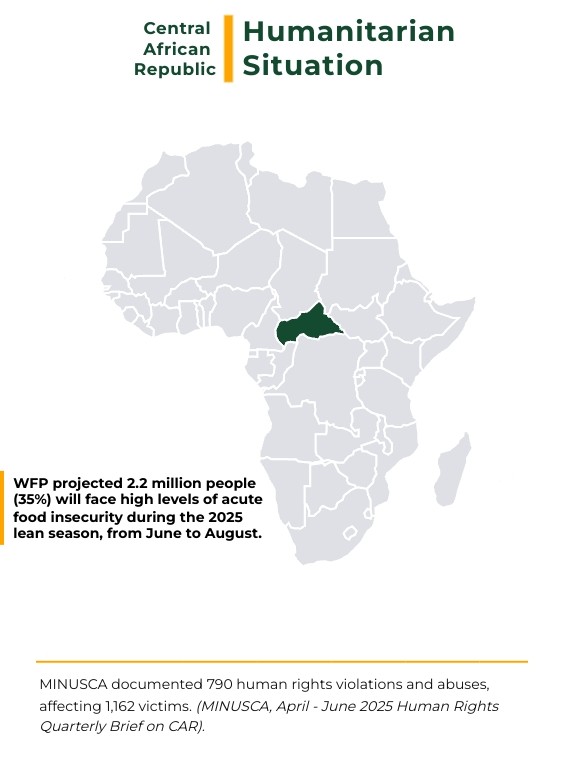
Apart from security dynamics and election deliberations, tomorrow’s meeting is expected to address the dire humanitarian and human rights situation, with civilians, particularly women and children, bearing the brunt of violence and displacement. According to the United Nations Office for the Coordination of Humanitarian Affairs (OCHA) 2025 report, 2.4 million people out of an estimated 6.4 million, representing 38 percent of the population, are considered extremely vulnerable, while one in five Central Africans is either internally displaced or living as a refugee abroad, largely due to conflict, violence, the collapse of essential services and increasingly extreme weather. Armed incursions from Sudan have caused casualties and mass displacement in regions such as Vakaga and Ouham-Fafa, localised flooding in Gbazara has worsened conditions for female-headed households, and the Sudan crisis has driven refugee influxes into northeastern CAR, in some places outnumbering host communities. Additional arrivals of Chadian refugees and CAR returnees in the northwest have intensified pressures, particularly as many areas are cut off during the June to December rainy season. The World Food Programme (WFP) projected that 2.2 million people, or 35 percent of the population, will face acute food insecurity during the 2025 lean season from June to August, while continued militia activity, intercommunal conflict and restricted humanitarian access exacerbate vulnerability, forcing displaced populations into negative coping strategies and exposing women and girls to heightened risks of gender-based violence, poor sanitation and lack of maternal care.
Human rights violations remain a major concern, with MINUSCA documenting 790 violations and abuses affecting 1,162 victims between April and June 2025. The UPC was identified as the primary perpetrator, accounting for 115 violations, while the national police were responsible for the highest number of victims (246). Another pressing issue is the persistent use of child soldiers, with Amani Africa highlighting that the exploitation of children in armed conflicts remains alarmingly widespread across Africa, and the Central African Republic stands out as one of the epicentres of child recruitment.
The expected outcome of the session is a communiqué in which the PSC is likely to reaffirm solidarity with the people of the CAR and welcome progress in implementing the 2019 APPR-CAR and the 2021 Luanda Roadmap, including recent disarmament commitments by groups such as the UPC and 3R. It may also condemn attacks on civilians and peacekeepers. The Council may encourage all stakeholders to engage in inclusive dialogue to guarantee credible and peaceful elections, welcome the deployment of the needs assessment mission in CAR, and call upon the AU Commission to enhance its technical assistance for the upcoming general elections. In doing so, the Council affirms its central role in upholding democratic principles, fostering transparency and ensuring that electoral processes contribute to long-term peace and stability. The Council is expected also to welcome Resolution 2789 (2025), consistent with its support for measures constraining non-state armed groups while reinforcing peace efforts, and Resolution 2759 (2024), which extended MINUSCA’s mandate until 15 November 2025. The Council may call for accountability of perpetrators and urge stronger coordination between MINUSCA and AU mechanisms, such as the Mission in the CAR (MISAC), while further emphasising the need to reinforce support for MISAC. On the humanitarian front, the PSC may call for resource mobilisation to assist refugees, IDPs and other vulnerable groups, underscoring the link between conflict, climate shocks and food insecurity.