
Why African Union’s membership in the G20 matters for both the G20 and Africa
Why African Union’s membership in the G20 matters for both the G20 and Africa
Date | 11 September 2023
Solomon Ayele Dersso with contribution from Lea Mehari
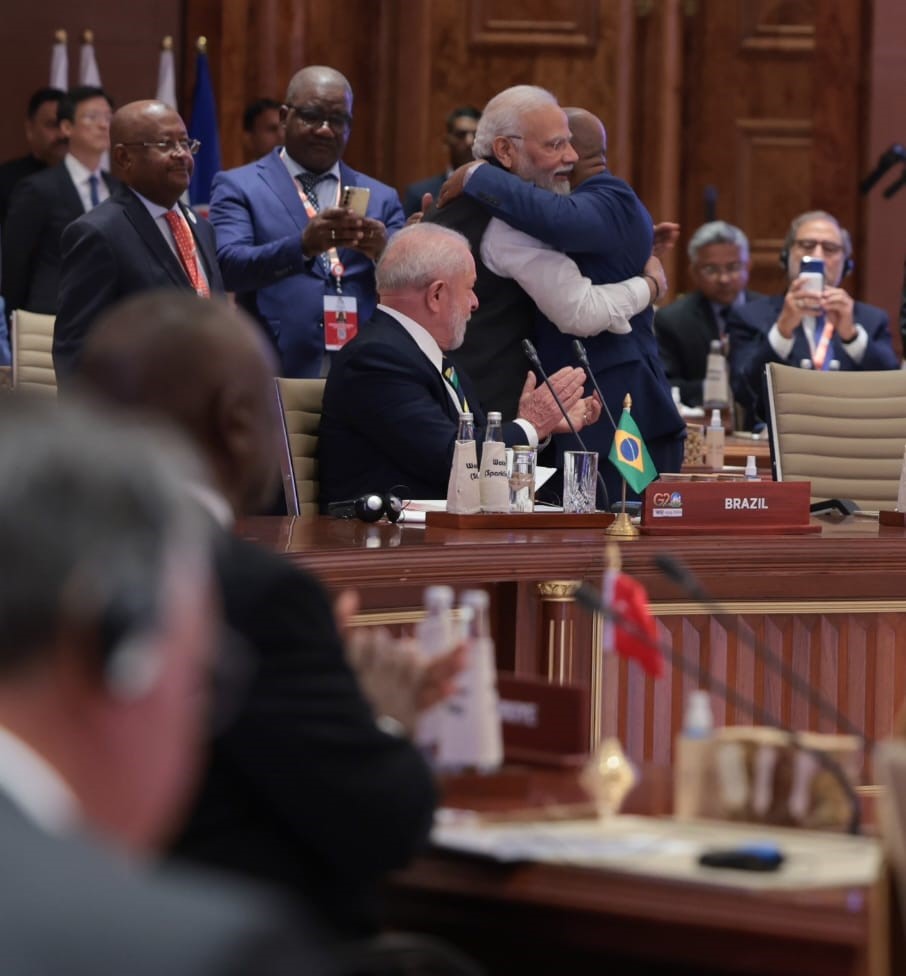
On Saturday 9 2023, which coincides with the African Union (AU) Day marking the anniversary of the decision for its establishment, the G20 in its meeting in New Delhi, India announced its decision of welcoming the AU as its new member. This can be transformative in profound ways for both the AU and the G20.
As with many key global governance multilateral platforms, Africa (despite its 55 AU member states, 1.3 billion people and resources on which developed and emerging economies depend for their economic growth) remained without seat at the G20, except the membership of South Africa.
The continent has thus largely remained receiver rather than shaper of decisions made at this global and major, but unrepresentative, forum of decision-making. With the entry of the AU, representing its 55 member states, into the G20 as a member, Africa is posed to change its status as an object of decision-making at the G20. On its part the global body enormously expanded its legitimacy and representativeness.
The G20 is a forum consisting of 19 of the most advanced and key economies plus, economically the largest regional organization, the European Union. The forum represents 75% of the world’s GDP, shaping global economic and political cooperation. Initially an informal platform to discuss international economic cooperation, it has evolved into a significant platform for global governance focusing on mobilizing policy responses to economic stability and global challenges.
By the nature of its composition, it is a body that gives the major powers and economies of the world heavy sway in global decision-making. At the same time, as a body deciding on major global economic and social issues, its role is not without consequences on the UN, as the most representative global forum for addressing global challenges. For Africa, which has the largest regional membership in the UN, the reduction of the role of the UN on account of the G20 becoming the major forum of decision-making on some of the most consequential global issues is not anything short of detrimental for its agency and representation in global economic and financial decision-making.
Without a voice at the table, Africa has thus far remained a passive receiver rather than an active contributor to discussions shaping its economic destiny. This has led to decisions that are not responsive to the needs of the countries of the region. Key initiatives, such as the G20’s Common Framework for Debt Treatment have fallen short in part due to the lack of African representation, rendering these decisions inefficient, slow, and ambiguous. Africa’s exclusion from the table also tilts the scales towards creditor nations, disproportionately affecting low-income countries within the continent.
These experiences are emblematic of how Africa’s exclusion is limiting the G20’s ability to formulate fully responsive policies even on matters of direct concern for Africa, thus limiting its capacity to devise inclusive and equitable solutions that are truly beneficial to the global community as a whole. AU’s active participation promises to ensure that G20’s policy decisions are fair for all stakeholders in the global economy: debtors and creditors.
For Africa as well, its representation through the AU would provide a platform for it to also put on the agenda of the G20 matters of concern that require international cooperation. For instance, consider the staggering illicit financial flows from Africa estimated at $88.6 billion, equivalent to 3.7 percent of Africa’s GDP, as per the United Nations estimates in 2020, encompassing revenues from unlawful activities, tax evasion, corruption, and more. This diversion of resources poses a significant impediment to economic development, hindering the progress towards both the UN’s 2030 Agenda on Sustainable Development Goals (SDGs) and the African Union’s Agenda 2063. Measures that could be adopted on this scourge at the level of the G20 could contribute enormously in countering this scourge, thereby contributing to availing huge resources that contribute to Africa’s development and the global goals of the Sustainable Development Goals.
Similarly, AU’s membership can also help to achieve clear strategic recognition at global level on the enormous potential of Africa to contribute to the global challenge of climate change. This the AU may achieve through, among others, facilitating understanding and clear appreciation of Africa’s enormous potential to play leading role in powering the global green transition and for developing cooperation framework for realizing this potential on a win-win basis.
The membership of the AU also provides the opportunity to redress the void created by the reduced role of the UN on economic policy making as a result of the emergence of the G20 as the main locus of international economic and development decision-making. AU’s membership would enable Africa to make up for the loss from the diminished role of the UN. It also gives Africa the opportunity to bring its standing as the largest block in the UN to bear on the work of the G20 and through that to also elevate its influence in the international financial system.

For AU’s membership in the G20 to harvest the expected dividends, there is a need for the AU to put in place effective structures and processes. Effective participation and influence in the G20 depend on such structures and process. In terms of representation, the decision of the AU is for the rotating Chairperson of the Union to seat on the AU seat in the G20 assisted by the AU Commission Chairperson. This essentially reflects the current practice of AU’s participation in G20 based on invitation. Yet, for this arrangement to work for the benefit of all the members of the AU, it is essential that the policy positions that the Chairperson of the AU presents at G20 are positions negotiated and adopted as common policy positions of the Union.
Beyond the representation at the G20 summit level, securing the interest of the continent through AU’s membership in the club necessitates that the AU is effectively represented in the meetings of the ministers, central bank governors and the G20 Finance Track and Sherpa Track technical working groups. Both for the participation in these key technical working groups and for helping with the development of the common positions, the AU Commission plays a key role. The AU Department of Economic Development, Trade, Tourism Industry and Minerals, properly staffed and capacitated, is best placed to play the role of the technical focal point in the AU Commission. For purposes of developing and negotiating common African policy positions both on matters on the agenda of the G20 and those that Africa wishes to advance as part of its membership in the G20 such as its vision of the reform of the multilateral financial institutions, there is a need for having a dedicated sub-committee of the AU Permanent Representatives Committee.
Considering the large number of meetings involved in G20 (over 200 such meetings were held for the G20 held in New Delhi), it is imperative that AU policy makers appreciate how AU’s membership in G20 transforms its role in global governance. The AU needs to move fast in developing a strategy for making the most out of its membership. Considering the enormity of the demand for active role, the AU also needs to articulate the capacity requirements, both at the level of the AU Commission, member states and in its representation in G20 countries, for it to fully shoulder the new and heavy responsibility in global governance that its membership in the G20 brings with it. Beyond AU actors, the role of the UN Economic Community for Africa, the African Development Bank and policy research organizations also needs to be effectively harnessed.
In the current multipolar world, the G20 needs Africa just as much as, if not more than, Africa needs the G20. With Africa’s full engagement, the G20 can reinvent itself and prevent the risk of the emerging decline of its relevance, particularly in the face of the increasing significance of BRICS. AU’s membership would be of enormous strategic consequence for global governance not just in terms of representation of Africa but also its potential to contribute to repurposing the G20 to be the vehicle for building a fairer, more prosperous, and sustainable world by leveraging multilateral bodies including the UN.
The content of this article does not represent the views of Amani Africa and reflect only the personal views of the authors who contribute to ‘Ideas Indaba’

Amani Africa Dispatch Ep3 - AU Membership in the G20: Boosting the Legitimacy of the Global Body
https://youtu.be/rJ3zfoHw_Po?si=-CXayDONYN2CULXs
Emergency session on the situation in Gabon
Emergency session on the situation in Gabon
Date | 31 August 2023
Today (31 August) at 3 pm East African Time, the African Union (AU) Peace and Security Council (PSC) is scheduled to convene an emergency meeting on the coup in Gabon.
On 30 August military officers appearing on national television announced the ouster of the government of the incumbent President Ali Bongo. The coup was announced soon after the announcement of the results of the general elections that Gabon held on 26 August. In the early hours of 30 August, the Gabonese Election Centre (CGE) announced the results of the presidential elections, declaring that the incumbent Ali Bongo the winner of the Presidential Election with 64.27 % of the votes cast.
The processes leading up to the announcement of the results were clouded with uncertainties, disputations and concerns about the transparency and credibility of the elections. While the leader of the opposition coalition Albert Ondo Ossa claimed victory in the elections, in the days ahead of the announcement of the election the opposition camp reported that the election was a ‘fraud orchestrated by Ali Bongo and his supporters’. This allegation came after the imposition of a curfew and the shutting down of the internet in the country by the government, thereby raising concerns that these measures were taken to create conditions for tampering with the election results.
The elections were indeed held under circumstances that cast doubt on the possibility of ensuring the credibility and transparency of the elections in a manner that reflects the will of the electorate. Election observers, including AU observers, were not welcomed. Some media outlets were suspended. The government also cut internet service and imposed a night-time curfew nationwide after the poll.
It is against this background that the military officers announced the seizure of power. Explaining their action, the senior military officers, self-styled as the ‘Committee of the Transition and the Restoration of Institutions, who seized power said that ‘[i]n the name of the Gabonese people … we have decided to defend the peace by putting an end to the current regime.’
Some members of the government were also arrested including the son of the president, Noureddine Bongo Valentin, the chief advisor of the president and his deputy, two other presidential advisors and two top officials of the ruling Gabonese Democratic Party (PDG). The military also put the ousted president under house arrest. Following the coup, the internet was restored. Yet, the coup makers maintained the nightly curfew imposed in place.
On the same day, the coup makers named General Brice Oligui Ngueme as the leader of the transition. General Ngueme, as head of the President’s Republican Guard, is not someone who is an outsider but very much internal to the regime. This signifies that while the coup removed the leader, the regime remains intact and in power.
As with other recent situations in countries that experienced coups, the ouster of Bongo was also greeted with celebrations from people. While the coup ushers in the end of a government that was in power for decades and opens a possibility for change, it does not provide a politically legitimate avenue for addressing the irregularities associated with the elections. In this respect, it would be of interest for the PSC to address the disputed elections including the convening of inclusive consultations with the opposition presidential candidates and the political parties for developing a roadmap for the convening of free and fair elections.
The AU Commission Chairperson issued a statement on the same day. Indicating that the chairperson was following the situation with great concern, the statement expressed his strong condemnation of ‘the attempted coup d’état’. He also encouraged ‘all political, civil and military actors in Gabon to give priority to peaceful political avenues and a rapid return to democratic constitutional order in the country.’ Similarly, the Secretary-General of the UN also firmly condemned ‘the ongoing coup attempt’ and expressed his ‘strong opposition to military coups.’
The PSC will make a determination on the application of Article 30 of the Constitutive Act within the framework of Article 7(1)(g) of the PSC Protocol. In light of the electoral crisis that preceded the coup, one of the issues for the PSC is how to facilitate a process that leads to not only the convening of free and credible elections, but also the building of fully functioning constitutional rule in Gabon.
The expected outcome of the session is a communique. The PSC may welcome the statement of the Chairperson of the Commission and express its condemnation of the coup pursuant to the AU norms banning coups including the African Charter on Democracy, Elections and Governance (ACDEG). The PSC may also decide to suspend Gabon from participation in the AU activities in accordance with Article 30 of the Constitutive Act and ACDEG. The PSC may express its concern about the recurrence of the holding of elections of questionable legitimacy and credibility and the need for African States to ensure that they create the space and mechanisms for ensuring that elections are held in accordance with the parameters set in ACDEG. With specific reference to the situation in Gabon, the PSC may call for the convening of consultation with the opposition political parties and presidential candidates to agree on a roadmap for the transition and the convening of free and fair elections. The PSC may also call for the removal of the military from politics and the establishment of an inclusive civilian transitional authority. It may also request in this respect that an AU high-level facilitator be designated with the responsibility of facilitating dedicated engagement for ensuring an inclusive civilian transition. The PSC may finally call for respect to ACDEG and respect for the rights of citizens including leaders and members of the opposition.