

Second Annual Consultative Meeting between the PSC and Representatives of CSOs and ECOSOCC
Second Annual Consultative Meeting between the PSC and Representatives of CSOs and ECOSOCC
Date | 6 July 2023
Tomorrow (6 July), the African Union (AU) Peace and Security Council (PSC) is expected to convene its 1161st session which will be dedicated to the second annual consultative meeting of the PSC with representatives of civil society organisations (CSOs) and the Economic, Social and Cultural Council (ECOSOCC).
Following opening remarks by Mohamed Lamine Thiaw, Permanent Representative of Senegal and Chairperson of the PSC for the month of July, AU Commissioner for Political Affairs, Peace and Security (PAPS), Bankole Adeoye is expected to make a statement. Representing ECOSOCC, Kyeretwie Osei, Head of Programmes will be delivering a statement. A representative of the Pan-African Civil Society Organizations Network on Political Affairs, Peace and Security will also be taking part in the session. CSO representatives from the five AU regions are also expected to make statements.
It is to be recalled that the PSC had its first consultative meeting with CSOs and the ECOSOCC on 14 September 2022, under the chairship of Ghana. Article 20 of the PSC Protocol which stipulates that the PSC shall encourage active engagement and participation of community-based and other CSOs in efforts aimed at promoting peace, security and stability in Africa, serves as the main basis for the conduct of the annual consultative meeting. Although yet to be explored, Article 8(11) of the PSC Protocol also envisages the holding of informal consultations with CSOs as one avenue of supporting the discharge of its responsibilities.
Further to the legal foundation provided under the PSC Protocol, the framework for engagement between the PSC and those in the CSO space is also articulated in the Livingstone Formula of December 2008, which was elaborated in line with the conclusions of PSC’s first retreat – the Dakar Retreat of 2007 which called for the development of a mechanism for managing engagement between the PSC and CSOs. The Maseru Conclusions of 2014 on Enhancing the Implementation of the Livingstone Formula for Interaction between the PSC and CSOs also form another important component of the framework for PSC-CSO engagement.
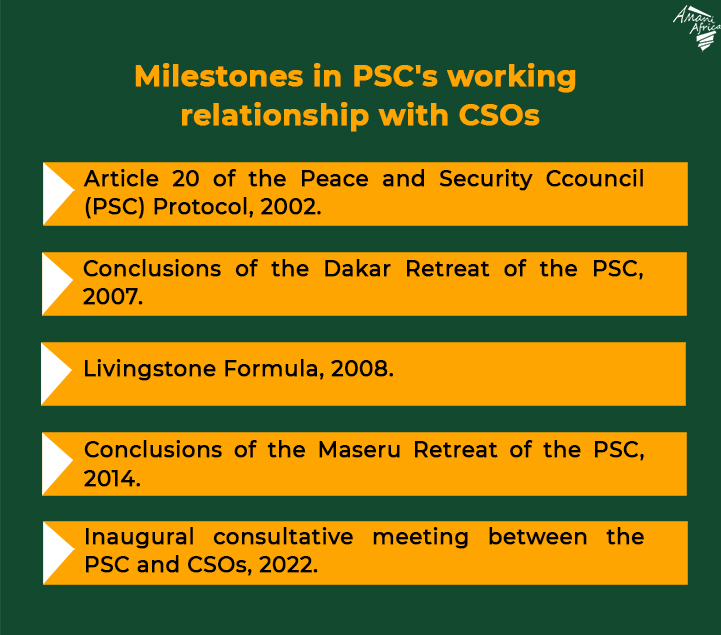
The normative provisions and the modalities outlined in PSC working methods attest to the recognition given to the significant contribution that CSOs make to the maintenance of peace and security in the continent. Yet, this recognition at normative level has not been systematically translated into practice, although the PSC has on many occasions invited the participation of CSOs in its sessions on thematic issues and on ad hoc basis. Indeed, outside of the ad hoc invitation extended to representatives of CSOs with relevant expertise to brief in sessions of the PSC on thematic issues and/or participate in open sessions of the PSC, there was no convening of the formal consultation between the PSC and CSOs until 2022. In this context, the holding of an annual consultation between the two not only institutionalises their engagement, but it also addresses gaps faced in terms of better refining the depth of discussions that can be held on a wide array of subject matters.
Those occasions when the PSC drew on the expertise and technical resources of research organizations and CSOs have attested to the value of such engagement in expanding the diversity of perspectives and policy issues. In the context of the expanding demand on the limited resources of the PSC, tapping into the expertise and technical resources of CSOs is not just a matter of legitimacy and normative commitment but it is also a strategic imperative. In the face of the growing peace and security challenges facing the continent, it has become increasingly clear that the effort of the PSC and state actors is not enough. The challenges require a whole of society approach in which CSOs in all their diverse formations and communities assume key role. This necessitates that attention is given to the engagement of CSOs both at the stage of policy making and implementation.
As the annual consultative meeting becomes institutionalized, one key issue that require attention is how to make it more than a ticking box exercise. This requires clarifying what the consultative meeting contributes to. The consultative meeting can be organized for the presentation by the CSOs of the five regions on the situation in the different regions from a non-state perspective, thereby contributing to the PSC’ report on the state of peace and security in Africa. It can also be an occasion for providing feedback on the policy actions of AU and Regional Economic Communities (RECs) on the various peace and security issues of the different regions with a view to contribute to the revision and updating of those policy actions.
The role of ECOSOCC is the other critical aspect in the relationship between the PSC and CSOs as envisaged in the Livingstone Formula and the Maseru Conclusions. ECOSOCC, an advisory organ composed of relevant professional and social groups from AU member states and whose central purpose is to promote and advance CSOs’ active involvement in shaping and contributing to AU’s programmes and policies, has been engaged in efforts that aim to establish a proper and systemic mechanism for enhanced engagement between the PSC and CSOs. It is to be recalled that ECOSOCC played the role of identifying the CSOs from the five regions that briefed the PSC during the inaugural consultative meeting held in September 2022.
In terms of follow up from the last session, the efforts by ECOSOCC to develop a comprehensive database of CSOs has in particular been identified as an important initiative at the inaugural annual consultative meeting of the PSC and CSOs. At the second consultative meeting taking place tomorrow, updates on progress made towards finalising the development of the database is expected to take centre stage among the envisaged discussions. Once finalised, the database is aimed to function as a hub of various accredited CSOs that could actively be engaged by the AU in its implementation of key agendas and initiatives, including those relevant to peace and security and the mandates of the PSC.
There are a number of advantages of developing the envisaged database. One important contribution such database could make is the identification and theme-based classification of CSOs. The idea of having a comprehensive database first of all enables a wide range of CSOs, including those at the grassroots level, to be in the records and gain a level of visibility that would enable them to actively participate in the policy space. At the same time, categorising the different CSOs on the basis of the main focus or central areas of work they are involved in allows the creation of thematic grouping of CSOs that have expertise in specific fields. For the PSC, this would be critical in gaining access to a ready list of CSOs with varied levels and areas of expertise, which can serve as the main source to guide PSC’s engagement.
Notwithstanding the potential contributions the CSOs’ database could make towards advancing better CSO engagement with the PSC, one should bear in mind the issue of inclusivity, particularly considering the diversity of CSO. ECOSOCC is currently in the process of conducting a series of consultations with various CSOs coming from the different sub-regions and engaged in a variety of thematic areas of works relevant to the PSC. The most recent of such consultations took place in April 2023, which afforded rich discussions between represented CSOs including Amani Africa and representatives from relevant AU departments as well as the various RECs. A follow-up consultation of the ECOSOCC is also expected to commence tomorrow, on 6 July as the PSC convenes its second consultative meeting.
Another issue that may come associated with the development of the database pertains to the creation of bureaucratic bottlenecks that may prove to be counterproductive. In this respect too, the PSC may wish to hear from ECOSOCC on what measures are put in place to ensure transparent processes in the utilisation of the database.
In addition to following up on the status of the development of the CSOs’ database, tomorrow’s meeting may also serve to reflect on where things stand with respect to implementing some of the key outcomes of the inaugural consultative meeting including CSOs efforts towards realising the decisions of the 16th Extraordinary Session of the AU Assembly on Terrorism and Unconstitutional Changes of Government (UCG) in Africa [Ext/Assembly/AU/Decl.(XVI)], as this formed one of the main areas discussed during the inaugural meeting, and the request made for ECOSOCC to conduct a stock taking exercise on the Livingstone Formula and Maseru Conclusions, so as to make recommendations for enhancing their realisation.
As an outcome of the consultative meeting, the PSC may issue a communiqué as it did for the last consultative meeting. Taking note of the progress made thus far in finalising the CSOs’ database, the PSC may encourage ECOSOCC to take all the necessary steps towards ensuring the finalisation of the database while ensuring inclusivity and transparency in the modality for its use. The PSC may underscore the significant role that CSOs play in supporting the realisation of its mandate in conflict prevention, management and resolution. It may further call on CSOs to fortify their efforts to respond to the increasingly complex and challenging threats to peace and security in the continent. Taking note of the critical role of CSOs in bringing the PSC and its policy decisions closer to African citizens, the PSC may also encourage CSOs in Africa to strengthen their role in promoting the culture of peace, in fighting misinformation, disinformation and incitement of hate and violence, in enhancing the adoption of informed policy decisions by relevant actors at national, regional and international level and in the advancement of the implementation of decisions for conflict prevention, management and resolution by the AU as appropriate. The PSC may also call for clarifying the focus and the end to which the consultative meeting contributes.
Provisional Program of Work for the Month of July 2023
Provisional Program of Work for the Month of July 2023
Date | July 2023
Senegal will be chairing the African Union (AU) Peace and Security Council (PSC) for the month of July 2023. The PSC’s Provisional Programme of Work includes four substantive sessions. One of the sessions will address country/region-specific issues, while the remaining three will cover thematic topics. All of the planned sessions are expected to be held physically, except for the only session that will be held at the ministerial level. The PSC is also expected to conduct a filed mission to the Sahel during the month.
On 6 July, the Peace and Security Council (PSC) will convene its first substantive session of the month through a consultative meeting with representatives of Civil Society Organizations (CSOs) and the Economic Social and Cultural Council (ECOSOCC). The holding of this meeting is in line with Articles 5 and 22 of the AU Constitutive Act, which establishes the ECOSOCC, and Article 20 of the Protocol Relating to the Establishment of the PSC. This is the second time that the PSC will be convening a consultative meeting with CSOs and ECOSOCC. It is to be recalled that the inaugural consultative meeting took place in September 2022. The convening of this second consultation promises to regularize the annual consultative meeting pursuant to the decision of the inaugural session. In the exchange, a selected CSOs from the five regions are expected to brief the PSC on their programs and activities. Those CSOs are also expected to share their proposals on how to enhance their cooperation with the PSC.
On account of the mid-year meeting of the Executive Council and the coordination meeting of the AU and the Regional Economic Communities/Regional Mechanisms (RECs/RMs) taking place during the week of 10 July, members of the PSC will be occupied with the session of the Permanent Representatives Committee of the AU and the will not accordingly convene session during that period.
On 21 July, the PSC will hold its second substantive and the only country specific session for the month. In this session, the PSC will be briefed on the situation in the Sahel. The last time the PSC discussed this issue was during its 1166th session in October 2022. However, discussions were focused on the political transition of Burkina Faso, Guinea and Mali during a session held in April 2023. During this session, the PSC requested for the revitalization of the Transition Monitoring Mechanisms for all countries in political transition as set out in PSC decisions. It is envisaged that the session will be briefed on the activities of the ECOWAS and CEN-SAD on the transition support mechanism.
Previously, the PSC also held its 1127th session that was dedicated to the deployment of 3000 troops in the Sahel Region. In the light of the decision of the Security Council to end the UN Mission in Mali the Multidimensional Integrated Stabilization Mission in Mali (MINUSMA) on the request of the de facto authorities of Mali, this session will serve to consider the requisite measures that should be taken to avoid the emergence of security vacuum and address the impact this may also have on the G5 Sahel operation which benefits from the support of MINUSMA.
On 25 July, the PSC will hold the third session of the month which will be aimed at discussing community responses to the security challenges on the continent. The session, which will be held at ministerial level, will be addressing the theme for the first time. In the light of the increasing militarization of the civilian population and the resort also of affected communities to self-defence groups and the associated challenges that arise from these developments, this session helps to understand these and related issues in community response to security challenges and explore relevant policy response measures.
The fourth session is scheduled to take place on 31 July to consider the Mid-Year Report of the Chairperson of the Commission on elections in Africa.The report aims to provide an overview of the outcomes of elections in Africa that were held or scheduled for 2023. The Chairperson’s report is expected to provide an outlook on the scheduled elections for 2023, as well as recommendations on how to improve electoral processes and outcomes. This session presents an opportunity for the PSC to engage in discussions and deliberations on upcoming elections in Africa. Moreover, given the potential for electoral violence in some countries, this session is also an opportunity for the PSC to explore ways to help member states prevent such violence.
In addition to the activities of the PSC, the programme of work encompasses the meeting of the Committee of Experts (CoE). The CoE is scheduled to convene on 18 July, to deliberate on the Terms of Reference for the PSC’s field mission to the Sahel. The field mission is anticipated to take place from 26 – 29 July. The visit is expected to enable the PSC to engage with member states in the region on developments related to the security situation in the wider region as well as political transitions in concerned member states
Furthermore, the CoE will discuss the preparation for the 3rd Annual Consultation meeting between the PSC and RECs/RMs Policy Organs. This item is intended to develop a comprehensive plan for the consultation in order to enhance the coordination and cooperation between the PSC and RECs/RMs. The issue of coordination and policy coherence between the PSC and RECs/RMs has increasingly become a major area of policy concern particularly since the past few years.
Amani Africa wishes to express its gratitude to the Australian Embassy in Ethiopia for the support in the production of this Insight on the Monthly Programme of Work of the AU Peace and Security Council
Annual Consultative Meeting between the Peace and Security Council (PSC) and Pan-African Parliament (PAP)
Annual Consultative Meeting between the Peace and Security Council (PSC) and Pan-African Parliament (PAP)
Date | 29 June 2023
Tomorrow (29 June) the African Union (AU) Peace and Security Council (PSC) is expected to convene its 1161st Session that is dedicated to an annual consultative meeting of the PSC with the Pan-African Parliament (PAP).
The PSC Chair for the month and Permanent Representative of Zimbabwe to the AU, Sophia Nyamudeza will be delivering the opening remarks. The Commissioner for Political Affairs, Peace and Security (PAPS), Bankole Adeoye, is also expected to make a statement. The President of the PAP, Fortune Charumbira is also expected to deliver a statement.
The convening of this session is grounded upon two legal bases. Firstly, the mandates of the PAP and the PSC are intertwined. One of the core objectives of the PAP, as stated in the 2001 Protocol to the Treaty Establishing the African Economic Community Relating to the PAP, is the promotion of peace, security and stability. Thus, PAP’s mandate has a component that overlaps with that of the PSC, although the PSC holds primacy on matters of peace and security.
Second and most importantly, tomorrow’s session is also convened within the framework of Article 18 of the PSC Protocol. This article provides for the establishment of a close working relationship between the PSC and the PAP, recognizing the complementary nature of their respective roles in the promotion of peace, security, and stability on the continent.
Despite this, the working relationship between the two in advancing peace and security has not been institutionalized. To-date, only two interactive sessions have taken place within the framework of Article 18 of the PSC Protocol. The first consultative meeting with the PAP was the 148th session that was held in August 2008, and the second and the last meeting was the 344th session held in November 2012. At the 344th session, a delegation from PAP’s Committee on Cooperation, International Relations, and Conflict Resolution (CCIRCR) engaged with the PSC on the relations between the two organs. The outcomes of those two sessions in 2008 and 2012 were a press statement.
The PAP’s general mandate, which is to ensure the full participation of the African people in the economic development and integration of the continent is stipulated under the Abuja Treaty, the Constitutive Act of the AU, and the Protocol to the Treaty Establishing the African Economic Community Relating to the PAP. Additionally, the PAP is invested with the role of receiving report from the PSC. Article 18 (2) and (3) of the PSC Protocol, the PSC is required to submit reports to the PAP through the AU Commission Chairperson whenever requested. The Chairperson also has the responsibility to present an annual report on the state of peace and security in the continent.
Yet, these mechanisms are as yet to be fully institutionalized. The lack of interaction between the PSC and PAP has been observed in the previous years, with the exception of statements delivered by the PSC Chairs during the Parliament’s Ordinary Sessions. During a debate on the status of peace and security in Africa on the second day of the First Ordinary Session of the Sixth Parliament in Midrand last November, the Chairperson of PAP’s CCIRCR has expressed concern that the relationship between the PSC and PAP has not developed as it should.
The above concern is true. The last time the PSC held a consultative meeting with PAP through CCIRCR at its 344th session, it commended the CCIRCR for the proposal it put forward at that session and ‘agreed to look in-depth into these proposals and other modalities for strengthening its relations with the PAP and to meet in due course to review the issue. Indeed, next steps towards addressing these concerns would require the elaboration of modalities for the operationalization of Article 18 of the PSC Protocol on close working relationship. The PSC may also invite PAP to update the proposal made during the last meeting in the light of developments since that meeting. Indeed, if the experience of the PSC with other AU bodies like the African Commission on Human and Peoples’ Rights under Article 19 of the PSC Protocol is useful guide, it would become most useful if proposal on how to operationalize Article 18 comes from PAP having regard to its mandate and how best the mandate can be leveraged in the implementation of the objectives of the PSC Protocol.
There are also institutional challenges that affect the effective operationalization of the relationship. One such challenge relates to the management issues afflicting the PAP over the past years, which tarnished the image of the institution and led to loss of confidence in the execution of its mandate. There is also the issue of the lack of ratification of the 2014 Protocol to the Constitutive Act of the AU Relating to the Pan-African Parliament (the 2014 PAP Protocol), which designates the PAP as the legislative body of the AU. As of 28 June 2023, 22 Member States had signed and 14 had deposited the instrument of ratification for the 2014 PAP Protocol. It is worth noting that only four of the current rotating chairs of the PSC have ratified the Protocol. This leaves the Protocol with half of the required member states to ratify the instrument for it to enter into force and for the Parliament to start implementing its legislative role. This continues to limit the substantive role of PAP, which in its current mandate is largely advisory. These should not however impede enhancing close working relations for leveraging the role of PAP.
For purposes of the peace and security component of its mandate, PAP has the CCIRCR, which is one of the ten (10) Permanent Committees of the PAP. Pursuant to the provisions of Rule 26(d) of the Rules of Procedure of PAP, the CCIRCR has the specific responsibility of introducing issues of peace and security in Africa for consideration of the Chamber.
In its consultative\advisory role, the PAP has since its earlier years sent various fact-finding missions to different conflict areas across the continent, including Cote d’Ivoire, Darfur/Sudan, Libya, Rwanda, Mauritania and Chad. These missions have produced reports, which are used to provide recommendations. It has also adopted resolutions for conflict resolution. Despite its mandate to forward these recommendations to all relevant bodies, including the PSC, there is no established means of communication for the PAP to transmit its recommendations. As a result, there is no record of the interaction between the PAP and the PSC regarding its recommendations on peace and security issues. Therefore, it is difficult to assert that the recommendations of the Parliament have been reflected in the decisions of the PSC.
In the earlier years of its establishment, the PAP also conducted election observation missions in various countries such as Kenya, Democratic Republic of Congo (DRC), and Zimbabwe for election observation. However, these election observation missions of the PAP have been discontinued since 2008. In a recent visit to the Parliament’s Headquarters in Midrand, South Africa, Commissioner Bankole Adeoye reaffirmed the decision taken by the Executive Council in February 2010. The decision stipulates that both the PAP and the AU Commission, through the Department of Political Affairs, Peace and Security, should collaborate in a joint AU Election Observation Mission (AUEOM). Furthermore, it allowed the PAP to contribute 40% of the observers to the mission. Tomorrow’s session may reflect on the follow up on this plan and whether PAP can best contribute to promoting free and fair elections other than through being part of AU election monitoring. This latter part is particularly important as PAP could deploy ahead of the convening of elections and share its observations on measures that need to be taken for enhancing credibility of elections in countries planning to have elections.
Although the outcome of the session is uncertain, the expressed need for collaboration between the two organs by Ambassador Emilia Ndinelao Mkusa, the PSC Chair for the month of November 2022, and the readiness to work together by Commissioner Adeoye, creates an expectation that the PSC adopts modalities for enhancing close working relationship with the PAP.
Irrespective of the format of the outcome of the consultative meeting, the PSC is expected to welcome updates from the PAP on the activities undertaken in relation to peace and security and to continue cooperation through the annual consultative meeting within the framework of Article 18. In addition, the PSC may call for modalities to operationalize Article 18 and in this respect invite PAP to update and present for PSC’s consideration the proposal it made at the 344th session of the PSC. The PSC may indicate that such proposal consider establishing a mechanism for the communication of decisions and recommendations of PAP on peace and security in order to ensure coherence and complementarity in decision-making processes. Furthermore, the PSC may decide to hold regular interactions between the PSC Chairperson and the Chairperson of the PAP. The PSC may also welcome the engagement of PAP in peace and security issues including through the issuance of statements on peace and security developments and indicate the importance of coordination to enhance effectiveness and coherence. Lastly, the PSC may urge Member States to ratify the 2014 PAP Protocol to fully operationalize the Parliament.
Monthly Digest on The African Union Peace And Security Council - May 2023
Monthly Digest on The African Union Peace And Security Council - May 2023
Date | May 2023
In May, Uganda chaired the African Union (AU) Peace and Security Council (PSC). In total, the PSC held seven meetings. For the first time, the PSC also held an informal engagement with the Chairperson of the AU, President Azali Assoumani of the Comoros. In early May, the PSC held the annual consultative meeting with its European Union (EU) counterpart, the European Political and Security Committee (EU PSC).