
Monthly Digest on The African Union Peace And Security Council - October 2024
Monthly Digest on The African Union Peace And Security Council - October 2024
Date | October 2024
In October 2024, the African Union (AU) Peace and Security Council (PSC) undertook its activities under the chairship of the Arab Republic of Egypt. The PSC’s initial Provisional Programme of Work (PPoW) envisaged eight substantive sessions with nine agenda items to be covered for the month. While the PPoW underwent two revisions, this mainly led to shifts in planned sessions and activity dates.

Can a unified leadership of the A3+ help in navigating the geopolitical gridlock in the UN Security Council in relation to African files?
Can a unified leadership of the A3+ help in navigating the geopolitical gridlock in the UN Security Council in relation to African files?
Date | 28 November 2024
Solomon Ayele Dersso, PhD
Founding Director, Amani Africa
Kaleab Tadesse Sigatu
Associate Researcher, Amani Africa
The 18 November 2024 Russian veto against the United Nations Security Council (UNSC) resolution on Sudan triggered understandable consternation. This development raises a major policy issue for the African Union (AU) and the three African members of the UNSC plus (A3 plus – currently made up of Algeria, Mozambique, Sierra Leone plus Guyana). This issue principally concerns how the A3 plus can facilitate consensus in the UNSC on African files and thereby help overcome the impact of the hardening rift in the Permanent five members of the UNSC (P5) and the rising resort to the use of veto even in relation to African files as highlighted by the recent voting in the UNSC on a resolution on Sudan.
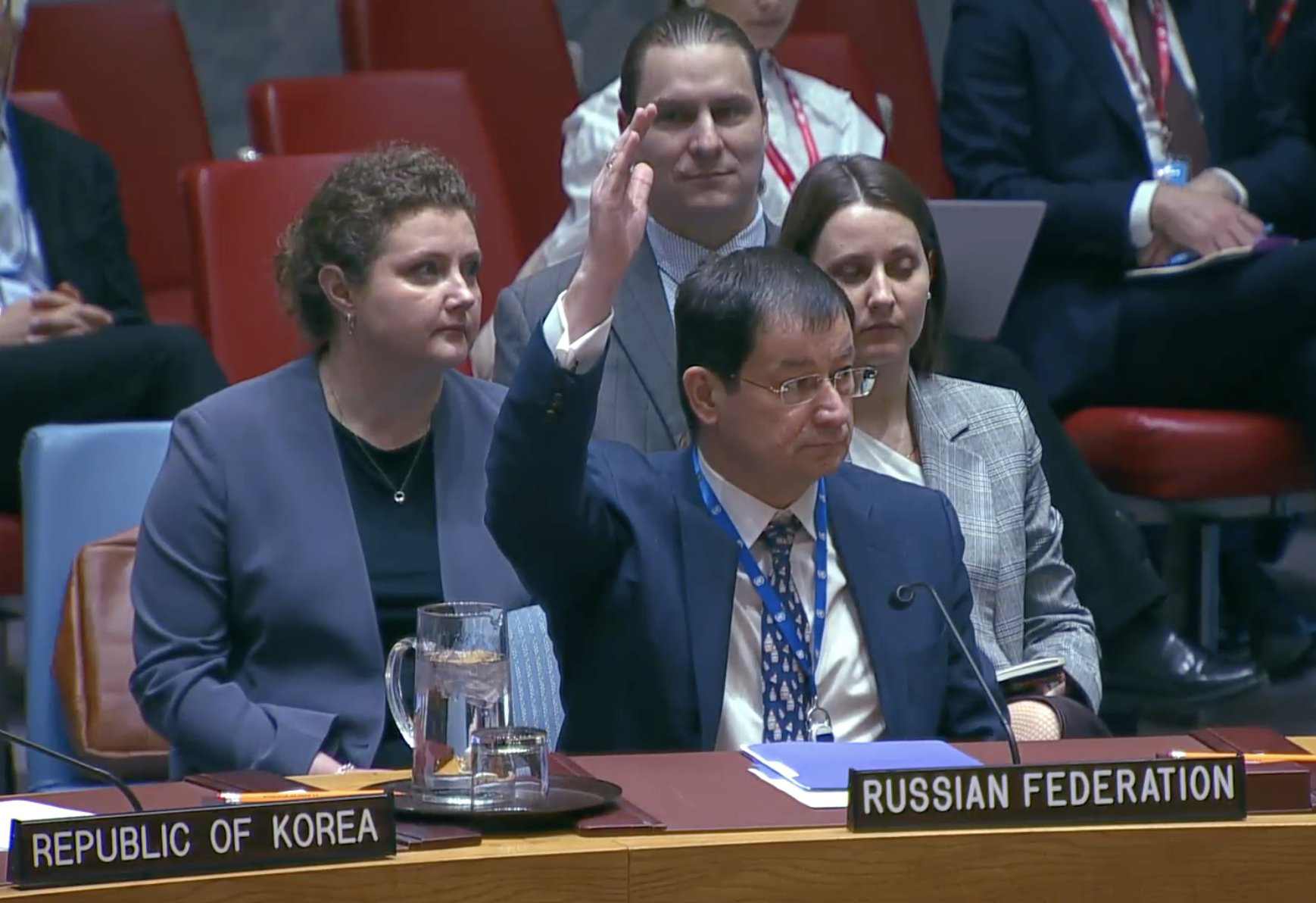
In recent years, the space for effective collective action in the UNSC has enormously dwindled. This in the main is owing to the rising geopolitical contestation on the part of the P5. One of the indices of this is the increasing use of the veto by the permanent five members of the UNSC. In 2024, a total of 7 vetoes were cast, making it the highest number of vetoes in a single calendar year since 1989.
While the deadlock in the P5 has until recently had limited impact on African files, this is no longer the case. As a result, the deepening geopolitical division in the P5 is also affecting African files on which the P5 have generally managed to achieve consensus in previous years. Such is particularly the case in instances in which the A3 are unable to take a unified position and robust African Union (AU) Peace and Security Council (PSC) backing is lacking.
On 18 November 2024, the UNSC failed, on account of a veto by Russia, to adopt a Resolution aimed at advancing measures to protect civilians in Sudan, as the war grinds on, killing tens of thousands of Sudanese and causing the largest displacement crisis in the world, with over 13 million people displaced. The draft resolution demanded the Sudanese Armed Forces (SAF) and the Rapid Support Forces (RSF) honour and fully implement their commitments in the ‘Declaration of Commitment to Protect the Civilians of Sudan’, which was signed by both sides in Jeddah on 11 May 2023.
The draft text was co-authored by the UK (the penholder on the Sudan file) and Sierra Leone. The UK apparently invited the A3 plus members (Algeria, Mozambique, Sierra Leone, and Guyana) to be co-authors on the draft resolution. However, the A3 plus members were unable to reach a unified position on taking this as a group. This led to Sierra Leone serving as the only co-penholder of the resolution. Sudan’s representative was invited to participate in the meeting.
Russia’s veto has the appearance of being a result of its increasing shift towards the Transitional Sovereign Council and the exchanges during the voting also suggest it is also a manifestation of the divide in the P5 reflecting the tension between Russia and the UK, which is the pen holder on Sudan. Yet, the fact that the A3 plus, despite voting in favour of the resolution on 18 November, were neither fully united nor took the lead on the file might have also played a role. Apart from the inability of the A3 plus to join in co-pen holding for drafting the particular resolution, the A3 plus did not take the same position on various aspects of the resolution during negotiation on the draft, as documented in SCR analysis.
As shown in the table below, there have at least been seven instances in which the UNSC considered products on the situation in Sudan since the outbreak of the current war in April 2023. While Russia abstained from many of them, the UNSC managed to adopt all of them until the latest resolution was vetoed by Russia.
UN Security Council Resolutions on Sudan
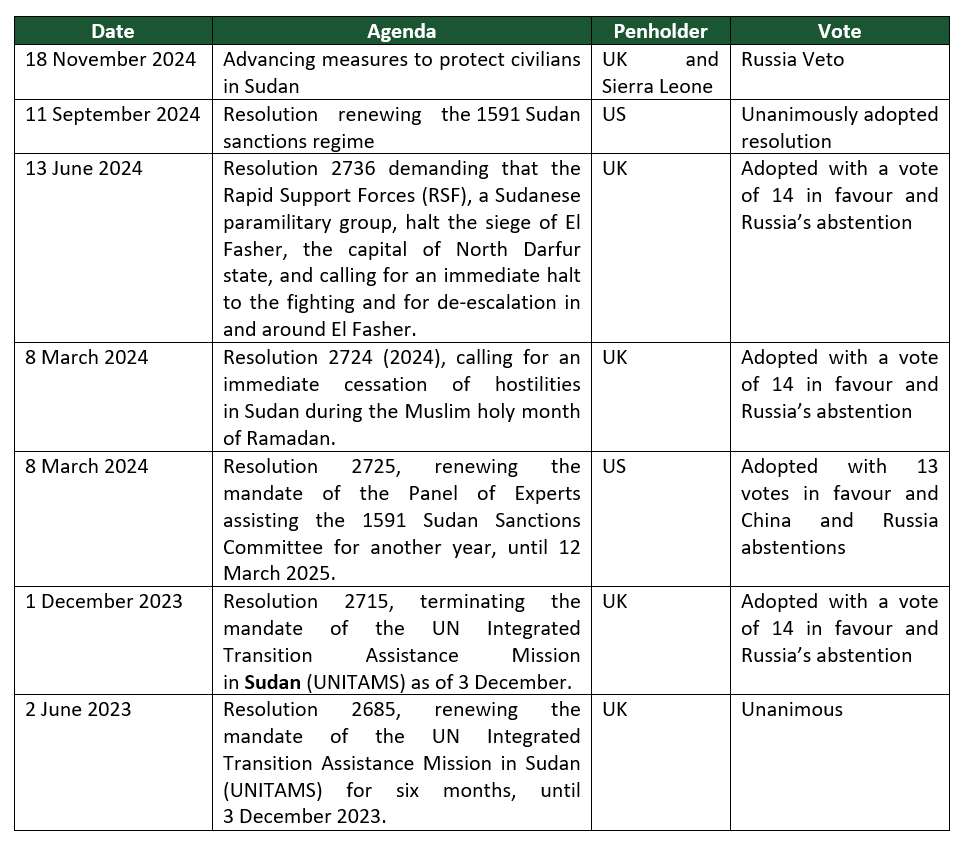
Source: Compilation by author based on materials from the Security Council Report
The latest voting on Sudan is clearly a warning sign, if not a turning point, that UNSC products on African files are no longer immune from being vetoed. This is particularly true in cases where the A3 plus are not fully united and not on the lead on a file. The upshot of this is that there is room for the A3 plus and the AU, particularly through the PSC, to help shield African files from the most severe manifestation of the tension in the P5. For this, all that is needed is to build on and expand the existing working arrangement that facilitates A3 plus collective stand.
It is worth noting that in order to mitigate the fact that Africa has no permanent representation in the UNSC with full prerogatives accorded to the P5, a major avenue the AU instituted the constitution of the A3 into a unified block. This has increasingly enabled the A3 plus and the AU to exercise rising influence in the UNSC as documented here and here, despite the fact that it may at times have the effect of limiting the UNSC’s engagement. It is anticipated that the influence of the A3 plus will further increase in the context of the deepening rift in the P5.
In view of the latest failure of the UNSC to adopt the resolution on Sudan, one potential area for such growth in the influence of the A3 plus is how the A3 plus both achieve unity and takes lead in drafting of UNSC products on African files. If such a way of organising is used for enhancing effective engagement of the UNSC rather than preventing its role, it has the potential for facilitating consensus and overcoming the gridlock in the P5 and avoiding veto.
This however requires addressing at least two challenges in how the role of the A3 is organised. The first of these, which is advanced by the AU policy organs and the A3 themselves, is the assumption of the role of pen-holding by the A3 plus particularly on African files. While there has been progress in this respect in recent years, the A3 plus have as yet to effectively assume this critical, if challenging, role. The second area is the crafting of unified position by the A3plus to speak with one voice and negotiate as a block, something on which the A3 plus has achieved substantial progress.
Furthermore, if the AU PSC institutes a practice of providing clear guidance on African files under consideration in the UNSC, thereby throwing its full weight behind the lead of the A3, it could enhance the legitimacy and support for A3 plus initiated resolution. Such strong engagement and backing of the PSC facilitates the conditions for achieving consensus in the UNSC and making vetoing, very difficult, although not necessarily impossible.
As the PSC convenes the 11 annual high-level seminar of Oran on peace and security focusing on the role of the A3 plus on 1-2 December 2024 in Oran, Algeria, one of the issues worth reflecting on is how to advance effective international action by the UNSC by limiting the deleterious impacts of the deepening contestation in the P5 on African files. As discussed above, the case of the vetoed UNSC resolution on Sudan offers a useful basis for informing the elaboration of such policy approach.
The content of this article does not represent the views of Amani Africa and reflect only the personal views of the authors who contribute to ‘Ideas Indaba’
Discussion on experiences and lessons learned in the implementation of the PSC mandate in line with the AU Constitutive Act and its Protocol
Discussion on experiences and lessons learned in the implementation of the PSC mandate in line with the AU Constitutive Act and its Protocol
Date | 27 November 2024
Tomorrow (28 November), the African Union (AU) Peace and Security Council (PSC) will convene a ministerial session on ‘Discussion on experiences and lessons learned in the implementation of PSC mandate in line with the AU Constitutive Act and its Protocol.’
The session will commence with opening remarks from Thérèse Kayikwamba Wagner, Minister of State of the Minister of Foreign Affairs and Chairperson of the PSC for the month of November. This will be followed by a statement from Bankole Adeoye, Commissioner for Political Affairs, Peace and Security (PAPS).
The thematic focus of tomorrow’s session seeks to draw attention to elements of the implementation of the mandate of the PSC not closely explored in the context of the stocktaking sessions that the PSC dedicated in the context of its 20th anniversary that is being marked this year. These previously unexplored elements of the implementation of the mandate of the PSC are expected to be those to be drawn from the reference to the AU Constitutive Act. While the AU Constitutive Act covers various elements relating to the broader mandate of the AU, some of the objectives and the principles it outlines constitute the bedrock on which the edifice of the mandate of the PSC is built. In this context, the dimensions of the mandate of the PSC that have not been addressed in the various sessions that the PSC dedicated in the course of the year (including in the high-level colloquium held at heads of state and government level in May 2024) mostly concern those pertaining to inter-state relations.
Tomorrow’s session is the first time that the PSC will mainly focus on the issues around inter-state relations in Africa that concern the mandate of the PSC. These principally derive from some of the key objectives and principles enunciated in Articles 3 and 4 of the Constitutive Act of the AU. Of significance in the objectives set out under Article 3 are those that seek to ‘a) achieve greater unity and solidarity between the African countries and the peoples of Africa b) defend the sovereignty, territorial integrity and independence of its Member States… e) promote peace, security, and stability on the continent.’ Of the 18 principles listed under Article 4 of the Constitutive Act, the ones that are of paramount significance to the mandate of the PSC include: sovereign equality of states; non-intervention in the internal affairs of states; peaceful resolution of conflicts among member states of the Union; prohibition of the use of force; uti positidetis or respect for the borders inherited at the time of independence; and peaceful co-existence of member states and the right to live in peace and security.
There are at least three factors that make the focus on these dimensions of the mandate of the PSC timely and of strategic significance for the effective functioning of the PSC. The first factor relates to the resurfacing of inter-state tensions on the continent in the context of weakening multilateralism globally and at continental and regional levels, rising mistrust and the rise of global power contestation over Africa. While inter-state conflicts did not completely disappear during the two decades of existence of the PSC, the conflict situations that dominated the agenda of the PSC during the past two decades are mostly intra-state. Amani Africa’s latest special research report presented that ‘[i]nternationalized internal armed conflicts have steadily increased, indicating a rise in conflicts involving multiple states or international actors. The data shows a general upward trend from 2013 (7 conflicts) to 19 conflicts in 2020.’ This trend has shown further increase during the past few years and is not confined to a few regions. Such tensions are visible not just in the Horn of Africa and the Great Lakes Region where such tensions are not uncommon but in other regions including Southern Africa and North Africa. One most current illustration of this is the formal complaint that the Government of Sudan filed with the African Commission on Human and Peoples’ Rights against Chad.
The second factor, not completely separate from the first is, the fact that many of the intra-state conflicts tend to have an international or transnational dimension. Despite the fact that most conflicts in Africa tend to be intra-state, in many instances they attract the involvement of outside state or non-state actors. A recent study established that most so-called ‘civil wars’ are internationalised reflecting some form of involvement of actors from states from the region or outside the region and that ‘[w]hile conventional interstate war remains rare, interstate rivalry using military means is common.’ Tomorrow’s session focuses on the inter-state relations dimension of the mandate of the PSC helps in drawing attention to and factoring in the international or transnational dimension of intra-state conflicts in initiating peace processes.
The third factor that makes the focus of tomorrow’s session particularly significant for the mandate of the PSC is the fact that the implementation of the PSC’s mandate is premised on a deeper level of collaboration and trust between member states. Where mistrust and tension pervade inter-state relations, the inter-state cooperation necessary for collective action through the PSC weakness. As the Common African Defense and Security Policy put it, there is a need, among others, for ‘eliminating suspicions and rivalry among African States’ and promoting ‘mutual trust and confidence among African States.’ The main reason for the focus on these strategic aims, as the Policy puts it accurately, is because ‘suspicions and rivalry among African States’ is ‘a factor that has traditionally engendered conflicts on the continent and hindered inter-state cooperation and integration in Africa.’
During tomorrow’s session members of the PSC will also reflect on experiences and lessons learned from the two decades journey of the PSC. While much of the conflict situations that dominated the agenda of the PSC remain intra-state conflicts, there have been instances in which inter-state tensions or conflicts featured on the agenda of the PSC. Reference can be made in this respect to the 33rd, 121th, 125th, 140th, 496th, 547th, 588th, 668th, 873rd, 984th, 1192nd, 1222nd and 1238th sessions of the PSC. One of the lessons that these cases make clear is that not the full universe of situations involving inter-state tensions that the PSC has been seized with.
The outcome of these sessions shows that, apart from being seized with such situations, the PSC has made use of a range of instruments. These include a) mediation/peacemaking as illustrated by the work of the AU High-level Panel on Sudan with respect to the 2012 confrontation between Sudan and South Sudan and the Luanda process currently mediating between DRC and Rwanda, b) fact-finding missions or reconnaissance missions as the PSC proposed for the conflict between Djibouti and Eritrea and Great Lakes Region, c) good offices of the AU Commission Chairperson and d) very rarely condemnation.
In the context of some of the concerning trends highlighting the resurfacing of inter-state tensions, the lesson encapsulated in the Common African Defense and Security Policy that suspicions and rivalry among African states engender conflicts remains relevant today. This underscores the need for the AU to enhance its diplomatic posture for mitigating the factors that fuel tension and facilitating dialogue for nurturing inter-state trust. Central to the enhancement of this diplomatic standing of the AU is securing and asserting its impartiality and credibility. The wisdom that UN Secretary-General Antonio Guterres articulated in his New Agenda for Peace Policy Brief is instructive in this respect. He stated that ‘an effective collective security system relies on an international civil service that is strong, efficient and impartial.’ Beyond and above being a key marker of an international civil service, impartiality, as Guterres rightly noted, ‘is vital in helping build trust among Member states.’
Considering the serious adverse impacts of inter-state tensions irrespective of the form that they take, they necessitate a more proactive diplomatic engagement in promoting the Common African Defense and Security Policy with a focus on the inter-state conflicts/threats to common security threats and hence posing a challenge to the principles of the AU Constitutive Act.
The expected outcome of the session is a communiqué. The PSC is expected to underscore the need for safeguarding the core principles of the AU as enunciated in Article 4 of the AU Constitutive Act. It may express concern over trends highlighting increasing incidents of inter-state tensions It may also call for enhancement of the diplomatic posture and the instruments at the disposal of the AU as critical for advancing friendly relations and trust among AU member states in pursuit of the common objectives set out in the Constitutive Act and Agenda 2063. The PSC may call for member states of the AU to recommit themselves to upholding the principles of state sovereignty and territorial integrity and peaceful resolution of conflicts. It may decide to dedicate a session as part of its annual calendar of events focusing on advancing the implementation of the Common African Defense and Security Policy as a critical avenue for promoting the core principles of the AU Constitutive Act that constitute part of the mandate of the PSC. To this end, the PSC may call for a summit-level meeting for a strategic review of the state of peace and security and the implementation of the mandate of the PSC including as it relates to the Constitutive Act of the AU and for charting ways of promoting friendly relations among African nations as a basis for the integration agenda of the AU.
Briefing on Continental Early Warning and Security Outlook
Briefing on Continental Early Warning and Security Outlook
Date | 26 November 2024
Tomorrow (27 November), the African Union (AU) Peace and Security Council (PSC) is expected to convene its 1247th session to receive a briefing on continental early warning and security outlook. This briefing is expected to be delivered by the Committee of Intelligence and Security Services of Africa (CISSA); the African Union Mechanism for Police Cooperation (AFRIPOL) and the AU Counter Terrorism Centre (AUCTC) – formerly African Centre for the Study and Research on Terrorism (ACSRT)).
Following opening remarks from Jean Léon Ngandu Ilunga, Permanent Representative of the Democratic Republic of Congo (DRC) to the AU and Chairperson of the PSC for the month of November, Bankole Adeoye, Commissioner for Political Affairs, Peace and Security (PAPS) Department, is expected to make a statement. It is also expected that Executive Secretary of CISSA, Jackson V. Hamata will make a statement. Representatives of AFRIPOL and AUCTC are also expected to deliver briefings.
This session is meant to present an early warning analysis focusing on the political, security and socio-economic dynamics shaping and informing existing and emerging conflict and security conditions on the continent. However, instead of the Continental Early Warning System established under Article 12 of the PSC Protocol, this session is being organised around the work of CISSA, AUCTC and AFRIPOL. This tends to limit the scope of analysis of threats to the domain of intelligence and crime, hence state-centric hard security issues. The implication of this is that it does not account for risks of conflict eruption or expansion involving political, social, economic and environmental issues. This once again underscores the need for anchoring the CEWS in a dedicated structure in the Department of PAPS consistent with Article 12 of the PSC Protocol. In this context, in the communiqué it adopted when it held its last session on this subject, the PSC underscored the imperative of ‘a robust and fully functional CEWS to effectively pre-empt and mitigate conflicts’ and further called for ‘enhanced inter-agency collaboration, technological advancement, capacity building and increased political engagement and advocacy aimed at fostering a cohesive CEWS.’ It would be of interest for members of the PSC to seek an update from the AU on the follow-up on this decision from the PSC’s 1208th session.
The last time the PSC convened a substantive session on this subject was on 16 April 2024 during its 1208th session on the ‘Joint Briefing by CISSA, ACSRT and AFRIPOL on unblocking obstacles to effective Continental Early Warning System (CEWS).’ It should also be recalled that in paragraph 11 of the communiqué, the Council requested the Commission to undertake a number of measures and report to the Council before the end of the year 2024, to unblock obstacles and ensure effective early warning and response.
There is a need for paying increasing attention to intercommunal conflicts that constitute the majority of non-state conflicts in Africa. This necessitates enhancing the development and use of peace and security tools tailored to addressing such non-state conflicts. Of interest in this respect are the need for enhancing the mapping of intercommunal conflicts and their trends through the Continental Early Warning system. It also necessitates the enhanced use of interventions that target the impacts of climate change, enhance peaceful dispute resolution mechanisms between diverse communities and deliver livelihood enhancing and other adaptation support.
During tomorrow’s session CISSA, AUCTC and AFRIPOL will provide updates and briefings on trends relating mostly to terrorism and violent extremism, transnational organised crime such as cybercrimes, human trafficking and such other security threats as arms proliferation. It is worth noting that these conditions are exacerbated by maritime insecurity and piracy affecting. Additionally, there are growing tensions between states, a resurgence of Cold War-like geopolitical rivalries and a significant governance deficit. Political inequities and corruption along with rising cost of living and rampant unemployment are leading to your led mass protests and political instability. This year parts of the continent have also faced health threats from the Marburg and Mpox pandemics. The continent also faces prolonged humanitarian crises, forced displacement and the weaponisation of sexual and gender-based violence. Compounding these issues are tensions over access to and illegal exploitation of natural resources, climate insecurity as a threat multiplier and emerging challenges related to new technologies and cybersecurity.
It is expected that in tomorrow’s session, the AUCTC will give an overview of the terrorism situation in Africa since its last briefing, with a regional focus and factors contributing to this. The proliferation and entrenchment of terrorist and violent extremist groups throughout Africa have turned various regions into hotspots of instability, making the continent one of the most severely affected by terrorism worldwide. As highlighted in a recent Amani Africa analysis on counterterrorism, Africa has seen a significant surge in both the proliferation of conflicts involving terrorist groups and their impact across the continent. The 2024 Global Terrorism Index (GTI) revealed that, for the first time in 13 years, a country other than Afghanistan or Iraq has taken the top spot, with Burkina Faso now ranked first. Mali and Niger also remain heavily affected by terrorism. The Sahel continues to be recognised as the epicentre of terrorism, not only in Africa but globally. According to the ACSRT Report, ‘a decade ago, the Lake Chad Basin was the focal point of the violent extremist threat, comprising 13,670 annual fatalities—67 per cent of the reported fatalities across the continent. North Africa was second, with 3,650 fatalities. Today, annual deaths in the Lake Chad Basin have declined almost fourfold from that high-water mark (though still above 3,600) while North Africa has the least reported fatalities of any of the five active regions.’ In addition, also a decade ago, ‘the Sahel was the region facing the fewest deaths linked to violent extremism. Today it is the region with the most fatalities, a distinction it has held for the past 3 years. It is reported that Somalia has arguably encountered the most persistent and severe violent extremist threat on the continent over the past decade. Currently, the Sahel and Somalia together account for over 80 per cent of all violent extremist-related fatalities on the continent.
It should also be recalled that the PSC during its 1237th meeting, requested the Commission to report back to Council, by the first quarter of 2025, on the steps taken to establish and operationalise the PSC Sub-Committee on Counter-terrorism. It is also expected that tomorrow’s session will give an update following Council’s previous request to AUCTC to ‘undertake a study on youth indoctrination and the prevention of the risks of radicalisation and violent extremism among young people…’
Another element that is expected to feature in tomorrow’s discussion is an overview of transnational organised crime by AFRIPOL. It covers not only criminal activities involving trafficking of various kinds but also the proliferation of drug trafficking and counterfeit pharmaceutical products but also cybercrimes accompanying the expansion and increasing reliance on new communication technologies including mobile banking. The main interest in receiving these updates for the PSC lies in the interface between these criminal activities and conflicts and their implications in corrupting political activities and undermining state authority.
According to Amani Africa’s, Towards a New Agenda for Peace and Security in Africa: New Security Threats and the Future of the Peace and Security Council, one of the new security threats in Africa arises from the expansion of the use of emerging technologies. It is expected that tomorrow’s session will give an overview of the emerging technologies vis-à-vis peace and security. It should be recalled that the 2024 Africa Cyber Threat Assessment Report by the INTERPOL underscored the alarming rise of cybercrime across Africa, identifying it as one of the continent’s most rapidly emerging threats. The rising use of digital technologies, such as mobile banking, has intensified the region’s susceptibility to cyber threats. The influx of new users the shift of governments and other organisations to digital technologies and the weaknesses of current protective measures against the constantly evolving methods of cyberattacks have resulted in a rise in successful cyberattacks across the African continent. According to Check Point, ‘the number of cyberattacks on enterprises in Africa increased by 20% in the first quarter of 2024 compared to the same period last year.’ These developments highlight the need for enhancing capabilities for preventing and mitigating cyber-attacks and crimes at the national level.
Beyond the foregoing, it would be of major interest for the PSC to consider in its discussions the impacts of climate change on peace and security. Beyond exacerbating intercommunal violence, such as the conflicts between herding and farming communities in parts of West Africa and the Sahel due to intensified competition for increasingly scarce resources, climate-induced weather events—including droughts and flooding in the Horn of Africa—continue to devastate large segments of the population across the continent. These climatic challenges not only strain the continent’s humanitarian response capacity but also severely hinder the abilities of states and multilateral bodies to manage existing security issues and conflicts effectively.
The expected outcome of tomorrow’s session is a Communiqué. The council is likely to express deep concern, over the persistence and escalation of peace and security threats in the Continent, both, man-made and natural. The PSC may reiterate its decision from its 1208th session on the imperative of ‘a robust and fully functional CEWS to effectively pre-empt and mitigate conflicts’. In this regard, it may call for the need for anchoring the CEWS in a structure dedicated to CEWS. The PSC may reiterate the commitment under the Dar es Salaam Declaration, adopted on 25 May 2024 at the High-Level Colloquium in commemoration of the 20th anniversary of the PSC to enhancing the PSC’s conflict prevention mandate, including by responding swiftly to early warning signs of looming conflicts and crises. The PSC may also reiterate the need for follow up on the request made during the Cairo Retreat held in October 2018 for the establishment of a ‘trigger mechanism and indicators’ to facilitate early action. The PSC may also underscore the need for a dedicated structure for CEWS in PAPS as critical to compliance with the PSC Protocol as envisaged in Article 12 of the PSC Protocol. It may encourage CISSA, AUCTC and AFRIPOL to enhance their coordination with states and initiatives for cross-border measures for tracking and foiling transnational criminal networks and activities. The PSC might also take note of concern for both emerging and ongoing peace and security threats in Africa. It may emphasise the need for the AU to implement deliberate and targeted strategies addressing the various threats to peace and security on the continent.
Discussion on enhancing mechanisms for curbing illegal exploitation of natural resources by armed and terrorist groups in Africa
Discussion on enhancing mechanisms for curbing illegal exploitation of natural resources by armed and terrorist groups in Africa
Date | 25 November 2024
Tomorrow (26 November), the African Union (AU) Peace and Security Council (PSC) will convene its 1246th session to deliberate on enhancing mechanisms for curbing the illegal exploitation of natural resources by armed and terrorist groups in Africa.
The session will commence with opening remarks from Jean Léon Ngandu Ilunga, Permanent Representative of the Democratic Republic of Congo (DRC) to the AU and Chairperson of the PSC for the month of November, followed by a statement from Bankole Adeoye, Commissioner for Political Affairs, Peace and Security (PAPS). Presentations are also scheduled from Marie-Antoinette Rose Quatre, Chief Executive Officer of the African Peer Review Mechanism (APRM) Continental Secretariat and representatives of other invited institutions.
The issue of illegal resource exploitation by armed groups is especially relevant to the DRC, making this session particularly fitting under the DRC’s chairship. According to a report from the United Nations Environment Programme (UNEP) and partners, each year, resources such as gold, minerals, timber, charcoal, and wildlife products, including ivory—valued at USD 0.7–1.3 billion—are illegally extracted and smuggled from conflict zones in eastern DRC. The report further reveals that this revenue sustains at least 8,000 armed fighters annually, allowing previously defeated or disarmed groups to reemerge and destabilise the region. Moreover, the income from these activities finances at least 25 armed groups, posing a continued threat to peace and security in eastern DRC. The most recent PSC-United Nations Security Council (UNSC) annual joint consultative meeting, held in October, recognised the linkage between the illegal exploitation of natural resources, illicit trade in such resources, and the proliferation and trafficking of arms as one of the major factors fuelling and exacerbating conflict in eastern DRC.
The PSC has increasingly addressed this issue in recent years, recognising the link between the illegal exploitation of resources and conflict. Notably, PSC’s 575th session, held in February 2016, was dedicated to the issue of natural resources and conflicts in Africa, where the Council highlighted how natural resources, while essential for economic growth, have fuelled conflict in vulnerable countries. The PSC further underscored that in most of the protracted conflicts in the continent, the issue of access, control and distribution of natural resources constitute a major underlying cause that should effectively be neutralised. Further sessions, including 776th, linked illicit financial flows, transnational crime, terrorism, poaching, and weapons proliferation to the illegal exploitation of resources, particularly by non-state armed groups.
Reports by the AU Commission chairperson on combating terrorism have repeatedly underscored the role of natural resource exploitation as a key funding source for terrorist groups in Africa. For example, in a report to the 1040th PSC session, it was noted that terrorist groups in Africa fund operations through the illegal exploitation of resources, extortion, and poaching, among other methods. Apart from the context of terrorism, the issue of sources of financing of conflict actors also prominently features in some of the country/region-specific files, notably in the DRC, the Central African Republic (CAR), Sahel region and Lake Chad Basin region.
On the part of the UN Security Council, it adopted several resolutions including 2195 (2014), 2462 (2019), and 2482 (2019), which recognised the illegal exploitation of natural resources as a source of funding for armed and terrorist groups as well as criminal networks. In October 2022, Gabon convened a high-level debate on strengthening the fight against the financing of armed groups and terrorists through the illicit trafficking of natural resources during its presidency of the UN Security Council.
The attention to the issue stems from its widespread impact across the continent. Illegal exploitation spans from gold, diamonds, coltan, and uranium in the Great Lakes region; to gold, diamonds, forest resources, and phosphates in the Sahel; to natural gas, fishing, and fuel trafficking in the Lake Chad Basin; to charcoal and livestock smuggling in the Horn of Africa. Control over natural resources has fueled numerous civil wars in Africa, particularly in the late 20th century, as seen in Sierra Leone and Liberia. With the shift in conflict dynamics in the new millennium, marked by the rise of terrorism and proliferation of poorly organised non-state armed groups, including in the mineral-rich Sahel, such non-state armed groups now exploit these resources to fund their activities.
Several factors contribute to the prevalence of illegal resource exploitation in Africa. One key factor, highlighted in the PSC’s 575th session, is bad governance affecting natural resources, where mismanagement and inequitable distribution are identified as major underlying causes requiring effective countermeasures. Additional factors include limited state presence, inadequate law enforcement capacity, porous borders, and insufficient legal frameworks for resource management, as well as strong ties between armed and terrorist groups and illicit trade networks some of which with links in the supply chains of multinational extractive companies.
This exploitation imposes a massive economic toll, with Africa estimated to lose $50-100 billion in revenue annually, which affects GDP growth and deprives the local population of revenue. The human rights impact on local communities and environmental degradation from unchecked exploitation are equally severe. Meanwhile, it has become a lucrative business for armed and terrorist groups. The United Nations Office on Drugs and Crime (UNODC) estimates that illicit wildlife trafficking alone brings in $400 million annually, with Al-Shabaab reportedly earning over $20 million from illegal charcoal sales. The lucrative income from such exploitation also creates powerful economic incentives that sustain armed and terrorist groups, perpetuating violence and complicating conflict resolution in the continent. It is anticipated that the illegal exploitation of natural resources may intensify in the context of the heightening global scramble for critical or transition minerals which are essential for green technology.
Various mechanisms at regional, continental and international levels have been put in place to address this challenge. Key in this regard includes the Kimberley process, an international certification scheme and a multi-stakeholder trade regime established in 2003 to prevent trade of conflict diamonds. Today, 99.8 per cent of the world’s diamonds reportedly come from conflict-free sources, highlighting the effectiveness of the mechanism. The Protocol to the Statute of the African Court of Justice and Human Rights also criminalises the illicit exploitation of natural resources. At the regional level, the most cited initiative in the Great Lakes region is the Regional Initiative against the Illegal Exploitation of Natural Resources in the Great Lakes Region (RINR), being coordinated by the International Conference on the Great Lakes Region (ICGLR).
Tomorrow’s session will also focus on mechanisms to curb the illicit exploitation of natural resources by armed and terrorist groups. An essential starting point is understanding the complex nature of this issue, including the roles of various actors involved. In response to the AU Assembly’s call during its 16th Extraordinary Session, the AU Commission could initiate a study to explore the link between illegal natural resource exploitation, and armed conflict, including terrorism across the continent, examine foreign interests, and recommend strategies to address the issue.
Second, it is important to recognise that natural resources themselves are neither a blessing nor a curse; rather, their impact depends on governance. As noted during the PSC’s 575th session, effective, transparent, and equitable management of natural resources that prioritises the interest of the local population, communities and the country at large is critical. This requires a robust legal and institutional framework governing access, control, and extraction of natural resources.
Third, tackling illegal exploitation also depends on strong regulatory frameworks backed by effective enforcement mechanisms. Member States should invest in enforcement capacities and strengthen state presence to secure resources from misuse by criminal networks and non-state armed groups. This should include not only a strong financial regulatory regime but also an adequately empowered legal and institutional regulatory system that criminally and financially punishes any engagement in the extraction of natural resources without a permit that is secured following due process including environmental, social and human rights impact assessment.
Fourth, due to the cross-border nature of illegal exploitation, regional cooperation and information sharing are vital to secure borders and prevent illicit resource movements. Finally, considering the asymmetry of power between individual states and multinational extractive companies, which at times enables a weak system of natural resources governance, at the continental level, the AU should also be tasked to develop a continental treaty on the governance of natural resources that builds on and covers not only the resources covered under the AU Mining Vision but also those that fall outside of it. In addition, it should strengthen its sanctions regime to target individuals, entities, and groups involved in illegal resource exploitation. The AU should leverage the work of AU bodies such as the Working Group on Extractive Industries, Environment and Human Rights of the African Commission on Human and Peoples’ Rights, the AU Commission based Africa Mining Centre and the APRM as well as regional initiatives such as the ICGLR’s RINR.
The expected outcome of the session is a communiqué. PSC is expected to express concern over the increasing illegal exploitation of natural resources by non-state armed groups including terrorist groups as a major source of funding for their activities. It may highlight the detrimental impact of such exploitations on the developmental aspirations of African states and its role in perpetuating violence in the continent. The PSC may warn that the situation may further aggravate in the face of the growing fierce global rush for access to and control of critical minerals which non-state armed groups may take advantage of. It may emphasise the importance of various initiatives both at the AU and regional levels including the Working Group on Extractive Industries of the African Commission on Human and Peoples’ Rights (Banjul Commission), the African Mining Centre at the AU Commission and the ICGLR’s RINR. It is also expected to outline mechanisms to combat this issue, including strengthening regulatory frameworks at the state level on the access, control, and extraction of resources; enhancing enforcement mechanisms such as financial monitoring systems; and increasing state presence to exercise effective control over natural resources. At the regional level, the PSC may underscore the need for fostering cross-border cooperation and information sharing considering that non-state armed groups and criminal networks use the territories of neighbouring states as channels for processing proceeds from the illegal exploitation of natural resources. The PSC may also task the AU Commission, working in consultation with relevant AU bodies including the Working Group on Extractive Industries, Environment and Human Rights of the African Commission on Human and Peoples’ Rights, the APRM and the Africa Mining Centre, to develop a continental treaty on the governance of natural resources in Africa. Echoing the decision of the Malabo summit, the PSC may call on the AU Commission, or specifically the AU Counter Terrorism Centre (AUCTC), to conduct a study on the illegal exploitation of natural resources by armed and terrorist groups highlighting practical strategies for addressing this challenge.
15th Annual Joint Consultative Meeting between the PSC and EU PSC
15th Annual Joint Consultative Meeting between the PSC and EU PSC
Date | 21 November 2024
Tomorrow (22 November), the African Union (AU) Peace and Security Council (PSC) and the European Union Political and Security Committee (EU PSC) will convene their 15th joint annual consultative meeting in Addis Ababa.
The informal joint retreat the two organs customarily convene ahead of their joint annual consultative meeting with the aim of facilitating constructive dialogue through informal engagements, was held earlier this year in March 2024 at the request of the EU PSC. In the joint informal retreat, the AUPSC and the EUPSC exchanged views on conflict prevention, mediation and post-conflict strategies and financing of Peace Support Operations (PSOs). The AUPSC and EU PSC also used the informal retreat to deliberate on their working methods.
Ahead of the consultative meeting, the representatives of the AU and the EU are set to hold a meeting at the level of directors on 21 November. On that same day, at the level of the PSC, the Committee of Experts of the PSC is scheduled to hold a final preparatory meeting.
It is envisaged that the meeting commences with welcoming remarks by the co-chairs, Jean Leon Ngandu Ilunga, Permanent Representative of Democratic Republic of Congo (DRC) to the AU and Chairperson of the PSC for the month of November and Delphine Pronk, Permanent Chair of the EU Political and Security Committee.
Considering that this meeting comes at the heels of two consecutive joint annual consultative meetings without a jointly issued communiqué, as a result of divergence particularly as it related to disagreements concerning responses to the Russia – Ukraine war, it is expected that this meeting will focus on thematic and continental security related agenda items of common interest and pathways for enhanced cooperation.
Despite some divergences, the broader scope of the AU – EU relationship suggests a commitment to regional stability and security areas where both organs’ interests intersect. Shifting the conversation to mutual areas of interest could allow both sides to sidestep their differences while advancing shared peace and security priorities on files of common interest. The agenda items for this year’s meeting show that they will focus on regional and country-specific situations of concern for both organs. These are: the situations in Somalia and the implementation of the UNSC Resolution 2719 (2023), Sudan, Sahel and Lake Chad Basin and Great Lakes Region.
Somalia
As it has become a common practice of the PSC, it is anticipated that different PSC member states take the lead in making interventions on the different agenda items on behalf of the PSC. On Somalia, it is anticipated that Uganda along with Egypt will take lead in making the intervention from the side of the PSC. On the part of the EUPSC, France along with Italy is envisaged to take the lead.
With respect to Somalia, the issue that is expected to attract the most attention is the transition from the African Union Transitional Mission in Somalia (ATMIS) to AU Support and Stabilisation Mission in Somalia (AUSSOM). This transition comes amidst rising piracy incidents along Somlaia’s coast, driven in part by shifting shipping routes due to Red Sea security concerns linked to the Middle East crisis.
There are two issues that are sure to dominate the meeting. The first relates to the lack of clarity and disagreement surrounding troop-contributing countries in the context of the transition from ATMIS to AUSSOM. Following the between Ethiopia and Somalia that were sparked by the signing of a MoU between Ethiopia and Somaliland, Somalia responded by insisting that it opposes the participation of Ethiopia, which is a major troop contributor to ATMIS, in the AUSSOM unless Ethiopia retracts the MoU. The post-ATMIS process has turned into a major regional flashpoint following the express reference welcoming Egypt’s offer to contribute to AUSSOM in the communique of the 1225th session of the PSC. This provoked an expression of alarm by Ethiopia about the risk of the situation endangering regional peace and security. There is a shared interest between the AU and the EU, given the considerable investment the EU put into supporting the AU mission in Somalia and its interest in preventing the unravelling of the situation in Somalia and the region, to urge that the countries refrain from taking measures or making pronouncements that escalate tension. They may also reiterate the AU PSC communique of its 1238 session that directed ‘the African Union Commission to undertake consultation with AU Member States that have expressed readiness to contribute troops to AUSSOM’ and requested the Chairperson of the AU Commission ‘to use all available preventive diplomacy tools to urgently find an amicable/peaceful solution to the differences between the Federal Republic of Somalia and the Federal Democratic Republic of Ethiopia based on the respect for the sovereignty, unity and territorial integrity of the Federal Republic of Somalia.’
The second issue concerns the financing of AUSSOM. On the part of the AU, the preferred source of funding is UNSC Resolution 2719 as stated in the various PSC communiqués. The EU, which has been the major source of funding for AU mission in Somalia, also supports this position. It has indicated that it does not anticipate to contribute more than Euro 60 million. Yet, considering that there is no consensus in the UN Security Council on the use of Resolution 2719, one of the issues in tomorrow’s meeting is whether the EU would be amenable for considering to provide a substantial portion of the funding for AUSSOM as a measure for bridging between the time of the deployment of AUSSOM and the activation of Resolution 2719 as seems to be proposed by the US.
Sudan
Sudan is another critical agenda item expected in the consultative meeting. It is anticipated that Egypt along with Uganda and Morocco would take the lead in making interventions on the side of the PSC. From the side of the EUPSC, Ireland and Cyprus are expected to take the lead.
The hostilities between the SAF and RSF have escalated into a humanitarian emergency with widespread reports of indiscriminate attacks on civilians, SGBV and violations against children, famine, displacement and violations of international humanitarian law. The conflict has resulted in a large scale crisis in the region with recent reports indicating that nearly 25 million people are in dire need of humanitarian assistance and over 14 million people forcedly displaced internally and into neighbouring states. High Representative Josep Borrell recently described the situation as one that is ‘becoming desperate’.
The AUPSC and EUPSC are expected to express deep concerns over worsening conditions, condemning attacks on civilians, including recent mass killings and rapes in Sudan’s El-Jazirah state. The two bodies are likely to emphasise based on respective existing pronouncements the urgent need for an immediate and unconditional ceasefire to halt the violence and ensure the protection of civilians while reiterating that a civilian-led government remains the only sustainable solution to the crisis. They are also expected to underline the importance of accountability for those responsible for atrocities. Additionally, the councils are anticipated to highlight the necessity of a coordinated international response to address the massive humanitarian needs. And stress the urgency of providing immediate humanitarian aid while supporting Sudan’s path toward long-term peace and stability.
Sahel and Lake Chad
Nigeria along with Morocco and Cameroon is expected to take the lead in making interventions on the side of the AU on the situation in the Sahel. It would be Hungary along with Luxembourg that would take the lead on the side of the EUPSC.
The Sahel’s complex security, governance and humanitarian crisis has long been a focal point for AU and EU security agendas. Since the last AUPSC – EUPSC session, the military governments of Mali, Burkina Faso and Niger have announced their withdrawal from the Economic Community of West African States (ECOWAS) and the formation of the Alliance of Sahel States (ASS) this setback in regional integration and security was further compounded by the dissolution of the G5 Sahel initiative and the withdrawal- upon the request of the host- of the UN’s 10-year mission in Mali, MINUSMA.
In light of these developments, it is expected that the two sides will express concern over the worrying security situation in the region and the attendant deteriorating humanitarian situation. They may echo existing pronouncements on the need for countries in political transition in the Sahel to adhere to the transitional timelines. They may also express the need for coordinating engagements in responding to the situation in the region and express support for the role of ECOWAS and the AU in advancing stability and the resolution of the constitutional crisis in the three Sahelian countries of Burkina Faso, Mali and Niger. The need for maintaining lines of communication and engaging the authorities in these countries may also underscored. Emphasis is also expected to be made on the need for enhancing support for people affected by the humanitarian situation in the region.
On Lake Chad, Cameroon along with Nigeria is expected to take the lead in making intervention on the side of the PSC. In Lake Chad, despite gains by the Multinational Joint Task Force (MNJTF) against Boko Haram and the splinter groups Islamic State’s West Africa Province (ISWAP) and Jama’tu Ahlis Sunna Lidda’awati wal-Jihad (JAS) factions, the security and humanitarian situations remain critical, with millions of civilians in urgent need of assistance. The AU PSC and EU PSC are expected to recognise the importance of a cohesive multidimensional regional approach to address the security and humanitarian crisis in the region. Cognizant of the threats the region faces from terrorism and violent extremism, coups and unconstitutional changes of government, it is also expected that the two organs will emphasise the need for enhancing security, civilian protection and humanitarian relief.
Great Lakes Region
On Great Lakes, Angola is expected to take the lead in making interventions on the side of the AUPSC while Belgium along with Romania will take lead on the side of the EUPSC. The discussion on the Great Lakes Region is expected to focus on the situation in Eastern DRC. The two organs will likely focus on terrorism, proliferation of armed groups, illegal exploitation of natural resources and the progress with the Luanda process. The EU’s renewed strategy for the GLR may also feature.
Since the last consultations between the two organs, the Luanda process has revived with the 30 July 2024 signing of a ceasefire between the DRC and Rwanda. However, the security situation in eastern DRC has remained volatile with armed groups continuing to perpetrate atrocities. It is thus expected that the AUPSC and EU PSC may express deep concern over the insecurity prevailing in Eastern DRC and the deteriorating humanitarian situation. They may condemn the various armed groups engaged in acts of violence in the region and the support that is extended to these armed groups wreaking havoc in the region. They may also commend the Luanda process and the progress achieved thus far in the talks under the auspicious of the Luanda process. In this respect, they may welcome the ceasefire agreement negotiated between DRC and Rwanda on 30 July 2024 within the framework of the Luanda process. They may also urge both DRC and Rwanda to maintain their commitment to and engage constructively in the Luanda process for achieving a conclusive peace agreement.
The agenda also allocates a slot for AOB. Beyond the foregoing issues that are on the agenda of the PSC, it is anticipated that representatives of the EUPSC would raise from the floor the war in Ukraine. This is a pressing issue of existential proportion particularly for members of the EUPSC from Eastern Europe. In their intervention, it is expected that EU representatives may underscore their expectation that the annual consultative meeting should not be focusing on African peace and security issues only and need to reflect on peace and security issues of concern in Europe as well with a focus in particular on Ukraine. They may emphasise that the blatant breach of the fundamental UN Charter and international law principles of state sovereignty and inviolability of the territorial integrity of states are matters of concern for all members of the international community and should be condemned.
Yet, while members of the PSC may empathise with the concerns of the EUPSC, there has been no change in their position from the last two years. Most notably, While AU member states may share the view that the invasion of one country by another and the breach of the sovereignty of one country by another is contrary to the UN Charter and international law and don’t support the invasion of Ukraine by Russia, they lack a common AU position to enable the PSC on adopting any measure against this particular breach of international law. In view of this, if EU member states insist on the inclusion of reference as a condition for the adoption of a joint communique, it is possible that the two sides may end up repeating the last two consultative meetings, thereby ending their meetings without adopting a joint communiqué.
However, aside from the issue of Ukraine, the two Councils share common interests and perspectives on most of the issues relating to the various agenda items of the consultative meeting. This may therefore be the moment for the two sides to decide on whether they should continue to be stuck on an issue in respect of which they face incompatibility arising from mandate gaps affecting the AU PSC and held themselves back from pronouncing themselves on all the issues on the agenda of the consultative meeting on which they do not have differences.
In the light of the dilemmas this poses and the strongly held policy position, the two sides are left with four options and scenarios. The first option is the repeat of the last two consecutive consultative meetings. This is the scenario of each clinging to its position and agree to disagree. This is in a way a well-known experience. The second option is they agree to adopt a joint communique with the EUPSC having the possibility of attaching as annexe their views on Ukraine. This is the scenario of tampered compromise which in some ways allows both sides to uphold their policy position with some adjustment. The third option is to adopt a joint communiqué in which there would be no reference to Ukraine and focusing exclusively on the agenda of the consultative meeting. The other and fourth scenario is the AU PSC relents on its existing position and agrees to a reference to Ukraine in the joint communiqué.