

Consultations on the Common African Position vis-à-vis climate change, peace and security
Consultations on the Common African Position vis-à-vis climate change, peace and security *
29 October 2024
Tomorrow (30 October), the African Union (AU) Peace and Security Council (PSC) will convene its 1240th session to hold consultations on the Common African Position vis-à-vis climate change, peace and security (CAP-CCPS).
The session is expected to commence with opening remarks from Mohamed Omar Gad, Permanent Representative of Egypt to the AU and chair of the PSC for October, followed by statements from Bankole Adeoye, Commissioner for Political Affairs, Peace and Security (PAPS). Representatives from the African Group of Negotiators and the Department for Agriculture, Rural Development, Blue Economy and Sustainable Environment (DARBE) may also deliver statements during the session.
It is recalled that PSC’s 774th session of May 2018 requested the Commission to undertake a study on the nexus between climate change and peace and security in the continent. This was further emphasised in the 1051st session held in November 2021, during which the PSC urged the Commission to expedite the finalisation of a climate-related security risks assessment study to define the varying security impacts of climate change on the African continent while taking steps towards mobilising a common African position towards climate change and security. Moreover, the 35th Ordinary Session of the AU Assembly held in February 2022 requested the Commission to expedite the finalisation of a climate-related security risk assessment study, in consultation with Member States as well as to expeditiously develop a Common African Position on the nexus between Climate, Peace and Security in preparation for the COP27.
In response, the Commission, in collaboration with its partner Adelphi, conducted the Africa Continental Climate Security Risk Assessment (ACRA), which provides an in-depth analysis of key climate-security risks from a continental perspective and emerging good practices to address them based on regional assessments. This study has since informed the preparation of the chairperson’s report on climate change, peace and security nexus, which serves as a basis for developing a Common African Position on the topic.
In November 2023, at its 1184th session, the PSC received the ACRA study and the Chairperson’s report. The session welcomed the preliminary findings and requested the Commission to consolidate the ACRA study and the Chairperson’s report into a comprehensive document, stressing the importance of advancing a Common African Position on Climate Change, Peace and Security. It is worth noting that one of the key recommendations of the ACRA study and the Chairperson’s report is the adoption of a CAP on the Climate Change, Peace, and Security Nexus to amplify Africa’s collective voice and response.
The Commission, building on the key findings from two pivotal reports, has crafted a draft Common African Position on Climate Change, Peace, and Security (CAP-CCPS), marking a significant step toward a unified African response to climate-related peace and security risks. To enhance this draft, the Commission organised a three-day consultation from 27 to 29 August 2024, in Nairobi, Kenya. This event gathered diverse stakeholders, including Member States, Regional Economic Communities/Regional Mechanisms (RECs/RMs), the African Climate Commission, civil society organisations, African researchers, academics, experts, and other regional actors to engage in discussions. The consultation culminated in the completion of the draft CAP-CCPS.
With the 2024 UN Climate Change Conference (COP29) approaching, scheduled in Baku, Azerbaijan, from 11 to 22 November, tomorrow’s session serves as an occasion for the PSC to consider and enrich the draft CAP-CCPS. This would not only shape AU’s position on climate change, peace, and security but also provide a strategic guide for the AU, RECs/RMs and Member States to speak with one voice on the global stage. It also reinforces Africa’s leadership, underscored by a significant growth in dedicated institutions and cross-sectoral collaboration mechanisms established in recent years to address climate-related peace and security risks.
In tomorrow’s session, Bankole is expected to emphasise some of the key aspects of the CAP-CCPS, particularly highlighting the intersections of climate change, peace, and security in Africa. One of the insights of the CAP in this regard is how climate change exacerbates competition over natural resources such as land, water, and forests. When combined with existing socio-economic and political tensions, this competition can escalate into violent conflict, as seen in farmer-herder clashes. It also highlights how the vagaries of climate change in several regions of the continent impact agricultural productivity, destabilising essential resources like food, water, and energy. This disruption often leads to price hikes and shortages that can inflame existing grievances, potentially driving political instability.
Additionally, the CAP highlights the impact of climate-induced migration, especially the increased mobility from rural to urban areas. When urban centres are unable to provide adequate services for this influx, tensions between communities may arise, contributing to social friction. Climate-related hardships, particularly in regions where state institutions are weak, further create opportunities for non-state armed groups, such as militias, terrorists, and criminal organisations, to exploit governance deficits, recruit members, and, in some cases, weaponise natural resources, as observed in the Lake Chad region and Somalia.
The CAP addresses the geopolitical dimensions of climate-related peace and security risks, noting that external policies on food systems, trade, and energy shape the drivers of climate insecurity and affect Africa’s capacity to adapt to climate shocks. It further underscores that vulnerable groups—including women, youth—and African island states face disproportionate risks from climate change, amplifying the need for particular attention and strategies.
The CAP also outlines key responses to ameliorate the impacts of climate change on peace and security. It calls for conflict-sensitive and peace-positive climate strategies, advocates for progress on the loss and damage funding mechanism—particularly to address economic losses from greenhouse emissions for which Africa contributes little—and urges African leadership in global adaptation goals which are critical for peace and security. Despite contributing less than 4% of global emissions, Africa faces pressure to pursue low-carbon development. As a critical element of resilience in the face of climate change, safeguarding the development interests and needs of Africa focusing on just transition and balancing climate action and socio-economic advancement including through the utilisation of the natural resource endowment of the continent is also a major policy imperative for the continent, beyond loss and damage. The CAP emphasises integrating adaptive approaches across sectors, enhancing climate-conflict data collection, and promoting knowledge exchange. Additionally, it advocates for mainstreaming climate considerations into early warning systems, peace operations, and peacebuilding efforts, building partnerships, increasing climate awareness, and domesticating international frameworks to strengthen capacity. Recognising existing initiatives, the CAP highlights the need to integrate climate consideration into stabilisation strategies. Identifying the special needs and unique vulnerabilities of some African states is further emphasised, with emphasis on the imperative of tailored strategies for these countries.
The CAP outlines key recommendations for its implementation. Emphasising the integration of climate change, peace, and security into the PSC discussions and decisions, it recommends strengthening the AU climate security cluster, jointly run by the Departments of PAPS and Agriculture, Rural Development, Blue Economy and Sustainable Environment (DARBE), as a central coordinating body for climate-security mechanisms. In addition, it advises the AU Commission to collaborate closely with the Joint Liaison Group—a group that shares and collects information on the operations and work programmes of the three Rio conventions: the Convention on Biological Diversity (CBD), the UN Convention to Combat Desertification (UNCCD), and the UN Framework Convention on Climate Change (UNFCCC)—to integrate climate, peace, and security considerations into these Conventions, ensuring context-specific mitigation and adaptation mechanisms.
For effective CAP implementation, the document highlights, understanding climate impacts on vulnerable groups is essential to develop an inclusive, strategic action plan with a focus on representation, coordination, and clear communication. It also calls for active coordination within the AU Commission and among AU departments and bodies—such as DPAPS, the AU Assembly and the Committee of African Heads of State and Government on Climate Change (CAHOSCC), the African Ministerial Conference on Environment (AMCEN), and African Group of Negotiators on climate change (AGN)—through a dedicated channel to track progress, changing vulnerabilities, and advancements in climate-security strategies.
The CAP further recommends policy steps across national, regional, and continental levels. Nationally, Member States should identify potential climate-conflict areas and enact preventive policies. Regionally, RECs should prioritise policies for the effective management of transboundary resources. At the continental level, the AU is urged to adopt the CAP promptly and incorporate its recommendations into policies and decision-making, solidifying its leadership in addressing the climate-security nexus.
The expected outcome of the session is a communiqué. The PSC is expected to provide recommendations for consideration to the development of the CAP-CCPS. It may encourage Member States, RECs/RMs, and the AU to leverage this framework as a guiding document in upcoming climate negotiations and to strengthen Africa’s united voice on climate issues. The communiqué could include key highlights of the CAP, such as the climate-related security risks and responses to address these risks. The PSC may emphasise the importance of strengthening the AU climate security cluster as a coordinating body for climate-security efforts, integrating climate considerations into all AU activities—especially in early warning and the prevention of climate-related conflicts—enhancing coordination among stakeholders and ensuring inclusivity and addressing the unique needs of vulnerable groups and African island states. The PSC may reiterate the importance of greater investment in risk prevention and resilience-building, including improved access to finance, investments in absorption capacities, and the rapid operationalisation of the loss and damage fund. It may also call for a significant increase in climate financing to address Africa’s special needs and circumstances.
* The discussion in this edition of ‘insights on the PSC’ is based on an earlier draft of the CAP-CCPS, as the latest version had not been circulated to the PSC Members at the time of publication.
Briefing by the ICRC on the Humanitarian Situation in Africa
Briefing by the ICRC on the Humanitarian Situation in Africa
Date | 28 October 2024
Tomorrow (29 October), the African Union (AU) Peace and Security Council (PSC) is expected to convene for its 1239th session to receive a briefing from the International Committee of the Red Cross (ICRC) on its activities and the humanitarian situation in Africa.
Following opening remarks by Mohamed Gad, Permanent Representative of the Arab Republic of Egypt to the AU and PSC Chairperson for October 2024, Bankole Adeoye, the Commissioner for Political Affairs, Peace and Security (PAPS), is expected to deliver a statement. Patrick Youssef, ICRC Regional Director for Africa, is expected to deliver the briefing.
The last time the ICRC briefed the PSC was at the 1178th meeting of the PSC convened on 10 October 2023, in which, among other decisions, called for ‘an immediate and unconditional cessation of hostilities in all conflict areas in Africa, in particular, in Sudan and the eastern Democratic Republic of Congo.’ It is expected that tomorrow’s briefing will provide updates on trends in the humanitarian situation on the continent. Apart from providing highlights of some of the major humanitarian crises on the continent, the session is also expected to reflect on the factors and dynamics contributing to the dire humanitarian situation on the continent. Additionally, the session serves as an opportunity to put a spotlight on the challenges to effective humanitarian action and sustainable resolution of the crises.
As highlighted in the data and analysis in the latest Amani Africa’s Special Research Report, ‘Memo to the New AU Commission Leadership from the Roaring Guns on AU’s First Decade of Silencing the Guns,’ the humanitarian crises on the continent are worsening. Ongoing conflicts, such as those in the Sahel, DR Congo and the Horn of Africa, have displaced millions, destroyed infrastructure and disrupted livelihoods. While conflict remains a major driver of the deterioration of the humanitarian situation, climate change has intensified, leading to severe droughts, floods and other extreme weather events that further strain already vulnerable communities. Food insecurity is growing, with millions facing acute hunger due to the combined effects of conflict, climate shocks and economic instability. Moreover, outbreaks of diseases like cholera, measles, Marburg virus and Mpox threaten vulnerable populations in parts of the continent.
In Sudan for instance, more than 18 months into the war in the country between the Sudan Armed Forces (SAF) and Rapid Support Forces (RSF), over 11 million people have been displaced both internally and across borders. In a recent Joint Statement by UNHCR Assistant High Commissioner for Operations and UNICEF Deputy Executive Director, around 13 million people are experiencing severe food insecurity. 14 regions throughout the country are on the verge of famine, with famine conditions already confirmed in North Darfur. This year, 3.7 million children under five years are expected to suffer from severe acute malnutrition and urgently require life-saving treatment. In fact, WFP Sudan reported that over 25 million Sudanese are facing a serious hunger crisis as wheat and sorghum prices soared by 25% from August to September 2024. Taking note of Chad’s cooperation in opening its border for humanitarian supplies, the statement called for the re-establishment of UN offices in Zalingei, Central Darfur and Kadugli, South Kordofan. More disturbing are the atrocities that RSF forces are unleashing in Jezira state and the suffering resulting from the persisting fighting in El Fasher, North Sudan.
Somalia faces the dual challenges of a devastating natural disaster and a volatile political and security landscape. Following a prolonged drought that began in 2021, heavy rains starting in October 2023 led to widespread flooding, impacting approximately 2.48 million people. This disaster resulted in the displacement of 1.2 million individuals and claimed the lives of over a hundred Somalis. The International Rescue Committee (IRC) reported that 3.8 million people are internally displaced, while 4.3 million are experiencing crisis or worse levels of food insecurity, highlighting the scale of the humanitarian crisis. It is to be recalled that the overflow of the Shabelle River displaced 3,650 people from the Belet Weyne and Afgooye districts, with nearly 200 hectares of agricultural land impacted and 130 shelters, 20 community latrines and one educational facility destroyed.
On the other hand, in West and Central Africa, torrential rains and severe flooding have recently affected about 6.9 million people in the region, which has led to internal displacement of over 1 million people in 11 countries. Out of the 16 countries hit by the flooding, the most affected are Chad, followed by Niger, Nigeria and DR Congo. In Chad, which has been experiencing significant flooding since late July 2024, government data indicated that as of 15 October 1,941,869 people have been impacted, with 576 reported fatalities. In Cameroon, as of 11 October 2024, the Regional Delegation of Health reported that 68,285 households—around 409,710 individuals—have been affected, including 139,651 children under five and 29,428 pregnant women. Humanitarian emergency response efforts are encountering significant logistical challenges, including limited access to the affected regions.
Apart from the flooding catastrophe, the Central Africa region continues to face recurring humanitarian crises caused by conflicts, affecting a number of countries including Cameroon, Central African Republic and the Democratic Republic of Congo (DRC). The DRC has the highest number of conflicts, with approximately 7 million people displaced from their homes, many repeatedly, with 2.5 million of those in North Kivu alone. Despite multiple peace agreements and international interventions, violence continues in the eastern regions, fueled by various armed groups, including the M23, the Democratic Forces for the Liberation of Rwanda (FDLR) and the Allied Democratic Forces (ADF). DRC is also the epicentre of the Mpox outbreak.
Many countries in Southern Africa face severe drought conditions. In Malawi, 52 new cholera cases were reported across three districts: Chitipa (41 cases, one death), Karonga (9 cases) and Machinga (2 cases, one death). In Mozambique, approximately 945,000 individuals have been internally displaced due to the ongoing armed conflict in Cabo Delgado Province. The latest Integrated Food Security Phase Classification (IPC) report anticipates an increase in acute food insecurity, rising from 2.6 million to 3.3 million people between October 2023 and March 2024. In Zambia on the other hand, a total of 12,200,000 people are affected by drought, with 6,600,000 in need of humanitarian assistance. Additionally, there have been 23,378 cumulative cholera cases resulting in 740 deaths, although no new cases have been reported since 29 June 2024.
In West Africa and the Sahel region, nearly 33 million Sahelians are in need of humanitarian assistance and protection to survive, with the number of food-insecure people rising from what it was in 2023. The countries with the highest numbers of food-insecure individuals in 2024 are Nigeria with 25 million, Chad with 2.4 million and Burkina Faso with 1.75 million. As of 30 April 2024, 7.6 million people were forcibly displaced in conflict and climate change-affected areas of Burkina Faso, Chad, Cameroon, Mali, Niger and Nigeria.
Amidst these challenges, humanitarian response efforts face major challenges. Aid agencies striving to offer effective support encounter a highly challenging operating environment. Violation of IHL has become recurrent. Humanitarian workers continue to be attacked. Similarly, infrastructure critical to the provision of humanitarian assistance such as hospitals are also targeted by conflict parties. In some conflict settings such as Sudan, humanitarian access is used as a weapon of war. Making matters worse bureaucratic obstacles, inadequate road infrastructure and escalating costs of humanitarian assistance—outpacing declining funding—are all hindering aid delivery and access in the areas of greatest need. Humanitarian response is also impeded by a lack of institutional and legal frameworks or their inadequacy for response to humanitarian emergencies or crises and weak implementation of AU policies.
The expected outcome of the session is a communiqué. The PSC may express concern over the growing humanitarian crises in the continent and may in particular note the humanitarian impact of the intersection of armed conflicts, violent extremism, climate change-induced extreme weather conditions and epidemics. It may condemn attacks by conflict parties against humanitarian actors, medical facilities, civilians and civilian infrastructure. The PSC may also commend humanitarian actors including local responders and communities hosting IDPs and refugees. It may call for a review of the implementation of the outcome of the Malabo Summit on the humanitarian situation in Africa under decision [Assembly/AU/Dec.856(XXXVI)]. The PSC may request the AU Commission to work with the ICRC to find ways of advancing the promotion of observance of IHL in conflict situations. It may remind all conflict parties that they have an obligation to respect IHL and hold those who engage in violation of IHL accountable. It may urge Member States to recommit themselves and contribute towards advancing the observance of IHL in all situations on the continent. The PSC may call upon parties to conflicts to implement practical measures to ensure civilian protection and unimpeded humanitarian access including the protection of and access to schools and other learning institutions. The PSC may call on Member States to carefully review, develop and implement domestic legislation and institutional processes that facilitate the protection of civilians, respect for IHL and effective and unhindered humanitarian response.
Briefing on the situation in Somalia and ATMIS
Briefing on the situation in Somalia and ATMIS
Date | 27 October 2024
Tomorrow (28 October), the African Union (AU) Peace and Security Council (PSC) will meet to receive an update on the situation in Somalia and the arrangements following the AU Transition Mission in Somalia (ATMIS).
The session is expected to commence with an opening statement from Mohamed Omar Gad, Permanent Representative of the Republic of Egypt to the AU and chair of the Peace and Security Council for October. Bankole Adeoye, Commissioner for Political Affairs Peace and Security Department is expected to make a statement and provide updates on the requests from the 1225th session of the PSC. The PSC may also receive an update from Mohamed El-Amine Souef, the Special Representative of the AU Commission Chairperson for Somalia and Head of ATMIS, and a statement from the representative of the Inter Governmental Authority on Development.
On 1 August, the PSC at its 1225th adopted the Concept of Operations (CONOPs) for the new mission expected to replace ATMIS when its current mandate expires by the end of December 2024, to be known as the African Union Support and Stabilisation Mission in Somalia (AUSSOM). In the communiqué it adopted, the PSC reiterated its request to the AU Commission to undertake consultations, in collaboration with the Troop/Police Contributing Countries (T/PCCS), FGS, and UN and report back to the Council by the end of September 2024, on the implications of Phase 3 drawdown of ATMIS to avoid any security vacuum during the transition to the AUSSOM. The PSC also requested the AU Commission to hold extensive consultations with the UN, EU and all strategic partners and report back on the financing of AUSSOM.
Tomorrow’s session is coming in pursuit of the above requests from PSC’s 1225th session. It serves as a bridge to the 15 November UN Security Council meeting on the Secretary-General’s report called for under resolution 2748.
As the focus of PSC’s requests from its 1225th session indicates developments since then, the discussion on AUSSOM has been dominated by two main issues. The first is how to secure predictable and sustainable funding for the mission which has complex financial and logistical arrangements with the UN providing a logistical support package and the EU supporting the mission’s military, civilian and police components. The EU has been calling for other bilateral and multilateral partners to share the financial burden after having supported the mission for the past 17 years. ATMIS has been in major financial shortfall almost from the start of the mission in 2022. In 2023, The AU had to re-channel some $20 million from various unspent budget lines and use the limited funds of its Crisis Reserve Facility of the Peace Fund to cover part of the financing gap in ATMIS troop reimbursement.
To avoid the financial uncertainty that afflicted ATMIS, AU seeks to secure support on resolving the issue of predictable and sustainable funding in the context of finalising preparations for the successor mission, AUSSOM, and UN Security Council (UNSC) Resolution 2719 on the financing of AU led peace support operations using UN assessed contributions. It is to be recalled that in the communique of its 1217th session, the PSC requested ‘that a dedicated funding mechanism, through UN assessed contributions in accordance with UN Security Council Resolution 2719 (2023) …be established to guarantee the financial stability of the mission.’ Highlighting AU’s clear policy position on this, the PSC in the communiqué following its 1225th meeting held on 1 August underscored ‘the need for a dedicated funding mechanism through UN assessed contributions in accordance with UN Security Council Resolution 2719 (2023), in order to avoid the perennial financial challenges faced by previous missions.’
On 15 August, the UN Security Council adopted resolution 2748, extending the ATMIS authorisation until 31 December and requested the Secretary-General to report on the overall mission design and financing options for AUSSOM by 15 November jointly with the AU Commission Chairperson and in consultations with Somalia and international partners. Accordingly, the UN Secretariat and the AU Commission have been working closely to carry out this decision. A Joint UN-AU team visited Somalia from 24 September to 1 October to undertake the necessary consultations with the Somali stakeholders, ATMIS troop-contributing countries, and international partners. This mission covered all the various work streams beyond financing including mission design, command and control and mission support. It is expected that the PSC may receive an update on the findings of the mission.
On 10 October, the Security Council held a private meeting to receive updates on the UN and the AU on their joint work. The Assistant Secretary-General for Africa in the Departments of Political and Peacebuilding Affairs and Peace Operations, Martha Pobee; the AU High Representative for the Peace Fund, Donald Kaberuka and the Special Representative of the AU Commission Chairperson for Somalia and Head of ATMIS, Mohamed El-Amine Souef briefed Council members.
While there appears to be broad agreement among Security Council members on the need for an ATMIS successor mission to preserve the security gains in Somalia, there is a divergence of views on the financing options. Particularly, the US has been arguing that it is premature to authorise the new mission in Somalia under resolution 2719. In this regard, it proposed a bridging mechanism to address the financing issue for the next two years. The US sent a delegation to Addis Ababa to discuss this matter with the AU officials. The UK, the penholder on Somalia, has been very much supportive of authorising AUSSOM under resolution 2719. However, it appears to have revised its position in view of the US’s strong position on the matter and to support the US-proposed bridging mechanism for at least one year.
On the question of where the bridging budget comes from, the US seems to be trying to persuade the EU. It appears in this respect that this issue was broached during the meeting (with the EU delegation to the AU) of the delegation of the US that visited Addis Ababa. While the EU is adamant that others should step up, it seems that it may be amenable to consider the bridging proposal on condition that there is a guarantee for predictable and sustainable funding after one year. At any rate, the EU position will have implications for the upcoming negotiations in November on the authorisation of the new mission by the Security Council. China and Russia have been supportive of the new mission and its authorisation under resolution 2719 as this is supported by the host country, Somalia and the AU. China particularly tends to highlight the responsibility of traditional partners to continue supporting Somalia and its mission. However, the EU and its members usually push back by arguing that both traditional and non-traditional partners must share the financial burden.
While the UN Secretariat and the AU Commission are expected to provide options as part of their upcoming report in November pursuant to resolution 2748, their preferred option appears to be resolution 2719. The AU seems to have argued at the Security Council private meeting that there is no reference to a bridging mechanism in resolution 2719. In the context of the 18th joint annual consultative meeting between the PSC and the UNSC, instead of AU’s preference for the use of Resolution 2719, reference is made, within the framework of UNSC Resolution 2748 (2024), ‘to the request for a range of options for financing AUSSOM including but not limited to support by international partners, by the framework established by resolution 2719, other suitable alternatives, or some combination of options.’
The second issue is the prevailing tension between Somalia and Ethiopia which is overshadowing the discussion on AUSSOM. Somalia has made it clear that it will not allow Ethiopian troops to be part of AUSSOM unless Ethiopia retracts the memorandum of understanding it signed with Somaliland on access to the sea and the establishment of a naval base. Turkey tried to mediate between the two countries in a bid to ease tensions and two rounds of talks were held including in Ankara. However, the third round of talks could not take place in the face of the escalating tensions between the two countries.
Following the PSC’s decision to establish the African Union Support and Stabilisation Mission in Somalia (AUSSOM) during its 1225th session on 1 August when Egypt’s proposal to be a troop-contributing country was welcomed in the PSC communiqué, Somalia’s intention to replace Ethiopian forces has made the post-ATMIS process a major regional flashpoint. This was apparently in full display at the Security Council private meeting on 10 October where the delegations from the two countries had a tough exchange in front of Peace Security Council members. Somalia went on a diplomatic offensive to mobilise support for its position. It signed a bilateral defense agreement with Egypt, which pledged to contribute troops to AUSSOM. In its 1 August Communique, the AUPSC welcomed Egypt’s offer to contribute to the elements of AUSSOM. In a tripartite summit in Asmara on 10 October, the Presidents of Somalia, Eritrea and Egypt also announced the establishment of a new alliance.
Ethiopia expressed concerns about these developments and their ramifications for regional peace and security. Ethiopia maintained that it had not been consulted on the development of the CONOPs for the new mission and insisted on the need for the AU to engage TCCs. As a matter of past practice, the AU consults the TCCs before submitting CONOPs to the AUPSC for its consideration and adoption. In this case, it did not do so to avoid unnecessary friction between Somalia and Ethiopia at the meeting. Instead, it seems to have consulted the TCCs bilaterally. Nevertheless, Ethiopia took advantage of a Conference it hosted in Addis Ababa on 17 October 2024 to convene a ministerial meeting of ATMIS TCCs. The meeting discussed the deployment of AUSSOM and stressed the need to consult with TCCs on AUSSOM’s mission design. Somalia and the African Union did not participate in the meeting. In apparent reaction to the Addis Ababa meeting, Somalia started bilaterally engaging with the TCCs at the highest level. President Hassan Sheikh Mahmoud visited Burundi, Djibouti, Kenya and Uganda as part of this diplomatic engagement.
Partners appeared to be worried about the prevailing tension between Somalia and Ethiopia. They are trying to signal both countries to tone down the rhetoric. In their bilateral engagement with Mogadishu, they seem to be urging Somalia to reconsider its decision about the future of Ethiopian troops given the significant role they played and continue to play in the fight against Al-Shabaab. On the other hand, they seem to be pressing upon Ethiopia to respect Somalia’s sovereignty and territorial integrity. This issue did not directly feature during the 18th joint annual consultative meeting between the PSC and the UNSC. However, the joint communique of the consultative meeting made reference to the reaffirmation of the two council’s support for the unity, territorial integrity, independence and sovereignty of Somalia.
While the discussion on the financing options is important, the tension between Ethiopia and Somalia appears to have the potential to upend upcoming discussions on the authorisation of AUSSOM. In light of all these developments, tomorrow’s meeting will be decisive for the future of AUSSOM.
The expected outcome of the session is a communique. It is expected that the PSC may underscore the importance of preserving the peace and security gains achieved through AMISOM and ATMIS and reiterate the commitment of the AU to support the fight against Al Shabaab. The PSC may also underscore the need for predictable, sustainable and flexible financing of AUSSOM and in this respect reiterate its emphasis from its 1225th session on the need for using Resolution 2719. The PSC may underscore that there should be a clear agreement on predictable and adequate source of financing AUSSOM if resort is not to be made to the use of resolution 2719. The PSC may also reiterate the encouragement it expressed in the communique of its 1225th session for the Federal Government of Somalia and ATMIS T/PCCs to work together towards ensuring a smooth transition from ATMIS to the new Mission.
Consideration of the Report of the Chairperson of the AU Commission on Countering Terrorism in Africa
Consideration of the Report of the Chairperson of the AU Commission on Countering Terrorism in Africa
Date | 22 October 2024
Tomorrow (23 October), the African Union (AU) Peace and Security Council (PSC) will convene its 1235th session at an ambassadorial level to consider the report of the Chairperson of the AU Commission on counter-terrorism. The session is envisaged to be held virtually.
Following the opening remarks by Mohamed Gad, the Permanent Representative of the Arab Republic of Egypt and Chairperson of the PSC for the month of October, the Commissioner of the Political Affairs, Peace and Security, Bankole Adeoye, will introduce the report of the Chairperson of the AUC on continental efforts in the prevention and combating of terrorism in Africa. Lallali Idriss Lakhdar, Acting Director of the Africa Centre for the Study and Research on Terrorism (ACSRT) is expected to make a presentation on trends in the threat of violent extremism and terrorism on the continent which will be followed by a statement from Representative of the Committee of Intelligence and Security Services of Africa (CISSA) and Representative of the African Union Mechanism for Police Cooperation (AFRIPOL).
The report of the Chairperson aligns with the decision made by the Assembly (/AU/Dec.311 (XV)) during its 15th Ordinary Session in July 2010. The Assembly requested the Commission to provide regular reports on the progress of counterterrorism efforts and cooperation in Africa. Furthermore, the PSC, in its 249th session in November 2010, urged the AU Commission to submit reports and briefings on the state of terrorism in Africa, as well as the efforts of the AU, Regional Economic Communities/Mechanisms and member States to combat this issue.
The PSC last reviewed the AU Commission Chairperson’s report on counter-terrorism and related issues during its 1182nd session on 27 October 2023. The Council, based on the report of the Chairperson, highlighted troubling trends of terrorism and violent extremism on the continent including the geographical spread of terrorism across the continent, particularly in the Sahel region, alongside the rising risk of its expansion into the coastal states of West Africa. Echoing Amani Africa’s Special Report on the topic, underscored the imperative of prioritising political solutions alongside military and security interventions. It further emphasised the need for ‘context-specific interventions’ tailored to address specific security, governance, development and humanitarian needs of the affected countries and regions.
Tomorrow’s session offers the opportunity for the PSC to follow on the implementation of decisions from its previous session including: the establishment of the AU Ministerial Committee on Counter-Terrorism (AUMCCT), the operationalisation of the African Counter-Terrorism Coordination Task Force (A2CTF), activation of the PSC Sub-Committee on Counter-Terrorism, operationalisation of the Special Fund on the Prevention and Combating of Terrorism and Violent Extremism in Africa, pursuant to Decision [Assembly/AU/Dec.614(XXVII)], conduct field research for purposes of gathering empirical evidence for policy response on the nexus between Transnational organised Crime (TNOC) and Terrorism and institute an annual roundtable on the alternative approaches countering terrorism and preventing violent extremism, tapping into the expertise local actors.
As pointed out in our various research outputs including our landmark special research report, Africa has experienced a major spike in not only the proliferation of conflicts involving terrorist groups but also in their impact and geographic spread. According to the African Centre for the Study and Research on Terrorism (ACSRT), Africa witnessed a staggering 400% increase in attacks and a 237% rise in deaths between 2012 and 2020. According to the 2024 Global Terrorism Index (GTI), for the first time in 13 years, a country other than Afghanistan or Iraq has topped the GTI, with Burkina Faso now ranked first. Mali and Niger remain among the most affected by terrorism as well. The Sahel continues to hold the status of being the epicentre of terrorism not only in Africa but also globally.
Data from multiple sources highlights three key trends in terrorism across Africa. The first is the alarming increase in the number of terrorist attacks. Nowhere is this more pronounced than in the Sahel region, where terrorism has surged dramatically over the past 15 years. The number of attacks has surged by 1,266% during 2023.
The second, equally concerning, is the rising number of fatalities resulting from these attacks. The same data source shows that deaths from attacks have skyrocketed by an astounding 2,860%. By the end of 2023, data from the Africa Centre on the Study and Research on Terrorism (ACSRT), now known as the African Union Counter Terrorism Centre (AUCTC), revealed a 99% increase in terrorist attacks and a 53% rise in terrorism-related deaths compared to the previous year. On average, the data recorded eight terrorist attacks and 43 terrorism-related deaths per day during this period.
The third trend highlights the persistence of the geographic spread of terrorism, particularly in the Sahel and the West African coastal states. In terms of regional distribution, West Africa remains the most affected region on the continent, recording 1,455 attacks resulting in 8,409 deaths in 2023. This trend persisted into the second quarter of 2024, with, data from AUCTC showing that West Africa accounted for 45% of all attacks and 62% of the total deaths in Africa. East Africa ranks second, with 688 recorded attacks leading to 3,654 deaths. In contrast, North Africa was the least affected region in 2023.
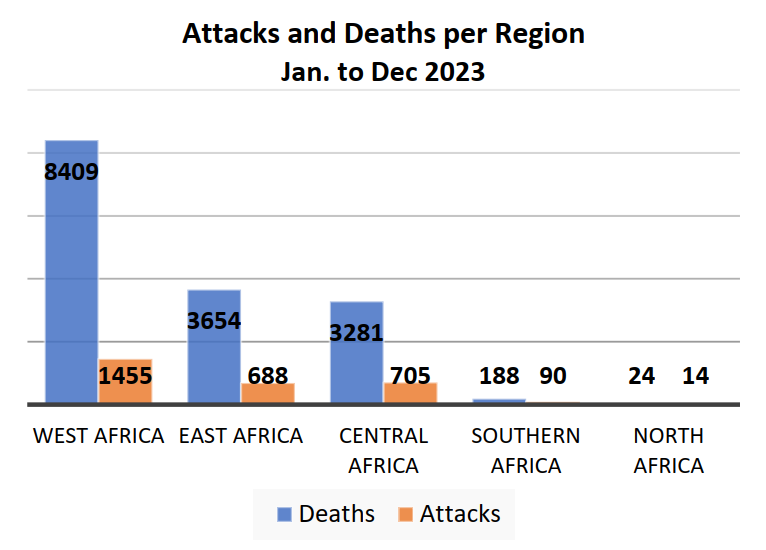
According to the latest data from the AUCTC, the five countries most affected by terrorist attacks during the second quarter of 2024 (April-June 2024) were Burkina Faso, Democratic Republic of Congo (DRC), Somalia, Mali, and Cameroon in decreasing order. The most active terrorist groups on the continent include Jama’a Nusrat ul-Islam wa al-Muslimin (JNIM), Al-Shabaab, Islamic State West Africa (ISWAP), Boko Haram, and the Allied Democratic Forces (ADF).
While no region of the continent is spared from conflicts involving terrorist groups, apart from the dire situation in the Sahel, particularly troubling, as noted by the President of the Economic Community of West African States (ECOWAS) Commission is the expansion of terrorism into the coastal states of West Africa, including Benin, Togo, and Côte d’Ivoire. Additionally, as these groups extend their reach towards the Gulf of Guinea, there is concern about a dangerous convergence of piracy and terrorism emerging.
Given the rise in the frequency and geographical spread of terrorism, it has become clear that the overreliance on hard security response measures is not delivering the expected outcomes. If anything, it has exacerbated the situation through its adverse impacts including abuses and collateral damages it inflicts on affected communities. This necessitates that the policy response achieves a shift towards enhancing and focusing on using non-security measures targeting the governance, institutional, socio-economic, environmental and development issues that create the conditions for the emergence and expansion of conflicts involving terrorist groups.
Beyond the geographic spread and growing prevalence of terrorist activities, the threat has become increasingly complex due to the interplay of geopolitics, external actors, and the breakdown of regional order in the Sahel and West Africa. Apart from the collapse of the Joint Force of the Group of Five for the Sahel (FC-G5S), a subregional arrangement initially composed of Burkina Faso, Chad, Mali, Mauritania, and Niger, the three Sahelian states of Burkina Faso, Niger and Mali announced their withdrawal from ECOWAS.
The other issue that the Chairperson’s report may also highlight is the phenomenon of foreign terrorist fighters, including the growing profile of ISIS in some regions. There are reports that the Islamic State’s Somalia Province has attracted attention due to reports of its global connections, including supplying funds to ISIS global networks. For terrorist groups in Somalia, the other major concern that emerged in the course of 2023/2024 is the possibility of close operational coordination, particularly between Al Shabaab and the Huthis in Yemen, who are in possession of weapons that have dramatically changed the security dynamics on the Red Sea.
As in the past, one other issue that has increasingly received attention in the Chairperson’s recent reports is the relationship between terrorism and transnational organised criminal networks. Among the terrorist groups operating in West Africa, the Jama’at Nusrat al-Islam wa al-Muslimeen (JNIM), the Islamic State in the Greater Sahara (ISGS), and the Islamic State of West Africa Province (ISWAP) are known for taking advantage of such networks including for financing their activities and the recruitment of new members. In areas with predominantly informal economies, limited state resources and presence, and pervasive corruption, terrorist groups find it easy to levy taxes with little opposition from locals. This is particularly observed in territories experiencing the insurgence of JNIM and ISWAP.
The consideration of Chairperson’s report is also expected to consider how terrorist groups operating in Africa are increasingly leveraging advanced technologies to mobilise support, recruit, undertake reconnaissance operations and carry out their attacks. Organisations such as al-Shabaab and ISWAP have adapted to the digital era by utilising a variety of tools and platforms to plan, communicate, and organise their operations. Some terrorist groups, for example, as highlighted in relation to the Lake Chad Basin region, Boko haram, have sought to use drone technology for surveillance and weapon delivery. The ISWAP for instance has increased its use of vehicle-borne improvised explosive devices (SVBIED). Attention should also be paid to the risk of such actors employing cyber warfare tactics to disrupt crucial infrastructure and communication networks.
Tomorrow’s session would also serve as an opportunity for reviewing the efforts made by the AU, its Member States, and RECs/RMs to contain the spread of and enhance concerted efforts in the face of the transnational and transregional character of the threat. As it did last time, the Chairperson’s report further emphasises that the predominant responses have been of a military nature, and ongoing attacks have resulted in increased militarisation of states’ reactions.
The expected outcome is a communiqué. The PSC is expected to express its concern over the continuing scourge of terrorism and violent extremism. The PSC may also request member states to enhance the implementation of applicable AU instruments and Decisions, specifically the 1999 Convention on the Prevention and Combating of Terrorism and the 50th OAU/AU Anniversary Solemn Declaration. Furthermore, the PSC is expected to stress the need for efforts to combat transnational organised crime, especially the proliferation of illicit arms, including through enhanced intelligence-sharing mechanisms, border management cooperation, and control. The PSC may also reiterate its previous decision on the need to address the root causes of terrorism, including poverty and marginalisation, the weak or absence of presence of the state and legitimate local governance infrastructures, which create the conditions for the emergence and expansion of terrorism. It is important to collaborate with Regional Economic Communities/Regional Mechanisms (RECs/RMs) and AU Organs to build community resilience and promote long-term recovery through post-conflict reconstruction and development programs.