
Briefing by the Peace Fund Secretariat
Briefing by the Peace Fund Secretariat
Date | 21 October 2024
Tomorrow (22 October), the African Union (AU) Peace and Security Council (PSC) will convene for a briefing from the Peace Fund Secretariat.
Mohamed Gad, Permanent Representative of the Arab Republic of Egypt to the AU and PSC Chairperson for October 2024, and Bankole Adeoye, AU Commissioner for Political Affairs, Peace and Security, are expected to make statements. Dagmawit Moges, Director, Peace Fund Secretariat is expected to brief the Council on the state of operationalisation of the Peace Fund and activities undertaken since the February 2024 AU summit.
As part of the effort to address the perineal adequate, predictable and sustainable funding, the AU Assembly, during its 27th Ordinary Session held in July 2016 in Kigali, Rwanda, through Assembly Decision [Assembly/AU/Dec.605 (XXVII)] resolved to revitalise the Peace Fund through contributions from member states. This decision led to the establishment of a $400 million endowment for the AU Peace Fund initially planned to be mobilised by 2020. The revitalised Fund is organised to provide support for three windows (intervention areas): preventive diplomacy and mediation activities; institutional capacity building; and peace support operations. Additionally, a Crisis Reserve Facility (CRF) is established to fund rapid responses to emergency crises.
The initial Assembly Decision 605 was that the Peace Fund would be financed through equal contributions from each AU region. The Assembly in its decision [Assembly/AU/Dec.734 (XXXII)] switched the basis for contribution to be used as the scale of assessment for the regular budget. While four regions of Africa supported the use of the scale of assessment, the North African region favoured the regional formula under Assembly Decision 605. The Executive Council in its October 2020 extraordinary session adopted by consensus, with reservation by the Northern region, the use of the scale of assessment for the regular budget for contribution to the Peace Fund (EX.CL Dec./1100(XXXVII)).
Over three years after the initial timeline of endowing the Fund with $400 million, the Peace Fund has a balance of $398 million as of June 2024. This amount is made up of member states contributions ($341 million), the balance from the Legacy Fund ($ 25 million) and the interest that is generated from the investment by the 2 Fund managers. Following various consultations with the countries of the Northern region who initially objected to the use of assessed contribution as a basis for contributing to the Peace Fund, it is reported that all countries of the region except two have paid 100 per cent. The remaining two countries, Egypt and Tunisia are on a three to five-year payment plan. Despite the substantial progress made and the extension of the timeline for endowing the Fund with the $400 million from 2020 to 2023, there remain outstanding contributions from some other member states assessed contributions towards the Peace Fund.
The other aspect that tomorrow’s session is expected to shed light on is the state of operationalisation of the various structures of the Peace Fund. The main structures of the Peace Fund are the Board of Trustees, the Executive Management Committee, the Independent Evaluation Group (IEG), the Fund Manager and a Peace Fund Secretariat. The Board of Trustees, made up of five high-level experts from the five regions of the continent and representatives of the UN and the EU, is fully operational. Similarly, the Executive Management Committee, chaired by the AU Commission Chairperson, is operational. Two Peace Fund managers have been appointed, although there are indications that these managers are not securing the level of returns from the investment in the Peace Fund. It is expected that further and better Fund Managers will be identified and appointed to enhance the returns from the investment in the Fund. The Peace Fund Secretariat became operational with the appointment of the Head of the Secretariat and has since recruited a few of its staff members. While the IEG is not operational, the process for instituting the IEG is currently underway. It would be made up of 2 representatives from the five regions of Africa and one representative each from the African Development Bank, the African Import-Export Bank and the World Bank. It is expected that the Head of the Secretariat will provide an update on the process of selection of the members of the IEG.
Tomorrow’s session is also expected to reflect on the state of utilisation of the Peace Fund. Utilisation of the Fund has thus far been limited to the CRF and as of 2024, for pilot projects of the Department of Political Affairs, Peace and Security (PAPS). Accordingly, $6.5 million and $12 million were approved for the CRF for 2023 and 2024 respectively, with $5 million dedicated to the Pilot Projects for 2024. In 2023, the 6.5 million CRF budget for 2023 was allocated for four disbursements under CRF amounting to $6.5 million for the EAC regional force in eastern DRC ($2 million), ATMIS funding shortfall ($3.5 million) and the DDR process under the Pretoria Peace Agreement of Ethiopia ($1 million).
In the context of the disbursement made thus far, one of the major issues that may arise in tomorrow’s session is the institutional arrangements for the proper utilisation of the disbursed funds for the intended purposes. For example, while $2 million was disbursed to the EAC Regional Force to the DRC in 2023, this Force was discontinued following the request from the DRC. The question that arises in this context is how to account for the $2 million, given that the fund could no longer be used for the purpose for which it was disbursed.
On 1 October, the AU Peace Fund’s Executive Management Committee (EMC) conducted a comprehensive review of the utilisation of the funds. The discussions delved into deliberating on prospective channels to leverage partnerships with the private sector and multilateral financial institutions to secure additional funding for the Peace Fund. In addition, the Committee conducted a review of the utilisation of funds disbursed through the PAPS Department. According to the press release, ‘Of the $7 million approved by the AU Executive Council, 92.8% of the funds were successfully deployed through the CRF.’ As of September 2024, the Peace Fund has disbursed a total of $19 million, reflecting its growing role in addressing conflicts across the continent. The Committee also provided strategic guidance for onboarding the IEG. The EMC proposed keeping the 2025 disbursement ceiling at $15 million.
The $7 million CRF funding for 2024 was disbursed towards supporting South Sudan’s transition process, aiding Sudan’s peace efforts through political dialogue and other activities, the SAMIDRC, enhancing stabilisation efforts in the Lake Chad Basin via the MNJTF and supporting Libya’s national reconciliation, dialogue and potential stabilisation initiatives. The funds will also aid Mozambique’s stabilisation efforts in Cabo Delgado, as well as the ongoing stabilisation efforts in Burkina Faso, Mali and Niger, and the Sahel region. It is clear that this small fund is thinly spread but it is unclear what meaningful impact it would have. This raises the key question of prioritisation in the use of the CRF funds for achieving the maximum impact from the use of the limited resources allocated thereunder.
The other issue expected to receive attention in tomorrow’s session is the question of the source of replenishment of the Peace Fund. It is on account of the lack of identification of the means of replenishment that the use of the Fund thus far is limited to the interest collected from the Fund only. Assembly Decision [EX.CL/Dec.1223(XLIII)] of the 43rd Ordinary Session of the Executive Council held on 13 and 14 July 2023 in Nairobi, Kenya, in which, among other things, requested the AU Commission, acting through the Peace Fund Secretariat, to explore modalities for seeking voluntary contributions from Member States as well as contributions from the private sector, and encouraged the AU Peace Fund Secretariat ‘to expand all efforts to mobilise additional resources through Member States voluntary contributions by engaging with the private sector, high net worth individuals and the citizens of our continent’. In pursuit of this, various initiatives have been undertaken by the Secretariat including outreach to the private sector and the convening of a high-level pledging event during the Mid-Year Coordination Meeting held in Accra, Ghana this last July.
Tomorrow’s session also serves to have an update on the Executive Council’s directive, during its 45th Ordinary session, for the AU Commission to develop a feasibility study for consideration by the Ministerial Joint Sitting on the payment of part of the Member States’ assessed contributions in national currencies for the consideration of the Policy Organs by February 2025. In addition, there could be an update on the assignment tasked to the Commission to develop a comprehensive cash flow management plan aimed at channeling funds to assigned programs in a timely and effective manner, thereby enhancing the planning and execution of activities and programmes.
The form for the outcome document for the session remains unknown. However, it is expected that the meeting will highlight the evaluation of the impacts of the 2024 CRF and Peace Fund Pilot Projects, which will also aim to capitalise on the current momentum and address gaps identified including compliance with the financial rules and regulations. The Council may commend the Peace Fund secretariat for the progress made so far in engaging with the multi-sectoral stakeholders to mobilise resources for the Peace Fund. The Council may urge member states who have not yet fulfilled their financial commitments to the Peace Fund to fulfil their commitments.

Joint Meeting between PSC, and PRC Budget (GSCBFAM), on Financing PSOs and PSC Activities
Joint Meeting between PSC, and PRC Budget (GSCBFAM), on Financing PSOs and PSC Activities
Date | 21 October 2024
Tomorrow (22 October), the African Union Peace and Security Council will convene a virtual engagement with the Sub-Committee of the Permanent Representatives Committee (PRC) on General Supervision and Coordination on Budgetary, Financial, and Administrative Matters (GSCBFAM).
The session is expected to commence with an opening statement by the PSC chair of the Month, Mohamed Omar Gad, Permanent Representative to the African Union and Chairperson of the AU PSC for October. Bankole Adeoye, Commissioner of Political Affairs and Peace and Security Department is also expected to make a statement. The last time the PSC held such a meeting was on 16 September 2022, it involved the GSCBFAM and the Board of Trustees of the AU Peace Fund. That meeting featured remarks from the Deputy Chairperson of the AU Commission, the Chairperson of the Board of Trustees of the Peace Fund, and the Chairperson of the AU Committee of 15 Finance Ministers (F15).
The GSCBFAM’s role has evolved over time. Originally known as the Advisory Sub-Committee on Administrative, Budgetary and Financial Matters, it was established as the successor to a similar committee within the Organisation of African Unity (OAU). Recognising the need for a more robust oversight body, the AU Executive Council in 2016 called for the committee’s reform and renaming.[1] This resulted in the establishment of the Sub-Committee on General Supervision and Coordination on Budgetary, Financial and Administrative Matters with its expanded mandate and strengthened authority. The mandate of the GSCBFAM is to have a financial oversight of the African Union (AU), ensuring the organisation’s fiscal health. It examines the proposed budget crafted by the AU Commission, assess administrative matters, and dives deep into the financial transactions of both the Commission and regional offices. This close review allows the GSCBFAM to identify areas for improvement and ensure efficient, transparent and accountable use of resources.
The GSCBFAM plays a crucial role in managing unforeseen circumstances. They consider requests from the Commission for budget adjustments to accommodate urgent decisions or projects and address unexpected expenditures. In addition to evaluating the current financial landscape, the GSCBFAM contributes to shaping the AU’s future financial regulations. They review draft financial rules before submission to the PRC for consideration. Once approved by the Executive Council and, ultimately, the Assembly, these regulations establish a framework for responsible financial management within the AU.
As noted, this is not the first time that the PSC engages the GSCBFAM but the focus and context of that engagement was different. Additionally, the PSC during the past couple of years has activated its role in presenting and defending its budget with the PRC in accordance with paragraph 117 of the Manual on the Working Methods of the PSC. GSCBFAM is only the second PRC sub-committee, next to the Sub-committee on Democracy, Governance and Human Rights, to have engagement with the PSC. This session marks the first occasion for direct engagement between the PSC and the GSCBFAM with a focus on the budget for AU peace and security work beyond and in addition to the Peace Fund.
Considering that the Chairperson of the PSC for October is the Chairperson of the GSCBFAM, this meeting is informed by the appreciation of the crucial role that the Sub Committee on GSCBFAM plays in the financial management of the Union’s operations including funds that are used for the peace and security work of the Union and the need for close coordination between them for aligning the requirements of the PSC for executing its mandate with allocation and responsible use of funds. This session aims to exchange on the processing of budgets for all AU peace and security activities, financial accountability in the use of funds including compliance with the AU financial rules and regulations, and whether and how the budget process provides unforeseen peace and security interventions.
According to the African Union’s budget for 2025, as identified by the Executive Council during the previous mid-year summit, the breakdown of the programmatic budget reveals several allocations for peace and security activities. This includes funding for the Peace and Security Council itself, which constitutes $1,782,979 of the program budget, along with other institutions such as the PCRD and the Africa Center for Counter Terrorism Research, which also has allocated budget lines in the AU program budget. Additionally, Peace Support Operations represent 9% of the total budget, including various operational expenses. Given these expenditures, it is vital for the PSC to engage with the PRC Sub Committee to gain a clear understanding of the funding directed toward peace and security initiatives undertaken by the Union. A better comprehension of the allocated budget for institutions that support and facilitate the African Peace and Security Architecture (APSA) will enable the Council to make informed decisions.
When making these decisions, the PSC can consider existing budget allocations for specific aspects of the APSA and evaluate their financial capacity to effectively carry out assigned tasks. For example, when the Council engages in conflict prevention activities, the budget required for such activities and how they would be sourced are expected to constitute part of the considerations in the PSC’s engagements. This helps to ensure that proposals for PSC decisions are put forward with due consideration of the financial requirements.
The other aspect that tomorrow’s session is expected to address includes the kind of working arrangement that the two sides may establish. Given that the PSC is a policy body, but the sub-committee of the PRC is a subsidiary body, the session affords an opportunity to determine the appropriate format for engagement between the PSC and PRC sub-committees broadly speaking. In this respect, the PSC may establish a sub-committee at the ambassadorial level for engagement with PRC sub-committees, including GSCBFAM.
Additionally, tomorrow’s session may explore the occasions and timelines for the convening of engagement between the PSC, potentially through the sub-committee for engagement with relevant PRC sub-committees that the PSC may establish, and the GSCBFAM.
The expected outcome of the session will be a Communique. The Council may welcome this engagement with the PRC Sub-Committee on GSCBFAM. To this end, the Council may commend the Sub Committee on its endeavours for supporting/facilitating the budget operation of the Union and more specifically, the areas that support the mandate of the PSC. The Council may affirm the need to strengthen collaboration and cooperation between the PSC and the Sub-Committee, particularly when the PSC makes decisions that have budgetary implications. In this regard, the Council may decide to institutionalise the convening between the PRC Sub Committee on GSCBFAM and the PSC to take place on an annual basis. Considering that the GSCBFAM is a sub-committee of a policy body rather than a policy body itself, the PSC may establish a sub-committee at the ambassadorial level for engagement with PRC sub-committees including GSCBFA.
[1] (EX.CL/Dec.916(XXVIII) https://portal.africa-union.org/DVD/Documents/DOC-AU-DEC/EX%20CL%20Dec%20931%20(XXIX)%20_E.pdf
Briefing by the Peace Fund Secretariat
Briefing by the Peace Fund Secretariat
Date | 21 October 2024
Tomorrow (22 October), the African Union (AU) Peace and Security Council (PSC) will convene for a briefing from the Peace Fund Secretariat.
Mohamed Gad, Permanent Representative of the Arab Republic of Egypt to the AU and PSC Chairperson for October 2024, and Bankole Adeoye, AU Commissioner for Political Affairs, Peace and Security, are expected to make statements. Dagmawit Moges, Director, Peace Fund Secretariat is expected to brief the Council on the state of operationalisation of the Peace Fund and activities undertaken since the February 2024 AU summit.
As part of the effort to address the perineal adequate, predictable and sustainable funding, the AU Assembly, during its 27th Ordinary Session held in July 2016 in Kigali, Rwanda, through Assembly Decision [Assembly/AU/Dec.605 (XXVII)] resolved to revitalise the Peace Fund through contributions from member states. This decision led to the establishment of a $400 million endowment for the AU Peace Fund initially planned to be mobilised by 2020. The revitalised Fund is organised to provide support for three windows (intervention areas): preventive diplomacy and mediation activities; institutional capacity building; and peace support operations. Additionally, a Crisis Reserve Facility (CRF) is established to fund rapid responses to emergency crises.
The initial Assembly Decision 605 was that the Peace Fund would be financed through equal contributions from each AU region. The Assembly in its decision [Assembly/AU/Dec.734 (XXXII)] switched the basis for contribution to be used as the scale of assessment for the regular budget. While four regions of Africa supported the use of the scale of assessment, the North African region favoured the regional formula under Assembly Decision 605. The Executive Council in its October 2020 extraordinary session adopted by consensus, with reservation by the Northern region, the use of the scale of assessment for the regular budget for contribution to the Peace Fund (EX.CL Dec./1100(XXXVII)).
Over three years after the initial timeline of endowing the Fund with $400 million, the Peace Fund has a balance of $398 million as of June 2024. This amount is made up of member states contributions ($341 million), the balance from the Legacy Fund ($ 25 million) and the interest that is generated from the investment by the 2 Fund managers. Following various consultations with the countries of the Northern region who initially objected to the use of assessed contribution as a basis for contributing to the Peace Fund, it is reported that all countries of the region except two have paid 100 per cent. The remaining two countries, Egypt and Tunisia are on a three to five-year payment plan. Despite the substantial progress made and the extension of the timeline for endowing the Fund with the $400 million from 2020 to 2023, there remain outstanding contributions from some other member states assessed contributions towards the Peace Fund.
The other aspect that tomorrow’s session is expected to shed light on is the state of operationalisation of the various structures of the Peace Fund. The main structures of the Peace Fund are the Board of Trustees, the Executive Management Committee, the Independent Evaluation Group (IEG), the Fund Manager and a Peace Fund Secretariat. The Board of Trustees, made up of five high-level experts from the five regions of the continent and representatives of the UN and the EU, is fully operational. Similarly, the Executive Management Committee, chaired by the AU Commission Chairperson, is operational. Two Peace Fund managers have been appointed, although there are indications that these managers are not securing the level of returns from the investment in the Peace Fund. It is expected that further and better Fund Managers will be identified and appointed to enhance the returns from the investment in the Fund. The Peace Fund Secretariat became operational with the appointment of the Head of the Secretariat and has since recruited a few of its staff members. While the IEG is not operational, the process for instituting the IEG is currently underway. It would be made up of 2 representatives from the five regions of Africa and one representative each from the African Development Bank, the African Import-Export Bank and the World Bank. It is expected that the Head of the Secretariat will provide an update on the process of selection of the members of the IEG.
Tomorrow’s session is also expected to reflect on the state of utilisation of the Peace Fund. Utilisation of the Fund has thus far been limited to the CRF and as of 2024, for pilot projects of the Department of Political Affairs, Peace and Security (PAPS). Accordingly, $6.5 million and $12 million were approved for the CRF for 2023 and 2024 respectively, with $5 million dedicated to the Pilot Projects for 2024. In 2023, the 6.5 million CRF budget for 2023 was allocated for four disbursements under CRF amounting to $6.5 million for the EAC regional force in eastern DRC ($2 million), ATMIS funding shortfall ($3.5 million) and the DDR process under the Pretoria Peace Agreement of Ethiopia ($1 million).
In the context of the disbursement made thus far, one of the major issues that may arise in tomorrow’s session is the institutional arrangements for the proper utilisation of the disbursed funds for the intended purposes. For example, while $2 million was disbursed to the EAC Regional Force to the DRC in 2023, this Force was discontinued following the request from the DRC. The question that arises in this context is how to account for the $2 million, given that the fund could no longer be used for the purpose for which it was disbursed.
On 1 October, the AU Peace Fund’s Executive Management Committee (EMC) conducted a comprehensive review of the utilisation of the funds. The discussions delved into deliberating on prospective channels to leverage partnerships with the private sector and multilateral financial institutions to secure additional funding for the Peace Fund. In addition, the Committee conducted a review of the utilisation of funds disbursed through the PAPS Department. According to the press release, ‘Of the $7 million approved by the AU Executive Council, 92.8% of the funds were successfully deployed through the CRF.’ As of September 2024, the Peace Fund has disbursed a total of $19 million, reflecting its growing role in addressing conflicts across the continent. The Committee also provided strategic guidance for onboarding the IEG. The EMC proposed keeping the 2025 disbursement ceiling at $15 million.
The $7 million CRF funding for 2024 was disbursed towards supporting South Sudan’s transition process, aiding Sudan’s peace efforts through political dialogue and other activities, the SAMIDRC, enhancing stabilisation efforts in the Lake Chad Basin via the MNJTF and supporting Libya’s national reconciliation, dialogue and potential stabilisation initiatives. The funds will also aid Mozambique’s stabilisation efforts in Cabo Delgado, as well as the ongoing stabilisation efforts in Burkina Faso, Mali and Niger, and the Sahel region. It is clear that this small fund is thinly spread but it is unclear what meaningful impact it would have. This raises the key question of prioritisation in the use of the CRF funds for achieving the maximum impact from the use of the limited resources allocated thereunder.
The other issue expected to receive attention in tomorrow’s session is the question of the source of replenishment of the Peace Fund. It is on account of the lack of identification of the means of replenishment that the use of the Fund thus far is limited to the interest collected from the Fund only. Assembly Decision [EX.CL/Dec.1223(XLIII)] of the 43rd Ordinary Session of the Executive Council held on 13 and 14 July 2023 in Nairobi, Kenya, in which, among other things, requested the AU Commission, acting through the Peace Fund Secretariat, to explore modalities for seeking voluntary contributions from Member States as well as contributions from the private sector, and encouraged the AU Peace Fund Secretariat ‘to expand all efforts to mobilise additional resources through Member States voluntary contributions by engaging with the private sector, high net worth individuals and the citizens of our continent’. In pursuit of this, various initiatives have been undertaken by the Secretariat including outreach to the private sector and the convening of a high-level pledging event during the Mid-Year Coordination Meeting held in Accra, Ghana this last July.
Tomorrow’s session also serves to have an update on the Executive Council’s directive, during its 45th Ordinary session, for the AU Commission to develop a feasibility study for consideration by the Ministerial Joint Sitting on the payment of part of the Member States’ assessed contributions in national currencies for the consideration of the Policy Organs by February 2025. In addition, there could be an update on the assignment tasked to the Commission to develop a comprehensive cash flow management plan aimed at channeling funds to assigned programs in a timely and effective manner, thereby enhancing the planning and execution of activities and programmes.
The form for the outcome document for the session remains unknown. However, it is expected that the meeting will highlight the evaluation of the impacts of the 2024 CRF and Peace Fund Pilot Projects, which will also aim to capitalise on the current momentum and address gaps identified including compliance with the financial rules and regulations. The Council may commend the Peace Fund secretariat for the progress made so far in engaging with the multi-sectoral stakeholders to mobilise resources for the Peace Fund. The Council may urge member states who have not yet fulfilled their financial commitments to the Peace Fund to fulfil their commitments.
Joint Meeting between PSC, and PRC Budget (GSCBFAM), on Financing PSOs and PSC Activities
Joint Meeting between PSC, and PRC Budget (GSCBFAM), on Financing PSOs and PSC Activities
Date | 21 October 2024
Tomorrow (22 October), the African Union Peace and Security Council will convene a virtual engagement with the Sub-Committee of the Permanent Representatives Committee (PRC) on General Supervision and Coordination on Budgetary, Financial, and Administrative Matters (GSCBFAM).
The session is expected to commence with an opening statement by the PSC chair of the Month, Mohamed Omar Gad, Permanent Representative to the African Union and Chairperson of the AU PSC for October. Bankole Adeoye, Commissioner of Political Affairs and Peace and Security Department is also expected to make a statement. The last time the PSC held such a meeting was on 16 September 2022, it involved the GSCBFAM and the Board of Trustees of the AU Peace Fund. That meeting featured remarks from the Deputy Chairperson of the AU Commission, the Chairperson of the Board of Trustees of the Peace Fund, and the Chairperson of the AU Committee of 15 Finance Ministers (F15).
The GSCBFAM’s role has evolved over time. Originally known as the Advisory Sub-Committee on Administrative, Budgetary and Financial Matters, it was established as the successor to a similar committee within the Organisation of African Unity (OAU). Recognising the need for a more robust oversight body, the AU Executive Council in 2016 called for the committee’s reform and renaming.[1] This resulted in the establishment of the Sub-Committee on General Supervision and Coordination on Budgetary, Financial and Administrative Matters with its expanded mandate and strengthened authority. The mandate of the GSCBFAM is to have a financial oversight of the African Union (AU), ensuring the organisation’s fiscal health. It examines the proposed budget crafted by the AU Commission, assess administrative matters, and dives deep into the financial transactions of both the Commission and regional offices. This close review allows the GSCBFAM to identify areas for improvement and ensure efficient, transparent and accountable use of resources.
The GSCBFAM plays a crucial role in managing unforeseen circumstances. They consider requests from the Commission for budget adjustments to accommodate urgent decisions or projects and address unexpected expenditures. In addition to evaluating the current financial landscape, the GSCBFAM contributes to shaping the AU’s future financial regulations. They review draft financial rules before submission to the PRC for consideration. Once approved by the Executive Council and, ultimately, the Assembly, these regulations establish a framework for responsible financial management within the AU.
As noted, this is not the first time that the PSC engages the GSCBFAM but the focus and context of that engagement was different. Additionally, the PSC during the past couple of years has activated its role in presenting and defending its budget with the PRC in accordance with paragraph 117 of the Manual on the Working Methods of the PSC. GSCBFAM is only the second PRC sub-committee, next to the Sub-committee on Democracy, Governance and Human Rights, to have engagement with the PSC. This session marks the first occasion for direct engagement between the PSC and the GSCBFAM with a focus on the budget for AU peace and security work beyond and in addition to the Peace Fund.
Considering that the Chairperson of the PSC for October is the Chairperson of the GSCBFAM, this meeting is informed by the appreciation of the crucial role that the Sub Committee on GSCBFAM plays in the financial management of the Union’s operations including funds that are used for the peace and security work of the Union and the need for close coordination between them for aligning the requirements of the PSC for executing its mandate with allocation and responsible use of funds. This session aims to exchange on the processing of budgets for all AU peace and security activities, financial accountability in the use of funds including compliance with the AU financial rules and regulations, and whether and how the budget process provides unforeseen peace and security interventions.
According to the African Union’s budget for 2025, as identified by the Executive Council during the previous mid-year summit, the breakdown of the programmatic budget reveals several allocations for peace and security activities. This includes funding for the Peace and Security Council itself, which constitutes $1,782,979 of the program budget, along with other institutions such as the PCRD and the Africa Center for Counter Terrorism Research, which also has allocated budget lines in the AU program budget. Additionally, Peace Support Operations represent 9% of the total budget, including various operational expenses. Given these expenditures, it is vital for the PSC to engage with the PRC Sub Committee to gain a clear understanding of the funding directed toward peace and security initiatives undertaken by the Union. A better comprehension of the allocated budget for institutions that support and facilitate the African Peace and Security Architecture (APSA) will enable the Council to make informed decisions.
When making these decisions, the PSC can consider existing budget allocations for specific aspects of the APSA and evaluate their financial capacity to effectively carry out assigned tasks. For example, when the Council engages in conflict prevention activities, the budget required for such activities and how they would be sourced are expected to constitute part of the considerations in the PSC’s engagements. This helps to ensure that proposals for PSC decisions are put forward with due consideration of the financial requirements.
The other aspect that tomorrow’s session is expected to address includes the kind of working arrangement that the two sides may establish. Given that the PSC is a policy body, but the sub-committee of the PRC is a subsidiary body, the session affords an opportunity to determine the appropriate format for engagement between the PSC and PRC sub-committees broadly speaking. In this respect, the PSC may establish a sub-committee at the ambassadorial level for engagement with PRC sub-committees, including GSCBFAM.
Additionally, tomorrow’s session may explore the occasions and timelines for the convening of engagement between the PSC, potentially through the sub-committee for engagement with relevant PRC sub-committees that the PSC may establish, and the GSCBFAM.
The expected outcome of the session will be a Communique. The Council may welcome this engagement with the PRC Sub-Committee on GSCBFAM. To this end, the Council may commend the Sub Committee on its endeavours for supporting/facilitating the budget operation of the Union and more specifically, the areas that support the mandate of the PSC. The Council may affirm the need to strengthen collaboration and cooperation between the PSC and the Sub-Committee, particularly when the PSC makes decisions that have budgetary implications. In this regard, the Council may decide to institutionalise the convening between the PRC Sub Committee on GSCBFAM and the PSC to take place on an annual basis. Considering that the GSCBFAM is a sub-committee of a policy body rather than a policy body itself, the PSC may establish a sub-committee at the ambassadorial level for engagement with PRC sub-committees including GSCBFA.
[1] (EX.CL/Dec.916(XXVIII) https://portal.africa-union.org/DVD/Documents/DOC-AU-DEC/EX%20CL%20Dec%20931%20(XXIX)%20_E.pdf
Annual Joint Consultative Meeting of the PSC and UNSC
Annual Joint Consultative Meeting of the PSC and UNSC
Date | 17 October 2024
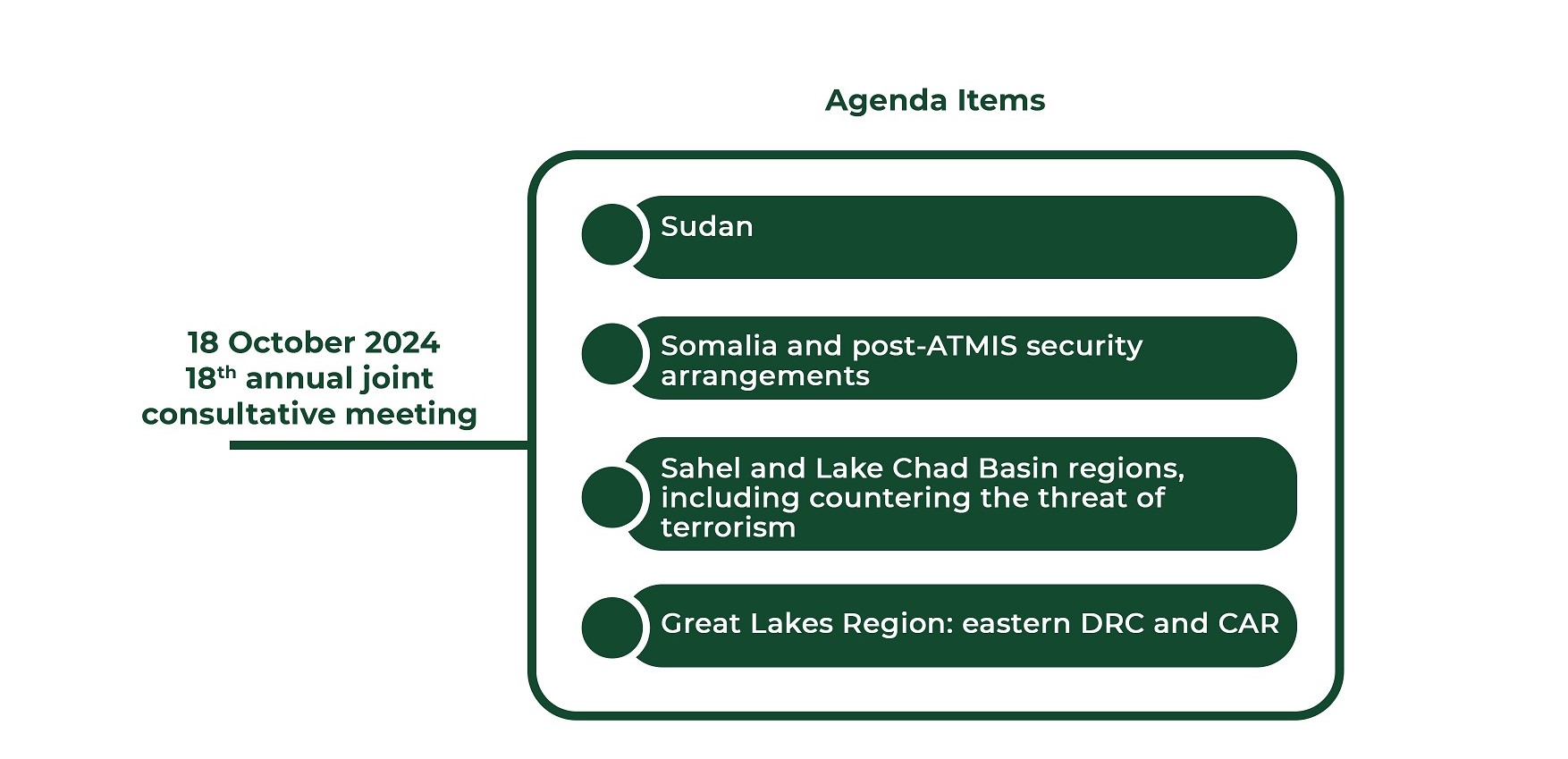
On 18 October, the African Union (AU) Peace and Security Council (PSC) and the United Nations Security Council (UNSC) will convene in New York for their 18th annual joint consultative meeting. The annual meeting alternates between New York and Addis Ababa. This year’s meeting will be co-chaired by Mohamed Omar Gad, Permanent Representative of the Arab Republic of Egypt to the AU and Chairperson of the PSC for October 2024 and Pascal Baeriswyl, the Permanent Representative of Switzerland to the UN and President of the UNSC for October 2024.
Ahead of the joint consultative meeting, the PSC’s Committee of Experts and its counterpart, the Ad Hoc Working Group of the Security Council on Conflict Prevention and Resolution held a preparatory meeting in New York from 11 to 16 October to work on the draft joint communiqué envisaged to be adopted at the end of the consultative meeting. The PSC also met with the three African members of the UNSC plus (A3+) on 15 October in preparatory consultation for the joint consultative meeting. It is expected that the role of the A3+ as a useful bridge between the PSC and the UNSC and in penholding, particularly on African files, would receive attention in the joint consultation.
Following the welcoming remarks of the co-chairs, it is envisaged that the meeting commences with the opening remarks of Bankole Adeoye, Commissioner for Political Affairs, Peace and Security and Martha Pobee, Assistant UN Secretary-General for Africa.
During the annual consultative meeting, the two Councils will address the situations in Sudan, Somalia and post-ATMIS security arrangements, the Sahel region and the Lake Chad Basin region including countering the threat of terrorism, and the Great Lakes region, specifically the Eastern DRC and Central African Republic (CAR). It is worth noting that the only agenda item that was not on the agenda of the 17th joint annual consultative meeting is the situation in the CAR. It is not far-fetched in this context to suggest that there may not be a major substantive difference between the joint communique of the 17th annual consultative meeting and the one expected to be adopted during tomorrow’s consultative meeting. It is evident that there is a need for the annual consultative meeting to contribute to enhance sustained collective action based on a review of the previous joint communiqué.
On Sudan, the main focus is likely to be on how the two Councils can effectively collaborate to facilitate political dialogue, secure a cessation of hostilities, enhance the delivery of humanitarian aid and protection of civilians, and ensure better coordination and complementarity among the various peace initiatives aimed at resolving the conflict. The recent spike in fighting including most notably the siege of El Fasher, which featured during the PSC Ministerial session last month, will receive particular attention. Apart from reiterating the call for the lifting of the siege on El Fasher, the two may call for respect for IHL and the provision of humanitarian access as well as implementation of the Jeddah Declaration of commitments for the protection of civilians.
Apart from reiterating their affirmation from last year’s joint communiqué that there is no military solution to the conflict in Sudan, the two sides may explore how AU’s role could be enhanced and they all rally around the roadmap for the resolution of the conflict. It is expected that the two Councils will reaffirm the importance of the AU roadmap for the resolution of the conflict in Sudan and may welcome the establishment of the PSC Presidential Ad Hoc Committee on Sudan. In this context, members of the UNSC may be particularly interested in hearing from the PSC about its recent engagement with Lt. General Abdel Fattah al-Burhan, Chairman of the Transitional Sovereignty Council, and other Sudanese stakeholders during its field mission to Port Sudan. While al Burhan’s direct urging of the PSC for lifting off Sudan’s suspension may not be responded to affirmatively before, at the very least, an all-inclusive transitional process and roadmap is agreed to by various Sudanese political and social forces, it is hoped that this visit and the recognition that it accorded to al-Burhan as the internationally recognised authority in Sudan may further enhance collaboration from SAF on AU’s mediation role. In this context, the AU is also expected to open its Sudan office in Port Sudan.
On Somalia and post-ATMIS security arrangements, the Councils are expected to discuss three critical issues. The first is the persistently precarious political and security situation of Somalia. Of particular concern is the fact that this situation has become further complicated by escalating tension between Ethiopia and Somalia over the January Memorandum of Understanding between Ethiopia and Somaliland. Following the PSC’s decision to establish the African Union Support and Stabilisation Mission in Somalia (AUSSOM) during its 1225th session on 1 August when Egypt’s proposal to be a troop-contributing country was welcomed in the PSC communiqué, Somalia’s intention to replace Ethiopian forces with Egyptian troops has made the post-ATMIS process a major regional flashpoint. In a statement issued on 28 August, Ethiopia’s Ministry of Foreign Affairs warned that the transition from ATMIS to a new peace support mission is ‘fraught with dangers to the region’. It is very unlikely that there will be any direct reference to this dimension of the complications around the post-ATMIS plans in the joint communiqué the two Councils are expected to adopt. Yet, reference may be made to the agreed language of the commitment of the two Councils to the sovereignty, territorial integrity and independence of member states.
The second issue is on the design of the post-ATMIS mission, endorsed by the PSC as the African Union Support and Stabilisation Mission in Somalia (AUSSOM) during its 1225th session on 1 August 2024. AUSSOM is set to commence on 1 January 2025, immediately after ATMIS mandate ends on 31 December 2024. On 15 August, the UNSC also adopted Resolution 2748, which requested the UN Secretary-General, jointly with the Chairperson of the AU Commission and in consultation with Somalia and international stakeholders, to report on the overall mission design for the proposed successor mission and financing options by 15 November. In line with this, the joint AU-UN delegation conducted an eight-day visit to Mogadishu in early October to engage with the FGS, ATMIS, UN, troop-contributing countries (TCCs), and international partners on the transition strategies and financing models.
The third is the perennial issue of financing and whether AUSSOM should be a test case for the application of Resolution 2719. This is where a major policy divergence exists between the PSC and some permanent members of the UNSC, notably the US. The PSC appears to favour linking the financing of AUSSOM with Resolution 2719 as reflected in its communiqués, including the latest one adopted at PSC’s 1225th session, which emphasised the need for a dedicated funding mechanism through UN-assessed contributions in accordance with Resolution 2719. In contrast, the US has expressed clear reservations on the matter. During the 3 October UNSC briefing on Somalia, the US stated that ‘this is not the time or place to apply 2719’, while highlighting the importance of avoiding the ‘premature application of the framework’ not to undermine its credibility. On 11 October, Donald Kaberuka and Souef Mohamed El-Amine, the SRCC and Head of ATMIS gave an update to the UNSC on this question of mission design and predictable funding for AUSSOM. The consultative meeting could offer an opportunity to take the discussion further and build consensus ahead of the UNSC meeting in November.
On the Sahel and Lake Chad Basin regions, the increasingly deteriorating security situation, the fallout between ECOWAS and the military juntas in Mali, Burkina Faso, and Niger, and the prolonged political transitions in these countries are likely to dominate the discussion. The two Councils are likely to highlight the need for enhancing civilian protection and compliance with IHL and the adoption of a multidimensional approach to the threat of terrorism and violent extremism. Although it may not be reflected in the joint communiqué, the weakening of the regional organisation, the Economic Community of West African States may also feature during the interventions. In a recent interview with France 24, Ghana’s President Nana Akufo-Addo described the announcement by the juntas of these three countries to withdraw from ECOWAS and form the Confederation of Sahel States (AES) in July as a ‘setback for regional security’.
The two Councils may be interested in the status of the long-overdue report by the high-level independent panel led by former Niger President Mahamadou Issoufou. Tasked by the UN, AU, ECOWAS, and the G5 Sahel Joint Force in September 2022 to conduct a strategic assessment of the underlying challenges in the Sahel, this report will be critical in guiding a coordinated response from the regional and international mechanisms to address the complex political, security and development challenges in the region.
Regarding the Great Lakes region, the focus will be on the situations in eastern DRC and the Central African Republic (CAR). Concerning the eastern DRC crisis, attention will be given to the threat that the presence of various armed groups poses to civilians and peace and security in the region and how to ensure the success of the Angola-facilitated peace talks between DRC and Rwanda (Luanda peace process) as well as the situation of MONUSCO, UN’s mission in the DRC. It is expected that they will condemn the various armed groups and the insecurity and violence that they continue to perpetrate in Eastern DRC with dire consequences to the lives and well-being of civilians. DRC may seek specific reference to the end of external support for the M23 and respect for the territorial integrity of the country.
Regarding the peace process, in a recent briefing to the UNSC, Huang Xia, Special Envoy of the Secretary-General for the Great Lakes Region, highlighted the positive impact of the 30 July ceasefire agreement signed between DRC and Rwanda under the Luanda Process, which has contributed to relative calm, albeit with occasional skirmishes. It is expected that the two Councils will welcome the ceasefire agreement and urge the two governments to uphold the agreement.
During the UNSC briefing on 8 October on the Great Lakes Region, DRC and Rwanda exchanged accusations over responsibility for the stalling of the Luanda Process. It is to be recalled that the meeting of Rwandan and DRC experts held on 30 August 2024 in Rubavu, Rwanda under the Luanda Process, adopted a harmonised plan focusing on the neutralisation of the FDLR, an ethnic Hutu armed group whose members include those who participated in the 1994 genocide and operating in eastern DRC, and what is called ‘the lifting of Rwandan defence measures’. Despite a ministerial meeting convened on 14 September in Luanda, Angola, it was reported that the ministers were unable to adopt the plan developed by experts including military leaders.
In its statement to the UNSC, DRC outlined three points for why the Luanda Process stalled: Rwanda’s requirement to link its withdrawal from DRC to the neutralisation of the FDLR; its rejection of liability clauses in a potential peace agreement; and refusal to a regional justice mechanism. Kigali refuted these accusations, arguing that clauses on liability and a regional justice mechanism were not even part of the expert-level negotiations, further asserting the importance of neutralising and fully disengaging the FDLR from the Armed Forces of the DRC (FARDC) as crucial to achieving a lasting solution to the conflict in eastern DRC.
These public disputations notwithstanding, the ministers of the two countries convened for the 5th tripartite Ministerial Meeting on 12 October in Eastern DRC within the framework of the Luanda Process under Angola’s facilitation. While it remains unclear how far the ministerial meeting went in clarifying the areas of disagreement and adopting the 30 August expert meeting conclusions, it was reported that the ministerial meeting concluded with the signing of the minutes of the meeting, signalling that the Luanda Process remains on track. Against this context, the two Councils may express their full support for the Luanda Process and urge the two parties to continue the dialogue in good faith and with a determination to achieve a settlement.
With respect to MONUSCO, it is expected that the two Councils would condemn attacks against MONUSCO peacekeepers and urge all actors to respect the non-inviolability of UN peacekeepers. The progress in the drawdown of MONUSCO and the need for ensuring a smooth transition in the context of the withdrawal of the mission would also be of interest to the two Councils. They may also welcome the UNSC authorisation of limited support for the SADC Mission to the DRC (SAMIDRC), although it is unlikely SAMIDRC would fill in the enormous footprint that MONUSCO would leave behind.
In the case of the Central African Republic (CAR), the postponement of local elections to April next year may draw attention. These elections, originally scheduled for July 2023 and then October 2024, would have been the first in over three decades. Other key issues likely to be discussed include the illegal exploitation of natural resources and its impact on the country’s peace and stability, the severe humanitarian crisis, the Disarmament, Demobilisation, and Reintegration (DDR) process of former combatants, the implementation of the Political Agreement for Peace and Reconciliation in the Central African Republic (PAPR-CAR) and the importance of the work of the Special Criminal Court of the CAR in the fight against impunity.
It is expected that the two Councils will adopt a joint communiqué. In recent years, these joint communiqués have been adopted shortly, suggesting that negotiations on their contents have been less contentious compared to earlier years, including 2016 and 2017 when the adoption of joint communiqués was delayed, and in 2019, where no outcome document could be agreed upon.
9th AUPSC-UNSC Annual Informal Seminar
9th AUPSC-UNSC Annual Informal Seminar
Date | 16 October 2024
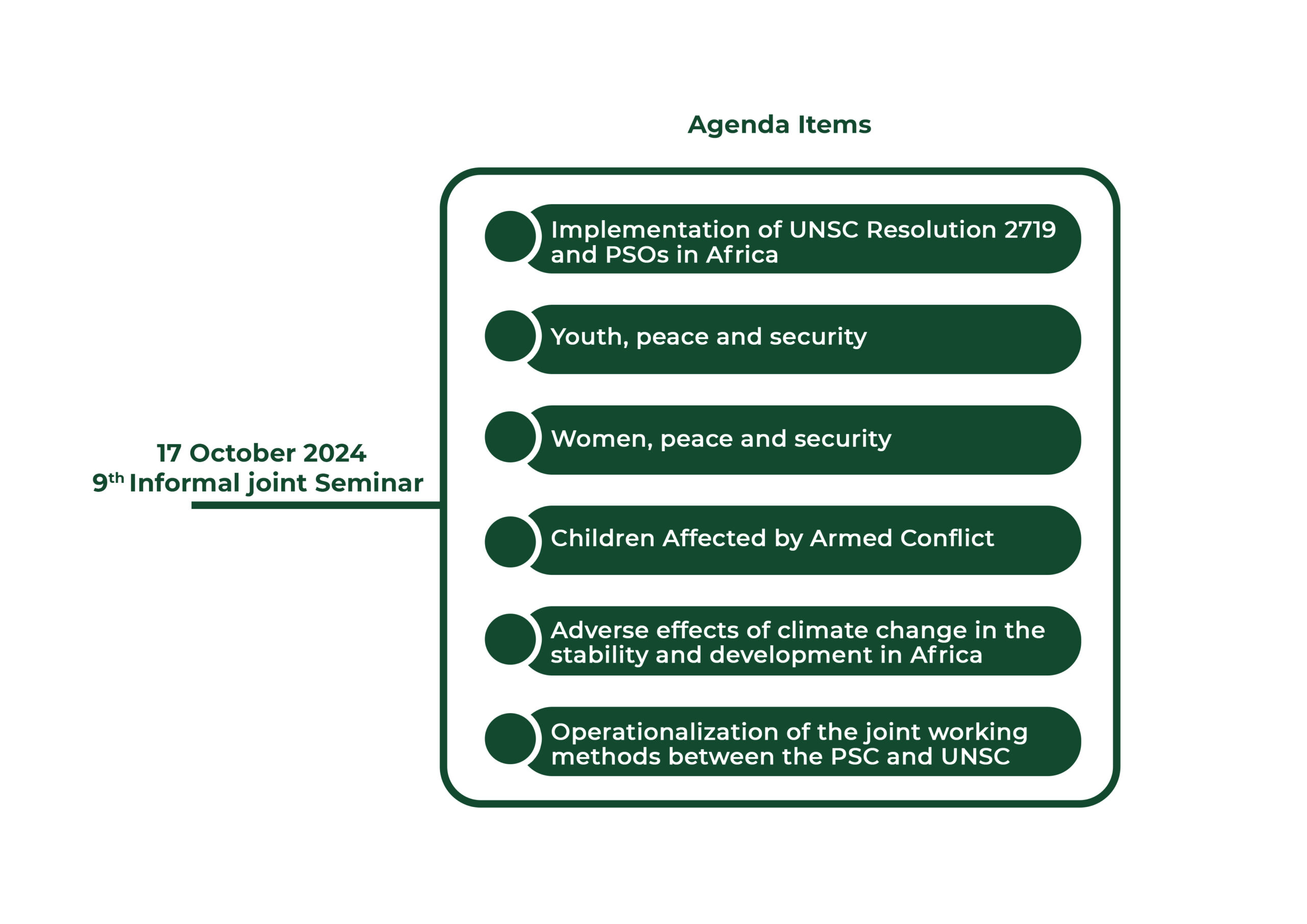
Tomorrow (17 October), the African Union (AU) Peace and Security Council (PSC) will engage in the 9th joint annual informal seminar with the UN Security Council. The annual joint seminar will be Co-Chaired by Mohamed Omar Gad, Permanent Representative of the Arab Republic of Egypt to the AU and Chairperson of the PSC for October 2024 and Pascal Baeriswyl, the Permanent Representative of Switzerland to the UN and President of the UN Security Council. The annual informal seminar presents an opportunity for policy exchanges between the two councils with a focus on thematic peace and security issues.
The Swiss as president of the UNSC and host of the annual consultative meeting, of which the informal seminar has become a part, proposed to hold the informal seminar in a retreat format. Accordingly, the seminar is expected to take place in Tarrytown, New York rather than at the UN compound.
This year’s informal seminar will feature several agenda items. These include: the implementation of Resolution 2719; youth, women, peace and security; Children Affected by Armed Conflicts (CAAC); ‘the adverse effects of climate change in the stability and development in Africa’; and operationalisation of the joint working methods. Of these items, the implementation of resolution 2719 may receive particular attention.
Regarding working methods, discussions may focus on the follow-up to the decision made during the 9th annual consultative meeting in March 2015 to conduct joint field missions to conflict situations in Africa. Despite the agreement, such missions have yet to materialise due to a lack of consensus on modalities. In 2018, it was agreed that modalities would be determined on a case-by-case basis, a reaffirmation made during the last consultative meeting. Whether progress will be made this year to translate this commitment into action remains to be seen. Other areas of focus may include improving structured monthly coordination between the Chair of the PSC and the President of the UNSC to better synchronise their agendas. While the monthly engagement between the monthly PSC Chairperson and the UNSC President has been regularised, discussions could explore how to enhance its impact, particularly in aligning and coordinating their respective consideration of the same files. They may also consider strengthening follow-up and increasing the reference value of the joint communiqué by systematically reviewing the previous year’s communiqué at the start of their annual consultative meetings, ensuring continuity and building on past consultations rather than starting from a clean slate every year. It is also an opportunity to reflect on whether the deliberations of the consultative meetings are productive and identify areas for improvement to make the annual engagement more productive and interactive.
On the implementation of Resolution 2719—a resolution adopted by the UNSC last December on financing AU-led Peace Support Operations (PSOs) through UN-assessed contributions—the two Councils may exchange views on how they understand the resolution, particularly on outstanding issues that require further clarification and common understanding for smooth process in triggering the activation of the resolution and its implementation. The two sides may highlight recent efforts in this regard, including the efforts to develop a joint AU-UN roadmap outlining the way forward for the implementation of the resolution. The Joint UN-AU task force has been in the process of developing the roadmap. This was organised on the basis of four thematic areas or work streams: joint planning, decision-making and reporting; mission support; financing and budgeting; and compliance and protection of civilians. The joint roadmap is expected to be adopted during the annual conference of the AU Commission Chairperson and the UN Secretary-General, scheduled to be held on 21 October in Addis Ababa. The discussion is also likely to touch on potential test cases for the operationalisation of the resolution. The PSC has specified the post-ATMIS mission in Somalia as a major focus for a test case. However, there are also background discussions on the possibility of activating the resolution for a potential deployment of forces in Sudan despite that this remains a distant prospect, as such deployment would depend on progress in the mediation process. Mozambique’s Cabo Delgado could perhaps be a good test case where AU’s comparative advantage in deploying missions with peace enforcement mandate is applicable, consensus can be achieved between various stakeholders including the US and the requirements in 2719 including time frame and clear exit as well as a political strategy can also be agreed to.
On youth, peace, and security, it is expected that the implementation of UNSC resolution and AU PSC framework on youth, peace and security will attract some attention during the seminar. The deliberations during the seminar are expected to pay particular attention to the inclusion of youth in decision-making processes. Youth Ambassadors for Peace (AYAPs) could be invited to share the outcome of the regional consultations and the continental dialogue on African youth perspectives on the New Agenda for Peace, held in August in Lusaka, Zambia. The consultations and the dialogue were facilitated by the AU in collaboration with the Embassy of Switzerland in Ethiopia, with Amani Africa providing technical support. One major outcome of these processes was the production of a report, which the AYAPs are expected to share with the participants of the seminar.
Regarding women, peace, and security, the two Councils are likely to emphasise the disproportionate impact of conflicts on women, reaffirming the need for their meaningful participation in the prevention and resolution of conflicts and in all stages of peace, security, development, and decision-making processes. They may commend the role of FemWise and the inclusion of women, peace and security in the revised AU PCRD Policy. Considering that October is the month for the commemoration of Resolution 1325, the two sides may affirm the importance of this resolution and call on member states to enhance its implementation.
In relation to climate change, the climate-security nexus remains a point of policy divergence between the PSC and the UNSC. While the PSC considers the climate-security nexus as part of its mandate and has acknowledged the intricate connections between climate change, peace, and security on several occasions, the UNSC lacks a similar level of consensus. For this reason, the Councils will be holding their exchange under the title of ‘the adverse effects of climate change in the stability and development in Africa’ (sic) rather than climate, peace and security. It is expected that the two sides will call for a holistic response to the impacts of climate change, the imperative of honouring international financial commitments for supporting efforts of African states in dealing with the impacts of climate change and implementing adaptation measures.
Children Affected by Armed Conflicts (CAAC) is not an item that is common in the engagements between the PSC and the UNSC in the context of their annual consultations. Children are increasingly bearing the brunt of conflicts. For example, the largest child displacement in the world is occasioned by the war in Sudan. Additionally, they are subjected to various forms of violence including those that constitute the six grave violations. As highlighted in a PSC session held last August dedicated to education, one of the major causalities of conflicts for children is their access to education. It is expected that the exchanges during the seminar will highlight these and related issues. The Gambia may take the lead, given its active role in advancing this issue within the PSC. The Gambia may use this platform to spotlight key outcomes from the ministerial and high-level open sessions on the promotion and protection of the rights and welfare of children in situations of conflict in Africa, held in December 2023 in Banjul.
Memo to the New AU Commission Leadership from the Roaring Guns on AU's First Decade of Silencing the Guns
Amani Africa
15 October 2024
WHY THIS SPECIAL RESEARCH REPORT
When the STG was first announced, seven years to 2020, the conflict landscape on the continent was not in as bad a shape as it is today. At the end of the first ten years of STGs at the end of 2023, only six years are left to 2030, almost the same length of time when the AU pledged in 2013 to silence the guns by 2020. As the guns get much louder today than ten years ago, questions abound not only on AU’s possession of the requisite strategy and means but also on whether it is acting with the urgency and decisiveness that the situation on the continent warrants.
While the inadequacy of the progress made is not on its own a problem, it is of paramount policy significance to have a clear picture of the extent of the setback that the AU’s STGs agenda has faced in terms of Africa’s peace and security outlook and the nature of this regression. Such clarity is critical to recalibrate the strategy and the approach to STGs and to mobilize the kind as well as nature of the response that the peace and security landscape on the continent warrants.
The first purpose of this memo is accordingly to elevate into the consciousness of policy makers the nature and gravity of the deterioration of the peace and security situation of the continent, with some deserving to be treated as situations of utmost emergency. More and more people are suffering from the plethora of peace and security threats that are compounded by the economic and governance woes facing many countries on the continent. Correspondingly, this research memo to enable the incoming AU Commission leadership adopt measures for changing the current peace and security situation by undertaking a strategic review of the situation and AU’s processes including the STGs and setting a new agenda for peace and security in Africa that has the prospect of success to achieve STGs.