

Provisional Program of Work for the Month of July 2024
Provisional Program of Work for the Month of July 2024
Date | July 2024
In July 2024, the Republic of Angola will take over the role of chairing the African Union (AU) Peace and Security Council (PSC) from the Republic of Uganda. The provisional program of work of the month envisages a total of five substantive agenda items. Additionally, the program of work also includes a field mission to Mozambique and an informal consultation between the PSC and the Commissioner of Political Affairs and Peace and Security (C-PAPS) on Early Warning. Of the five substantive agenda items, two will address country-specific situations while the remaining three will focus on thematic issues. One of the sessions is scheduled to take place at ministerial level. Apart from the activities of the PSC, the Military Staff Committee (MSC) and the Committee of Experts (CoE) will also be meeting during the month.
The first session of the month is scheduled for 5 July and as part of the commemoration of the PSC at 20 it will hold an open session to brainstorm on the ‘Summit of the Future’. On 21 September 2020, the United Nations General Assembly (UNGA) adopted the UN75 Declaration, tasking United Nations Secretary-General António Guterres with providing recommendations to enhance global governance amidst escalating threats and the lack of progress in implementing the Sustainable Development Goals. In response to this mandate, Secretary-General Guterres released a report titled ‘Our Common Agenda’ on 5 August 2021, outlining his vision for the future of multilateralism and proposing the ‘Summit of the Future’. Scheduled for September 2024, the Summit of the Future aims to bring world leaders together to accelerate efforts toward fulfilling current global obligations and to take concrete actions addressing emerging challenges and opportunities. This summit is designed to revitalise the multilateral system and will culminate in the endorsement of a document named the ‘Pact for the Future,’ which is currently being negotiated through consensus-based intergovernmental negotiations. Therefore, this session is expected to take stock of the state of participation of African states in the negotiations and to contribute towards the articulation of shared perspectives on the proposals that African states could advance collectively regarding the various chapters of the Pact of the Future.
On 9 July, the PSC will convene an informal consultation with the C-PAPS on Early Warning. This consultation aligns with the 13th PSC retreat on its working methods within the context of AU institutional reforms, which agreed to a monthly informal consultation between PSC Ambassadors/Charge d’Affaires and the C-PAPS. As stated in the retreat’s conclusions, the meeting will serve as a platform for the Commission and Council to share particularly sensitive early warning information. Additionally, the discussions are expected to explore ways to enhance and fully operationalise the CEWS to improve anticipation, preparedness, and early response to conflicts across the continent. The meeting may also address institutional and technical challenges to CEWS and follow up on previous decisions, particularly those from the PSC’s 1208th session held on 14 April 2024.
On 11 July, the PSC will hold its second substantive session of the month for an update on the situation in the Central African Republic (CAR). The last time the PSC held a session on CAR was at its 1157th session, which was held before the local elections that were scheduled for July 2023. During the session, it emphasised the responsibilities of the government and all political and social stakeholders to ensure the elections occurred as scheduled. However, the local elections were postponed to prepare for a constitutional referendum that was held on 30 July 2023. In relation to the local elections, the PSC is expected to receive a briefing on the necessary arrangements for CAR’s rescheduled local and regional elections, now set for 13 October 2024, and 26 January 2025. Furthermore, the session is expected to review the implementation status of the peace agreement, including the integration of the African Union Observer Mission in the Central African Republic’s (MOUACA) mandate into the AU Mission in CAR and the mission’s capacity to follow up on these tasks. Additionally, considering the PSC’s previous requests for the UN Security Council to lift the arms embargo against CAR, and with the CAR sanctions regime set to expire on 31 July 2024, as extended by UNSC Resolution 2693 adopted on 27 July 2023, the PSC is expected to discuss developments on this matter. Another issue that has particular resonance with the current continental policy discussion on unconstitutional changes of government and may receive attention is the July 2023 constitutional amendment that removed the two-term limit on the mandate of the President.
On 15 July, the PSC will consider the role of mediation and reconciliation in conflict resolution in the Eastern Democratic Republic of Congo (DRC), focusing on the Luanda and Nairobi Processes. During its 1203rd session, the PSC highlighted the importance of the diplomatic efforts embodied in these processes. The Nairobi and Luanda processes are ongoing regional initiatives under the auspices of the East African Community (EAC) and the International Conference on the Great Lakes Region (ICGLR). The Nairobi Process aims to mediate a resolution between the Government of the DRC and various armed groups active in the eastern regions of the country. Concurrently, the Luanda Process seeks to address the inter-state dimension of the crises in the Eastern DRC through dialogue between the DRC and Rwanda. Considering the persistence of the fighting involving the M23 and the fact that both the Nairobi and Luanda processes are stalled, the PSC, apart from receiving updates on the state of the conflict and the peace efforts, faces the challenge of how to overcome the impediments to the two peace processes. The other issue that this session is expected to address concerns how the Southern Africa Development Community (SADC) Mission to DRC (SAMIDRC) can support and align with the Nairobi and Luanda processes.
On 24 July, the PSC scheduled a key thematic session to discuss the future of Peace Support Operations (PSOs), focusing on financing, new configurations, coordination, lessons learned, and best practices. This session follows the 14 June 2024 PSC session on UN Security Council Resolution 2719(2023), in which member states expressed differing viewpoints on the matter. It is therefore anticipated that PSC members will have further discussions on the modalities for the implementation of Resolution 2719.
On 25 July, the fifth and the last session of the month will convene to consider the Mid-Year Report of the Chairperson of the Commission on Elections in Africa, covering the period from January to June 2024. This report aims to provide an overview of the elections conducted during the first half of the year, January to June 2024. In addition to reviewing these past elections, the report will offer an outlook on upcoming elections scheduled for the second half of the year, from July to December 2024. It is expected to highlight the evolving situations in Rwanda, Algeria, Mauritius, Namibia, and Ghana as these countries prepare for elections. Special attention may be given to Mozambique due to the worsening security situation in the northern part of the country. Furthermore, considering the potential for elections in conflict-affected countries such as Libya and South Sudan, the report is expected to provide updates on recent developments regarding elections in these Countries. Besides, this session presents an opportunity for the PSC to explore ways to assist member states in preventing electoral violence, addressing potential risks in some countries that are prone to election-related violence. Moreover, the Chairperson’s report is anticipated to include recommendations for improving electoral processes and outcomes.
Aside from these substantive sessions, the program of work for July indicates in the footnote the convening of the 3rd Policy Session of the African Union Inter-Regional Knowledge Exchange (I-RECKE) on 20 July 2024 in Accra, Ghana with a theme, ‘Joint Resource Mobilisation for Regional and Continental Conflict Peace and Security Initiatives’ 20 July 2024, Accra, Ghana. The program also anticipates a meeting of the MSC on 8 July, scheduled for a discussion on the proliferation of mercenaries and its impact on peace and security in the continent. The CoE is also scheduled to meet on 12 July for the preparation of the 18th Annual Joint Consultative Meeting between the UNSC and AUPSC, in preparation for the induction of the newly elected members of the PSC.
The field mission to Mozambique is expected to be the last activity of the PSC for the month of July 2024. The field mission is scheduled to be held from 29 to 31 July. The mission is expected to enable the PSC to engage with the Government of Mozambique on developments related to the security situation in the country. Given the field mission is coming after the 15 July 2024 deadline for the withdrawal of SAMIM, during the field mission, the PSC will also assess the measures being put in place to avoid the emergence of a security vacuum post-SAMIM.
Monthly Digest on The African Union Peace And Security Council - May 2024
Monthly Digest on The African Union Peace And Security Council - May 2024
Date | May 2024
In May, under Tanzania’s chairship, the African Union (AU) Peace and Security Council (PSC) initially planned to conduct five sessions, addressing six agenda items and including a field mission to the Tigray region of Ethiopia. After several revisions of the programme of work, five sessions were held and seven agenda items were considered.
Consideration of the situation in Sudan
Consideration of the situation in Sudan
Date | 20 June 2024
Tomorrow (21 June), the African Union (AU) Peace and Security Council (PSC) is expected to convene its 1218th session at the level of Heads of State and Government to consider the situation in Sudan. This will be the second time Uganda has convened a summit-level session on Sudan during its chairship of the PSC since the conflict erupted in April 2023, the first being held last year in May.
Uganda’s President and chairperson of the PSC for the month of June, Yoweri Kaguta Museveni, is expected to preside over the session. The Chairperson of the AU Commission, Moussa Faki Mahamat, and Mohamed Ibn Chambas, the chair of the AU High-Level Panel on Sudan and High Representative for Silencing the Guns, are expected to brief the PSC. António Guterres, Secretary-General of the United Nations (UN), Workneh Gebeyehu, Executive Secretary of the Intergovernmental Authority on Development (IGAD), and Ahmed Aboul Gheit, Executive Secretary of the League of Arab States (LAS) are also anticipated to deliver statements.
Tomorrow’s session is expected to discuss the state of the stalling regional and international diplomatic efforts to end the conflict. It is likely that the PSC will hear from the High-Level Panel on the efforts to the convening of an ‘all-inclusive inter-Sudanese dialogue.’ As per a briefing note prepared for the 1209th session, the Panel has developed a three-pronged approach to address the situation in Sudan: shuttle diplomacy with various stakeholders to mobilise support; enhanced coordination with partners and regional organisations to consolidate mediation efforts and avoid duplication; and convening an inclusive inter-Sudanese political dialogue focusing on ending the conflict and charting a course for the future of the country.
This dialogue, intended to complement the Jeddah Process, is envisaged to proceed in two phases: the planning phase and the main phase. The planning phase is expected to address a variety of issues that will set the tone for the main phase, including the categories of entities or individuals to be invited, quotas of representation, agenda, structure of management of the dialogue, venue, date, funding and logistics, and the role of the international community. Since its last update to the PSC, a major development that the Panel is expected to highlight concerns its plan for holding a preparatory meeting. The Panel has sent out invitations to Sudanese civilian forces for a preparatory meeting to be held on 10-15 July 2024 that is meant to pave the way for the convening of ‘all-inclusive inter-Sudanese Dialogue’. Some of those who received the invitation are sounding alarm that there was no adequate consultation such as on the invitation extended to the representatives of the Sudanese Armed Forces (SAF).
One of the challenges for the peace process in Sudan is the plethora of initiatives for peace, with overlapping, if not competing, engagements and initiatives. Apart from spreading thinly diplomatic resources and giving rise to ‘forum shopping,’ the diversity of, and at times competing, initiatives are undermining the effectiveness of regional and international engagements. Apart from the proposed preparatory meeting in Addis Ababa scheduled to begin on 9 July, for which the AU Panel sent out invitations, it is reported that a conference for Sudanese political forces is expected to be hosted in Egypt at the end of June 2024.
Despite expectations for the resumption of the Jeddah process with expanded participation of key regional actors, it remains in abeyance with facilitators not getting a commitment for decisive negotiation from both parties. On his part, the UN Special Envoy for Sudan, Ramtane Lamamra, has continued with his consultations including for the convening of the major actors involved in peace efforts in Sudan including on how to enhance coordination and joint efforts. The only notable recent international convening for peace on Sudan was concluded on 12 June 2024 in Cairo, Egypt hosted by the LAS. The consultative meeting was attended by, among others, representatives of AU, UN, IGAD, the European Union (EU), the Kingdom of Bahrain, the Islamic Republic of Mauritania and the Republic of Djibouti, in which it concluded with a communiqué.
On the part of the civilian actors, there were two developments worth highlighting. On 8 May 2024, the SAF-aligned political coalition ‘National Forces Coordination’, which comprises some 48 political and civil groups, signed a political Charter in Cairo, Egypt, proposing a non-partisan transitional government with a joint military-civilian Sovereign Council after the conflict, while a Sudanese-Sudanese dialogue is envisaged to determine the form and system of governance for the country. Meanwhile, the other civil coalition known as Taqadum, which claims neutrality between warring parties, convened its founding conference in Addis Ababa on 27 May 2024. Attended by more than six hundred participants, the conference outlined its political vision to end the conflict, approved its bylaws and structure, and elected former Prime Minister, Abdalla Hamdok, as the head of Taqadum.
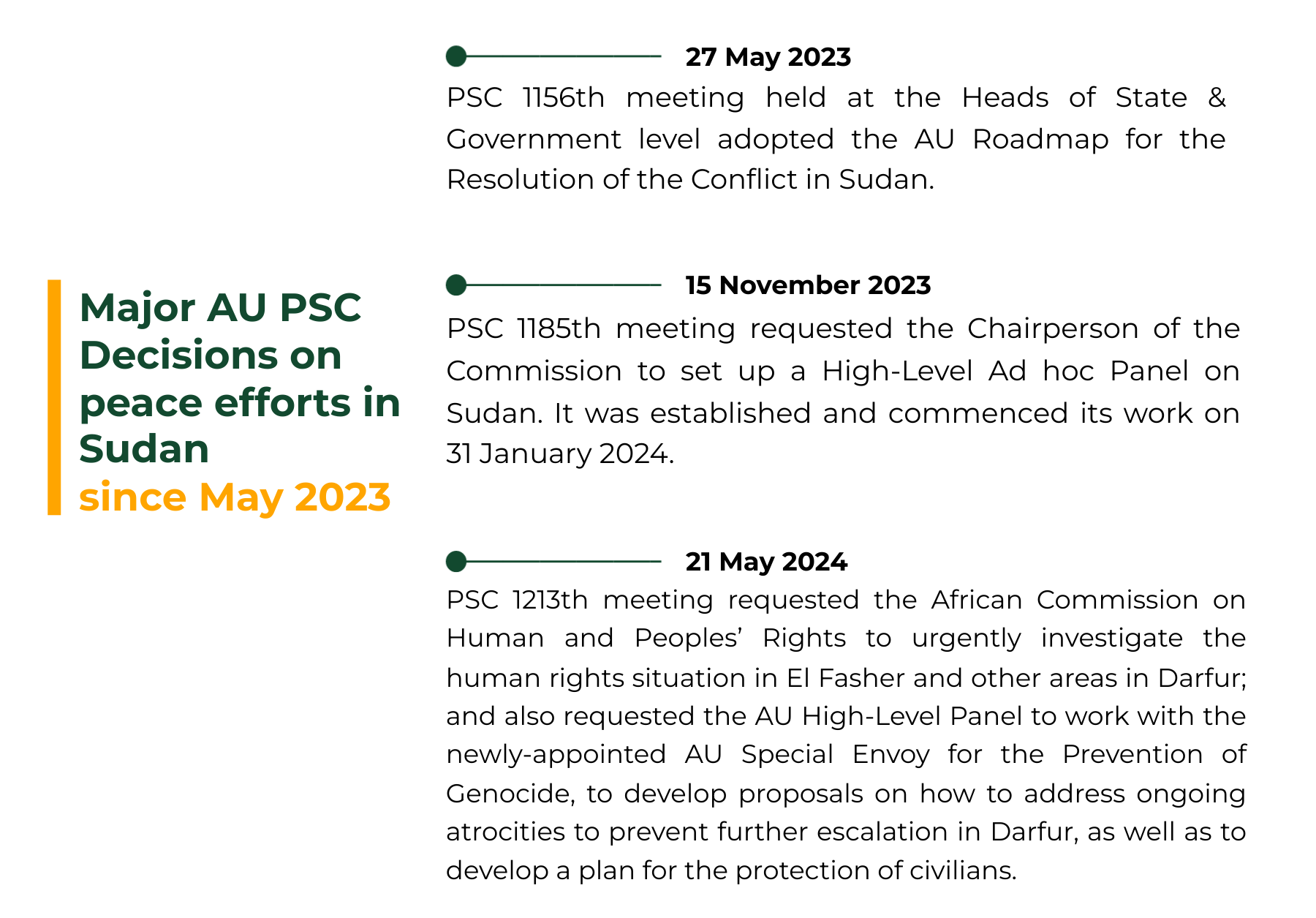
The other aspect of the situation in Sudan that tomorrow’s session is expected to pay particular attention to is the state of the war and its humanitarian consequences. The last time the PSC considered the situation in Sudan on its programme was on 21 May 2024, during its 1213th session, which came against the backdrop of escalating violence around El Fasher, North Darfur—the last major town in Darfur not under the control of the Rapid Support Forces (RSF). In a press statement adopted at the session, the PSC not only raised the alarm over the ‘increasing likelihood of grave atrocities’ but also took specific decisions aimed at mitigating the impact of the war on civilians and ensuring accountability. Most specifically, the PSC requested ‘the African Commission on Human and Peoples’ Rights to urgently investigate the human rights violations in El Fasher and other areas in Darfur.’ It also requested the AU High-Level Panel on Sudan to ‘work with the newly-appointed AU Special Envoy for the Prevention of Genocide to develop proposals on how to address ongoing atrocities, prevent further escalation in Darfur, and develop a plan for the protection of civilians.’ Reiterating the statement issued by the Chairperson of the AU Commission on 26 April 2024, the PSC also urged the warring parties to return to the local truce in El Fasher, lift the siege on the city, and return to an expanded negotiation platform in Jeddah.
Tomorrow’s session is expected to focus on receiving updates on the situation in the country since the last meeting. The discussion is expected to review the state of, and challenges faced in the implementation of the Roadmap for the resolution of the conflict in Sudan that the PSC adopted during the last summit-level meeting in May 2023, and explore further steps that should be taken to address the escalating situation.
The fighting between SAF and the RSF continues to rage in various parts of the country. Despite the call from AU and the UN to halt the offensive on El Fasher, the city and its surrounding areas have become a site of major fighting and atrocities. El Fasher has continued to experience atrocious violence targeting civilians that is reminiscent of some of the brutal atrocities inflicted on West Darfur last year and the genocidal violence that Darfur experienced two decades ago. In a statement issued on 5 June 2024, the Special Advisor of the UN Secretary-General on the Prevention of Genocide, Alice Wairimu Nderitu, noting the displacement of an estimated 130,000 people due to the fighting in El Fasher, expressed ‘serious concern’ over reports of ethnically motivated attacks against the non-Arab communities in and near the city, including by the RSF and their allied militias, while also noting reports of retaliatory attacks targeted against Arab civilians in the region. She raised the alarm that ‘risk factors and indicators for genocide and related crimes are present, and the risks are increasing.’
Against these worrying developments in North Darfur, the UN Security Council adopted Resolution 2736 (2023) on 13 June, demanding that the RSF halts the siege of El Fasher and calling for an immediate cessation of the fighting and de-escalation in and around the city. The Council demanded that all parties to the conflict have to ensure that civilians are protected, and further requested them to allow and facilitate the ‘rapid, safe, unhindered and sustainable passage’ of humanitarian relief for civilians. The Council also asked the UN Secretary-General, in consultation with the Sudanese authorities and regional stakeholders, to make recommendations for the protection of civilians in Sudan. However, a day after the adoption of the resolution, intense fighting was reported in the city, reportedly claiming the life of Ali Yaqoub Gibril, RSF operation commander in North Darfur.
The violence was not limited to the Darfur region but also escalated across several other areas including Khartoum, Al Jazirah, Kordofan, and White Nile. In one major incident of violence in Jazirah, at least 150 civilians, including at least 35 children were killed on 5 June amid attacks on the capital Wad al Nourah, prompting the Chairperson of the AU Commission to issue a statement on 7 June, condemning the ‘massacre’ in the ‘strongest terms’.
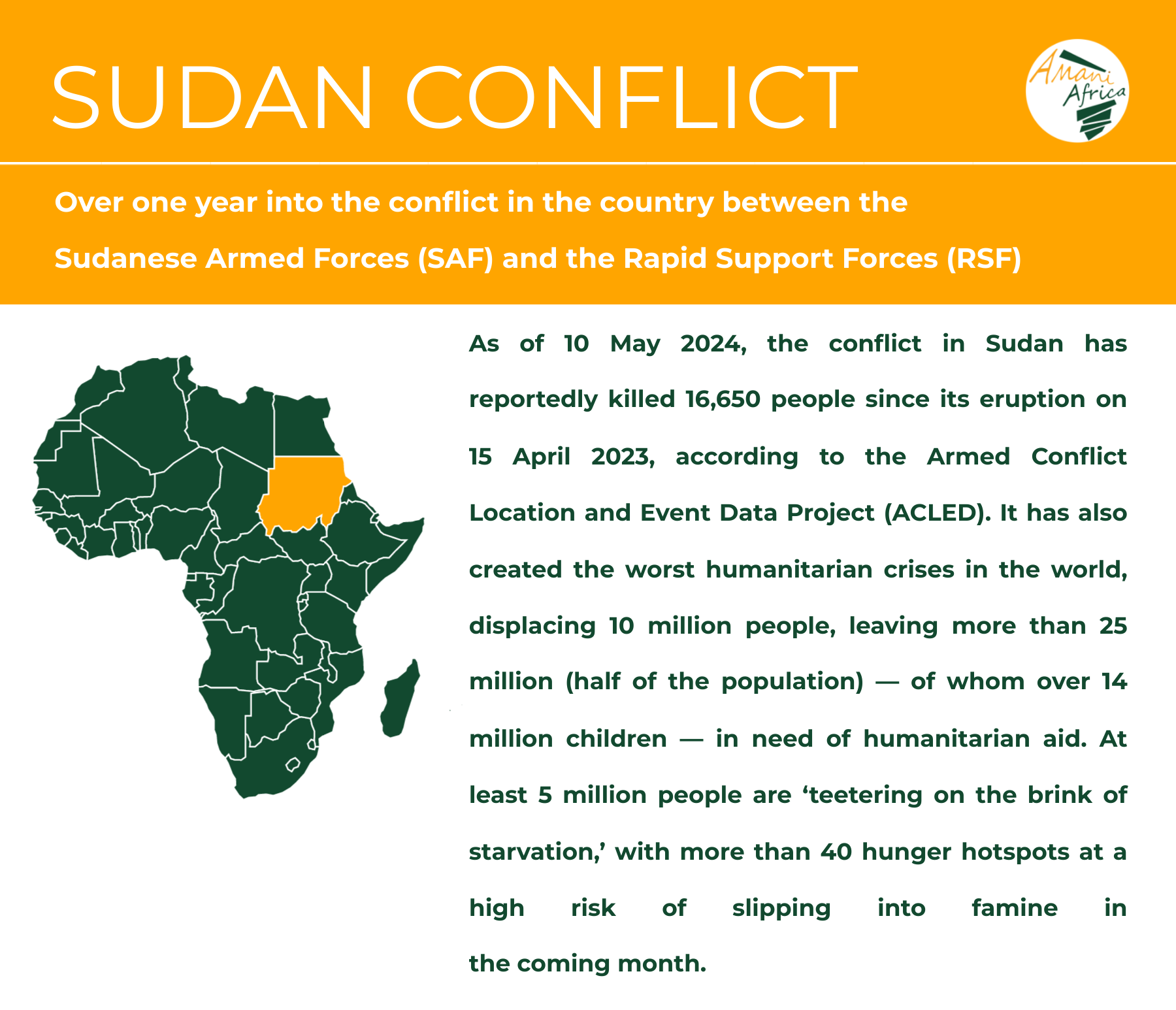
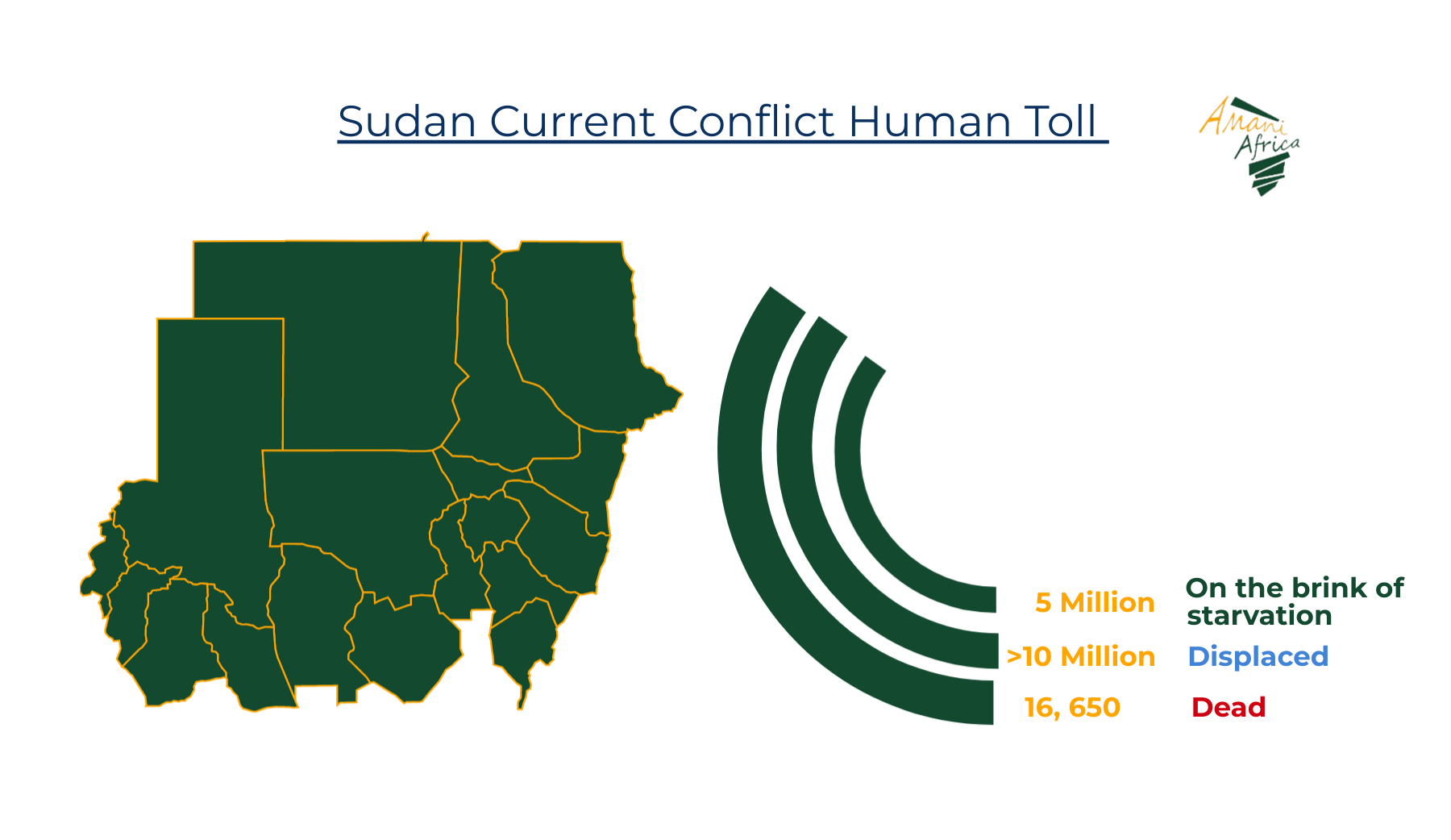
As of 10 May 2024, the conflict in Sudan has reportedly killed 16,650 people since its eruption on 15 April 2023, according to the Armed Conflict Location and Event Data Project (ACLED). It has also created the worst humanitarian crises in the world, displacing 10 million people, leaving more than 25 million (half of the population)—of whom over 14 million children—in need of humanitarian aid. At least 5 million people are ‘teetering on the brink of starvation,’ with more than 40 hunger hotspots at a high risk of slipping into famine in the coming month. If the war continues to escalate, it is not clear how it would not push the current dire situation into humanitarian catastrophe.
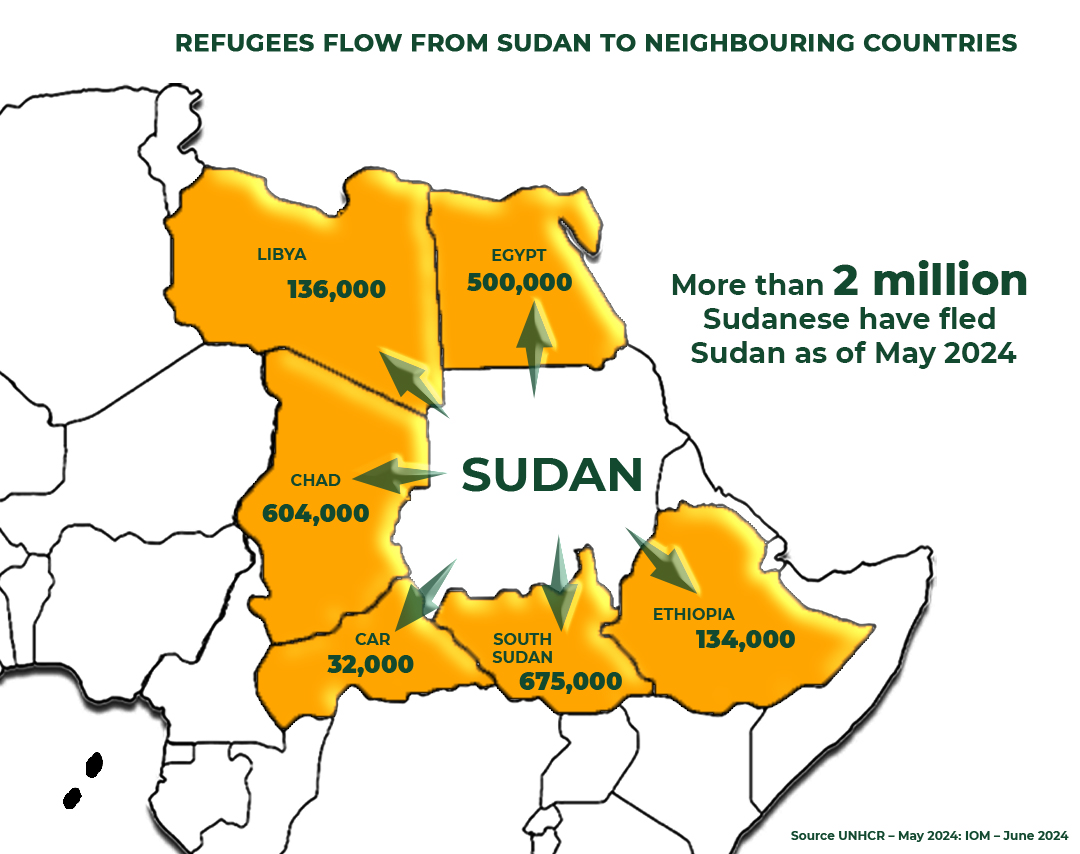
The fast-worsening humanitarian situation in Sudan is not the only concern for the AU and the wider international community, rather, of equal concern is the grave threat that the continuation of the war poses to regional and international peace and security. Despite the fact that neither the SAF nor the RSF stand a chance to achieve military victory, there is no sign of the war coming to an end. Weapons and funds channelled from those backing the two sides have continued to fuel the raging fire of the brutal war. As a result, there are growing concerns that the persistence of the war could precipitate the fragmentation and/or collapse of Sudan. In her briefing to the UN Security Council on 18 June, UN Assistant Secretary-General for Africa, Martha Pobee, warned that ‘Without swift action, Sudan risks becoming engulfed in more ethnic violence and fragment even further.’
With many conflict-affected neighbouring states, Sudan’s fragmentation (Libya scenario) or collapse (Somalia scenario) is sure to have a knock-on effect on these countries, for some with dire consequences. Considering Sudan’s location, its collapse is also sure to reverberate across parts of Lake Chad, Great Lakes, North Africa and the Horn of Africa regions. As the experience of Somalia also showed, the consequences of Sudan’s fragmentation or collapse are unlikely to be confined inland. It is inevitable to spill over into the Red Sea, with grave consequences to international maritime trade and economic stability. The vacuum that the deterioration of the situation in Sudan creates may end up attracting terrorist networks from the Sahel and Horn of Africa as well as from beyond Africa.
The expected outcome is a communiqué. The PSC is expected to express its grave concern over the escalating violence in and around North Darfur and other regions of Sudan, as well as the dire humanitarian situation in the country. The PSC may welcome the adoption of UN Security Council resolution 2736 and reiterate its call for the RSF to lift the siege of El Fasher and immediately halt the fighting in and around the city. It may particularly express its concern over the worrying trend of grave human rights violations by the warring parties, who are disregarding international human rights and humanitarian laws. The PSC may strongly condemn the recent killings of civilians in Wad al Nourah, Gezira State, echoing the statement from the AU Commission Chairperson on 7 June 2024. In this regard, it may follow up on its previous decisions adopted at its 1213th session to address the escalation of atrocities and hold perpetrators accountable. Other measures that the PSC may take include the establishment of a) internationally monitored humanitarian corridors for preventing further humanitarian catastrophe b) a mechanism for monitoring, documenting and reporting on compliance with international humanitarian law c) disengagement from hostilities in major civilian population centres supervised by a joint monitoring mechanism of the AU, IGAD and LAS supported by the UN, and d) heads of state and government level ad hoc Committee to mobilize and leverage the collective weight of AU member states for bringing the warring parties to the negotiating table. The PSC may also urge the warring parties to immediately and unconditionally return to the expanded Jeddah platform.
Briefing on the situation in Somalia/ATMIS
Briefing on the situation in Somalia/ATMIS
Date | 19 June 2024
Tomorrow (20 June), the African Union (AU) Peace and Security Council (PSC) will convene its 1217th session to discuss the situation in Somalia and the AU Transition Mission in Somalia (ATMIS).
Rebecca Otengo, Permanent Representative of Uganda and Chairperson of the PSC for June will start the session with opening remarks which will be followed by a statement from Bankole Adeoye, Commissioner for Political Affairs, Peace and Security (PAPS). It is expected that PAPS will introduce the ‘Report of the African Union Commission on the Strategic Assessment for the Post-ATMIS Security Arrangement for an AU-led Mission in Somalia. Abdullahi Warfa, Permanent Representative of the Federal Republic of Somalia is expected to deliver a statement. A representative of the Inter-Governmental Authority on Development (IGAD) is also expected to make a statement.
As per the drawdown plan, ATMIS is expected to complete the drawdown of 4,000 personnel by the end of June. Over the weekend, the mission started handing over its forward operating base in Lower Shabelle to the Somali Security Forces (SSF) as part of this drawdown process. However, the Somali government requested a revised timeline in a letter to the PSC dated 16 May, proposing a phased drawdown with 2,000 troops leaving Somalia by the end of June and a second batch exiting by September.
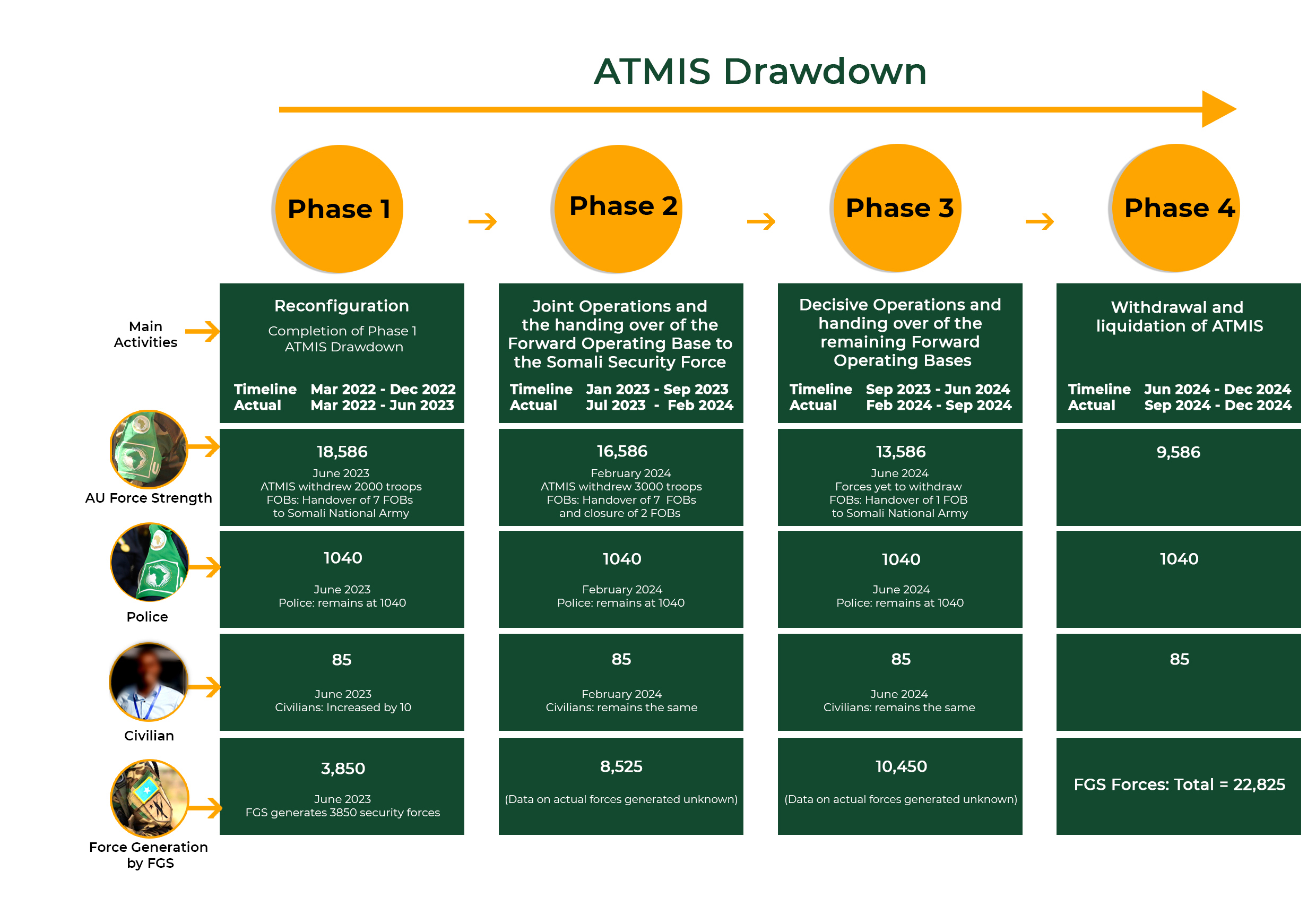
Data available on Amani Africa’s ATMIS Drawdown Tracker
With ATMIS expected to complete its drawdown and exit by the end of the year, discussions on a post-ATMIS arrangement have also picked up. The Somali government requested a follow-on mission at the Somalia Security Conference in New York in December 2023. Subsequently, it submitted a proposal to the PSC in March and the Security Council in April. The mission’s mandate includes providing stabilisation support, facilitating state-building priorities, and securing strategic population centres and critical infrastructure. Initially, the proposal intended to retain the remaining 10,000 ATMIS personnel after the third phase of the drawdown process. However, the discussion has evolved since then.
In the communiqué of its 1205th Session of 3 April, the PSC welcomed Somalia’s proposal for post-ATMIS security arrangements and requested the AU Commission to undertake comprehensive and detailed planning based on the situation on the ground. It also emphasised the need for adequate, predictable, and sustainable financing for the post-ATMIS mission, including through Security Council Resolution 2719 (2023) on the financing of AU-led peace support operations (AUPSOs). Following this, an AU delegation led by General Cheikh Dembele, head of the Peace Support Operation Division (PSOD), visited Somalia from 24-30 April to conduct the assessment in line with the PSC decision. While a technical report was prepared on the basis of data collected and consultations held, the PSC was unable to consider the report as Somalia objected to some contents of the report that it found politically unpalatable. The AU also developed a strategic concept of operations for the follow-on mission. Based on the assessment of security threats and the necessary tasks that should be carried out, including offensive operations against Al-Shabaab rather than just securing critical infrastructure initially proposed by Somalia, the AU revised the troop strength, arguing that the new mission requires more personnel. Following discussions with Somalia, an agreement appears to have been reached to revise the number of troops to 11,900. In an informal meeting on 21 May, the AU delegation gave the PSC an oral briefing on its assessment and the strategic concept of operations developed for the follow-on mission. Accordingly, during tomorrow’s meeting, the PSC is expected to consider the version of the report ‘updated’ following Somalia’s objection.
Tomorrow’s PSC meeting takes place against the backdrop of these developments and its deliberations will be crucial in outlining the next steps for the ATMIS drawdown process and the security arrangements beyond December. The meeting will be informed by the chairperson’s report circulated to members, which incorporates elements from the strategic assessment, including the threat analysis, progress in joint operations by ATMIS and the Somali Security Forces, the implementation of the security transition, the ATMIS drawdown process, and proposal for the post-ATMIS security arrangements.
Particularly, the Chairperson’s report identifies options for the follow-on mission and its financing arrangements. In terms of the former, the first option proposed in the report is an AU-led mission which appears to be the most favoured option given the AU’s longstanding engagement in Somalia and the experiences gained over the past 17 years of AMISOM/ATMIS deployment. While it is thus anticipated that the post-ATMIS Mission would principally be made up of the ATMIS troops with any additional capabilities that the mandate of the mission requires, there are indications that the leadership of the FGS would like to see a change in the composition of the post-ATMIS mission. Despite the fact that an AU-led mission is the first and most favoured option, the report states that its implementation requires the provision of predictable, sustainable, and adequate funding. The second option is a regional security framework which would involve an intervention force from countries of the region but the report notes the challenges it presents in ensuring accountability and transparency. It also states that this option may not qualify for the UN logistical support package or the requirements set out in Resolution 2719. The third option is an AU-UN hybrid mission, which the report says, could be challenging to implement due to issues of command and control.
Not surprisingly and considering the funding challenges that afflicted ATMIS, financing is a major issue in the policy discussion on post-ATMIS. The Chairperson’s report further outlines four options in terms of the financing arrangements for the follow-on mission. The first option is to finance the mission under resolution 2719, including through the UN support office package. This is also the option that Somalia included in its proposal submitted to the PSC in March 2024. The second option is the hybrid model which represents the current support arrangement for ATMIS through the provision of the UN logistical support package. But the report indicates that this option does not include troop and police reimbursement, and death and disability compensation. The third option is the trust fund option which depends on voluntary contributions from partners and does not ensure predictable and sustainable funding. The fourth and last option is securing support through 100% UN-assessed contribution which is considered ideal. Understandably, this is proposed not within the framework of Resolution 2719 but as an exceptional case for preventing the emergence of a vacuum and risk of relapse, which is a possibility. It is interesting to note that the options did not include the funding of the post-ATMIS mission on the basis of the funding mechanism used for AMISOM.
Therefore, PSC members are expected to examine these options at their meeting tomorrow and chart out the way forward. The outcome of their deliberation will likely inform the upcoming discussions at the Security Council in New York. The UK, the penholder on Somalia, has already shared a draft resolution with some Council members, including the African members, in anticipation of the PSC meeting. Among other provisions, the draft resolution requests the Secretary-General to conduct a joint strategic assessment with the AU Commission, building on the work already done by the AU, and submit the outcome by the end of August. According to the draft text, the joint strategic assessment should also include options for financing the new follow-on mission, including through but not limited to, resolution 2719 (2023).
The joint strategic assessment is expected to be conducted in consultation with Somalia and its partners some of whom have already outlined their positions on the implementation of resolution 2719 and the post-ATMIS arrangement through their respective non-papers. The US, in particular, does not seem keen to support the financing of the follow-on mission under resolution 2719 and this might pose a particular challenge during the upcoming negotiations. The US has clearly stated that ‘[t]he first AUPSO authorised under UNSCR 2719 ideally would not re-hat or be a successor to a previous UN, AU, or African regional mission, so as to avoid preconceived notions from previous missions while enabling the establishment of a new AU-UN partnership.’ In this regard, it has been making demarches to various stakeholders to explain its position.
On the other hand, the UK has expressed full support for a new AU follow-on mission authorised by the Security Council to succeed ATMIS. The UK believes that ‘[t]his is the option identified by the FGS and its core security partners to be most effective in addressing their needs, as set out at the Somalia Security Conference in December 2023.’ It also maintains that this is ‘the option best equipped to support Somali-led counter al-Shabaab operations, protect the security gains of the last 16 years, and enable continued humanitarian and stabilisation efforts.’ The UK also shared its views on the various options proposed for the post-ATMIS arrangements which appear to align with the AU Chairperson’s report.
The EU has been a major partner to Somalia and the AU in supporting AMISOM/ATMIS. It backs a new follow-on mission with a limited scope, size, and timeframe, and agrees in principle on applying resolution 2719. However, it argues that this decision depends on the framework and mandate to be agreed upon. The EU prioritises burden-sharing and supports the potential use of the AU Peace Fund, including the Crisis Reserve Facility, or other relevant AU facilities. It also emphasises the need for Somalia’s other bilateral partners to share the burden.
The French non-paper aims to unpack resolution 2719 to foster a collective understanding of its implementation and argues that the first PSO authorised by the Security Council under resolution 2719 should serve as a baseline for future operations. In this context, France appears to have a different stance from Brussels on the post-ATMIS security arrangements and wants to be convinced of the need to apply resolution 2719 on Somalia as a first test case.
In light of these developments, tomorrow’s PSC meeting will be crucial in clearly outlining the AU’s position on the ATMIS drawdown process and plans for the post-ATMIS arrangements. This will be the key to determining the financial and logistical needs of the mission for the rest of the year and beyond, given the ongoing UN peacekeeping budget discussions in New York and the upcoming discussions in Brussels in July on the allocation of the EU Peace Facility. If the situation requires extending ATMIS beyond December, further discussion on financing options with the UN and other donors might also be necessary. The other pressing issue seems to be that Somalia will assume its seat on the Security Council in January as a non-permanent member for the 2025-2026 term. Therefore, the above-mentioned discussions must be finalised by the end of December. The upcoming US election in November and the possibility of another Trump presidency also add to the urgency.
Politically, tensions between Somalia and Ethiopia appear to be further complicating the situation. The Somali national security advisor was recently quoted in the media stating that Somalia will ask Ethiopian troops to leave the country unless Ethiopia revokes its memorandum with Somaliland to gain access to the sea and set up a naval base. Ethiopian troops are deployed in Somalia under ATMIS and through bilateral arrangements. Whether what the national security advisor said is the official position of the Somali government remains unclear, but some regional states such as South West State and Jubaland have voiced strong opposition. Externally, there are also concerns that the withdrawal of Ethiopian troops could leave a security vacuum that Al-Shabaab might exploit.
The expected outcome of the session is a communiqué. The PSC is expected to welcome the commencement of the third phase of ATMIS troop withdrawal while emphasising the importance of ensuring that the drawdown is conducted in a manner that avoids creating a security vacuum in Somalia. The PSC may also endorse the request from Somalia for stratifying the planned drawdown while expressing the need to avoid adding further strain on ATMIS. On the post-ATMIS security arrangements in Somalia, the PSC is expected to welcome the AU Commission report on the joint strategic assessment for the post-ATMIS security arrangements for an AU-led mission in Somalia. Echoing the recommendations of the report, the PSC may decide that ATMIS is followed by an AU-led, UN-authorised multilateral mission, limited in size, scope and timeframe, as the most viable option for post-ATMIS security arrangements. The PSC may also affirm that the proposed AU-led mission is constituted on the basis of the ATMIS troops to ensure continuity. Regarding the financing arrangement, the PSC may reiterate the imperative of securing predictable, sustainable and adequate funding for the post-ATMIS mission. In this context, the PSC may propose accessing UN-assessed contributions within the framework of UNSC resolution 2719 the funding modality for the mission, backed by a UN-mandated logistical support package or 100% use of UN-assessed contributions as an exceptional case.